Exploring the link between parents’ differentiation of self and children’s externalizing behavior problems: the mediating role of need-supportive vs. need-frustrating parenting practices
Michal Klein, Tomer Levy, Cory Shulman, Etan Lwow, Tamar Silberg

TL;DR
This study explores how parents' emotional maturity affects their parenting style and children's behavioral problems, finding that supportive parenting by fathers may help reduce these issues.
Contribution
The study reveals that fathers' need-supportive practices uniquely reduce children's externalizing behavior problems.
Findings
Need-frustrating parenting practices mediate the link between parental differentiation of self and children's externalizing behavior problems.
Fathers' need-supportive practices are negatively associated with children's behavioral symptoms.
No direct link was found between parental differentiation of self and children's symptoms.
Abstract
Externalizing behavior problems (EBPs) are common in children, with significant long-term impact on the child and family members. Parents, particularly mothers, of children with EBPs often experience heightened emotional distress. One crucial factor affecting parents’ ability to manage this distress is their level of differentiation-of-self (DOS). Differentiated parents are more likely to engage in practices that meet their child’s psychological needs, thus supporting the self-determination theory principles vital for a child’s well-being. This study examined the impact of parental DOS on parenting practices and subsequently on the child’s EBPs, exploring possible differences between mothers and fathers. Thirty-two mother–father dyads with children aged 6–14, diagnosed with EBPs participated. Parents completed the Differentiation of Self Inventory–Short Form, the Revised Parents as a…
Genes, proteins, chemicals, diseases, species, mutations and cell lines named across the full text — each resolved to its canonical identifier and authoritative record.
Click any figure to enlarge with its caption.
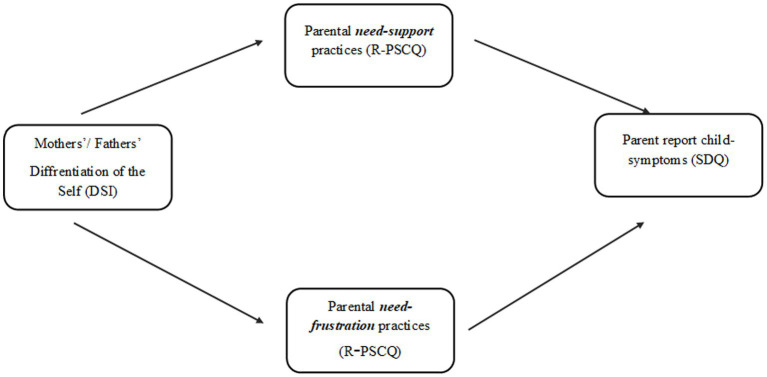 Figure 1
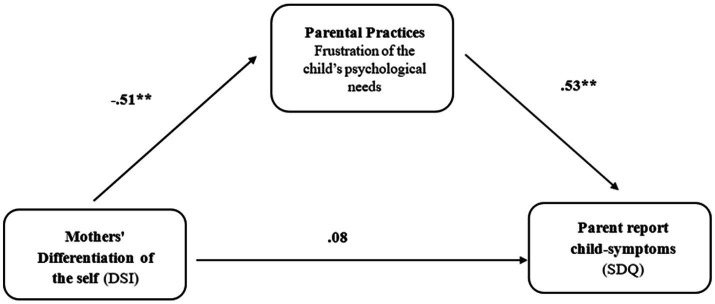 Figure 2
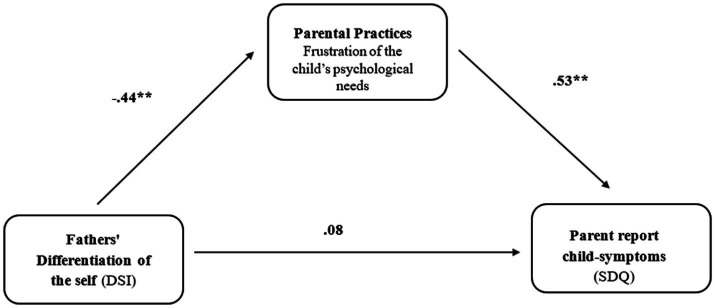 Figure 3
Peer Reviews
No public reviews on file for this paper yet. If you reviewed it on a platform where reviews are public (OpenReview, ICLR, NeurIPS, ICML), you can paste yours below so the community can read it here.
Videos
No videos yet. Explain this paper in a talk, walkthrough, or lecture? Add one.
Taxonomy
TopicsChild and Adolescent Psychosocial and Emotional Development · Family and Disability Support Research · Attachment and Relationship Dynamics