Application patterns and outcomes of hematopoietic stem cell transplantation in peripheral T-cell lymphoma patients: a multicenter real-world study in China
Hongye Gao, Zhuoxin Zhang, Jiali Wang, Yannan Jia, Yawei Zheng, Xiaolei Pei, Weihua Zhai, Rongli Zhang, Xin Chen, Qiaoling Ma, Jialin Wei, Donglin Yang, Aiming Pang, Yi He, Sizhou Feng, Hao Zhang, Xin Du, Xianmin Song, Yao Liu, Dehui Zou, Erlie Jiang

TL;DR
This study examines how hematopoietic stem cell transplantation is used in T-cell lymphoma patients in China and finds that early treatment improves outcomes.
Contribution
The study reveals distinct HSCT application patterns in PTCL patients in China and highlights the benefits of early consolidation therapy.
Findings
Upfront allo-HSCT provides better progression-free survival for non-nodal PTCL responders.
Nodal PTCL patients undergoing auto-HSCT after multiple treatment lines have higher relapse rates.
Early consolidation with HSCT improves long-term disease control in PTCL patients.
Abstract
The optimal timing and type of hematopoietic stem cell transplantation (HSCT) for treating peripheral T-cell lymphoma (PTCL) remain controversial. This retrospective real-world study investigated the application pattern and outcomes of HSCT in China. The analysis encompassed 408 PTCL patients with a median age of 45.5 years, all of whom received initial adequate therapy at five hospitals. Among patients with nodal PTCL who responded effectively to first-line therapy (the “responders”, n = 127) and subsequently underwent HSCT consolidation (n = 47, 37.0%), 93.6% received auto-HSCT, while 6.4% underwent allo-HSCT. Front-line auto-HSCT showed potential for long-term disease control in nodal PTCL responders. Among non-nodal PTCL responders (n = 80) with HSCT (n = 26, 32.5%), 46.2% underwent allo-HSCT and 53.8% received auto-HSCT. Upfront allo-HSCT provides longer progression-free survival…
Genes, proteins, chemicals, diseases, species, mutations and cell lines named across the full text — each resolved to its canonical identifier and authoritative record.
Click any figure to enlarge with its caption.
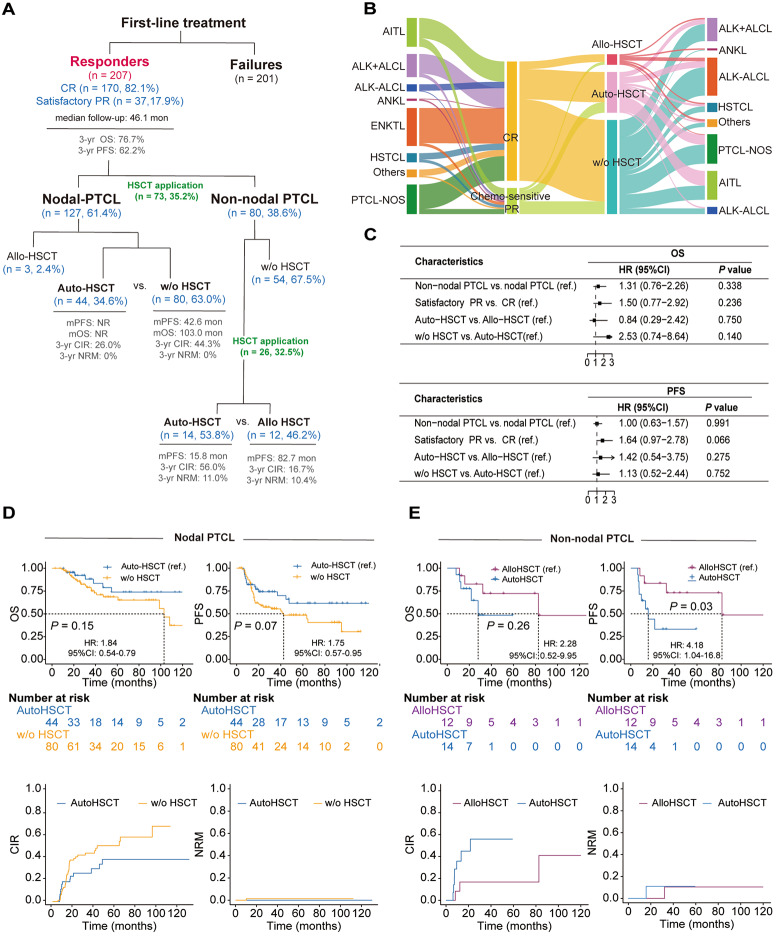 Figure 1
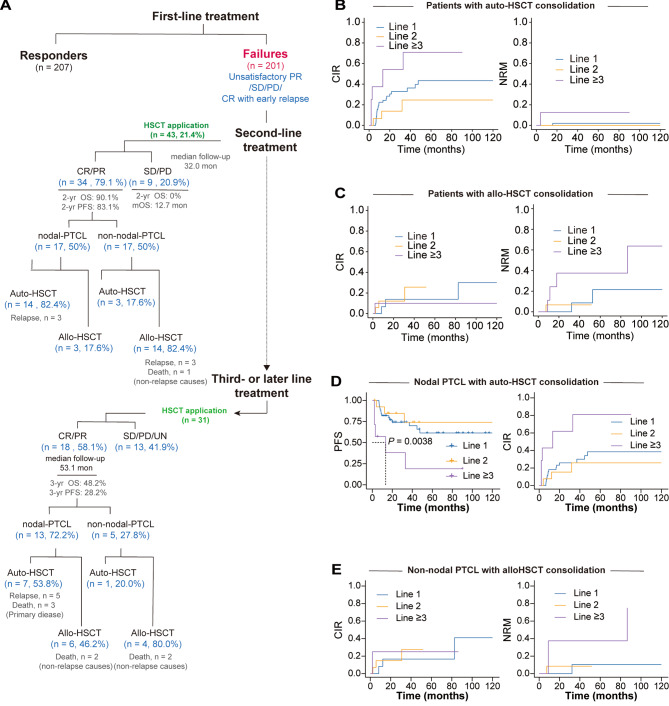 Figure 2
Peer Reviews
No public reviews on file for this paper yet. If you reviewed it on a platform where reviews are public (OpenReview, ICLR, NeurIPS, ICML), you can paste yours below so the community can read it here.
Videos
No videos yet. Explain this paper in a talk, walkthrough, or lecture? Add one.
Taxonomy
TopicsLight effects on plants