Reciprocal restriction fragment length polymorphism (RFLP) analysis reveals mitochondrial heteroplasmy in Caenorhabditis briggsae hybrids
Kevin Helwick, Joseph Ross

TL;DR
This study uses a DNA analysis method to show that some hybrids of a worm species have mixed mitochondrial DNA from both parents.
Contribution
The novel reciprocal RFLP analysis enables detection of paternal and maternal mitochondrial DNA in hybrids.
Findings
Some hybrids of Caenorhabditis briggsae are heteroplasmous with both paternal and maternal mitochondria.
Other hybrids have become homoplasmous for the paternal mitochondrial type.
Paternal mitochondrial transmission appears common in C. briggsae hybrids.
Abstract
Although mitochondria are typically inherited maternally, exceptions exist. We previously demonstrated that within-species crosses of Caenorhabditis briggsae result in paternal mitochondrial transmission, and it would be useful to know whether hybrids have only paternal mitochondria (homoplasmy) or paternal and maternal mitochondria (heteroplasmy). We developed a reciprocal restriction fragment length polymorphism analysis to separately detect paternal and maternal mitochondrial DNA. Using new hybrid lines, this approach revealed that some hybrids are heteroplasmous and others have become homoplasmous for the paternal mitotype. These results motivate additional investigation of how paternal mitochondrial transmission is apparently facile in C. briggsae .
Genes, proteins, chemicals, diseases, species, mutations and cell lines named across the full text — each resolved to its canonical identifier and authoritative record.
Click any figure to enlarge with its caption.
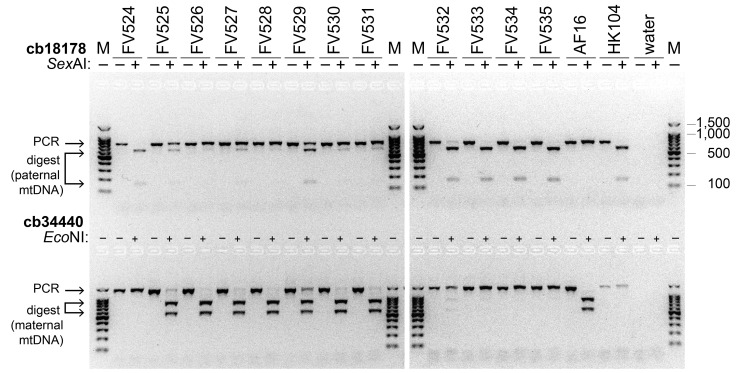 Figure 1
Peer Reviews
No public reviews on file for this paper yet. If you reviewed it on a platform where reviews are public (OpenReview, ICLR, NeurIPS, ICML), you can paste yours below so the community can read it here.
Videos
No videos yet. Explain this paper in a talk, walkthrough, or lecture? Add one.
Taxonomy
TopicsMetabolism and Genetic Disorders