Taxonomic review of Amemboa Esaki, 1925 from China, with description of a new species (Hemiptera, Heteroptera, Gerridae)

Abstract
Genes, proteins, chemicals, diseases, species, mutations and cell lines named across the full text — each resolved to its canonical identifier and authoritative record.
Click any figure to enlarge with its caption.
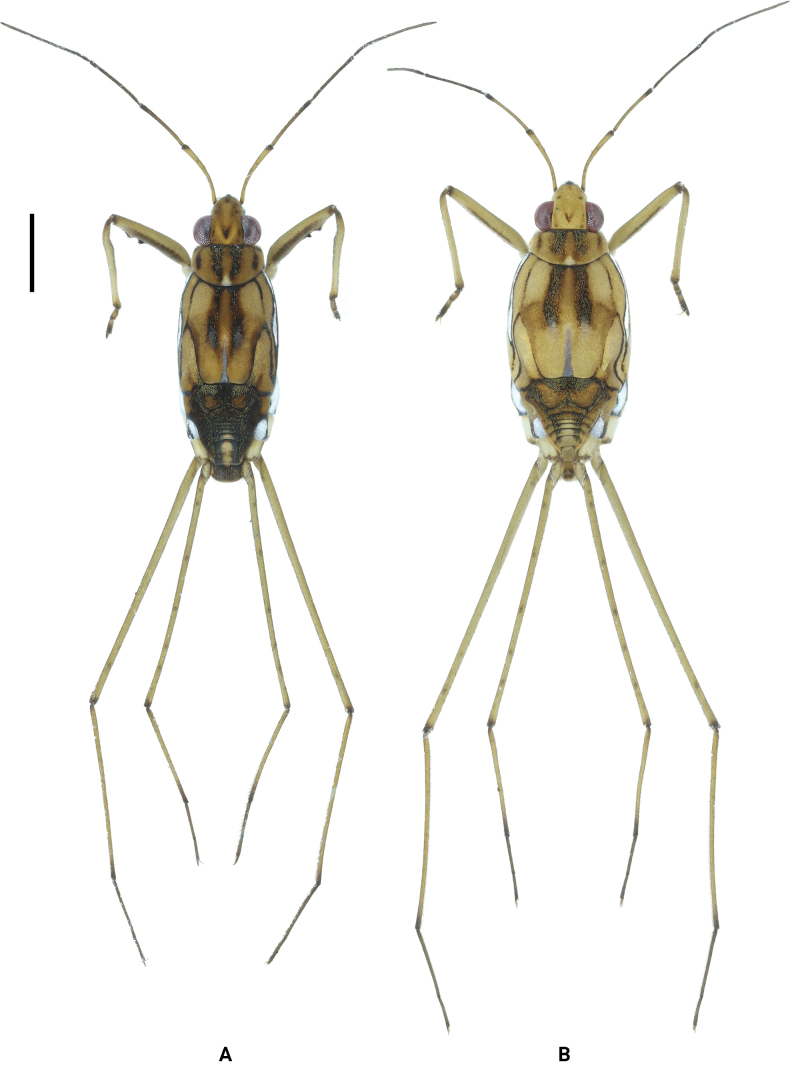 Figure 1
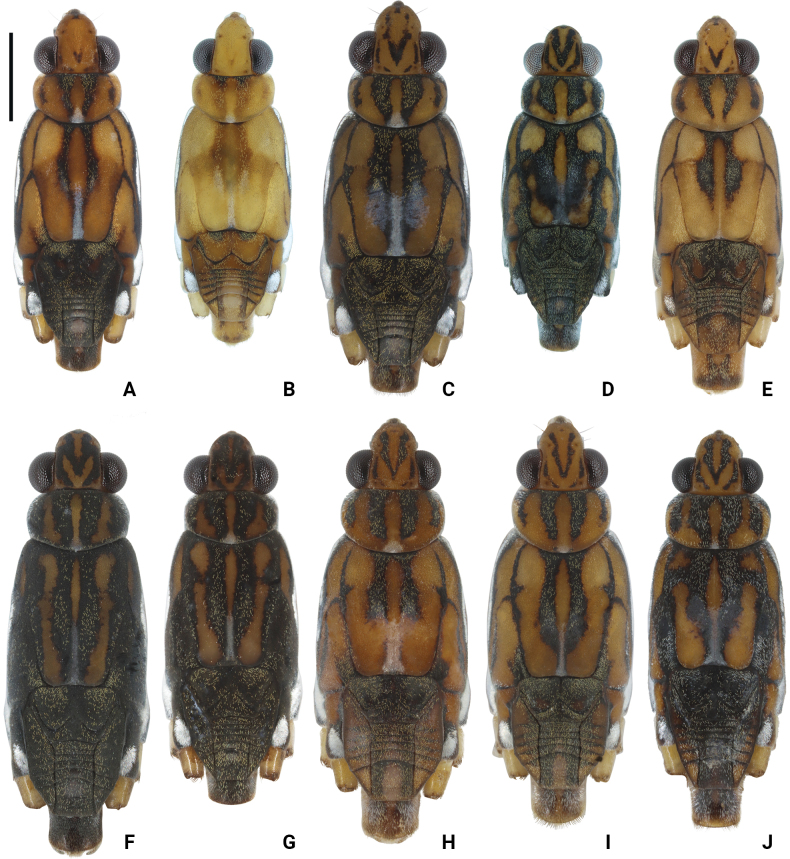 Figure 2
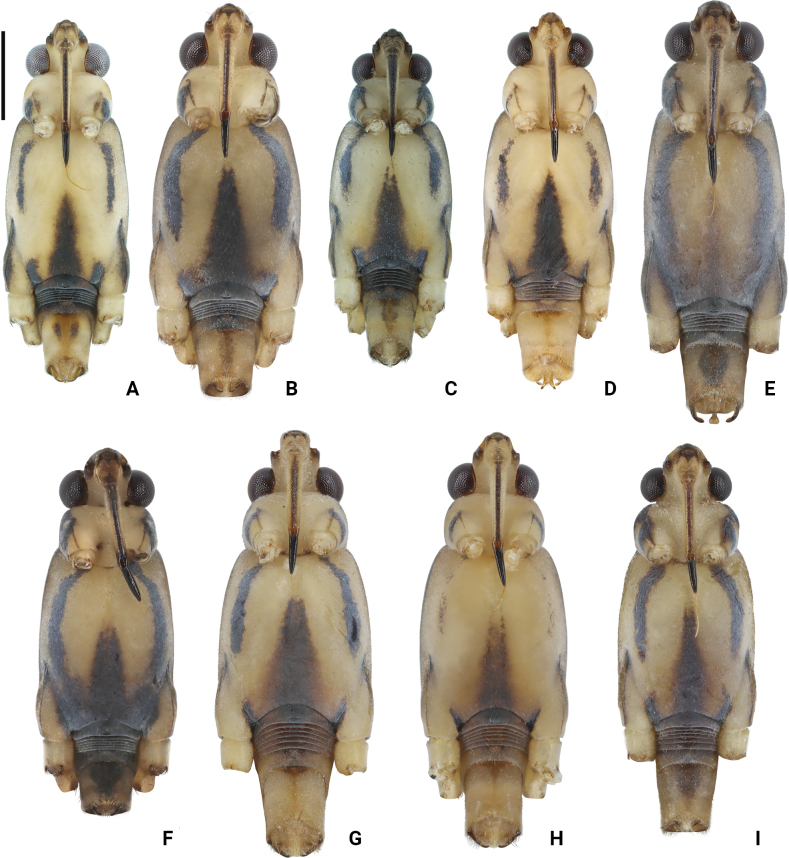 Figure 3
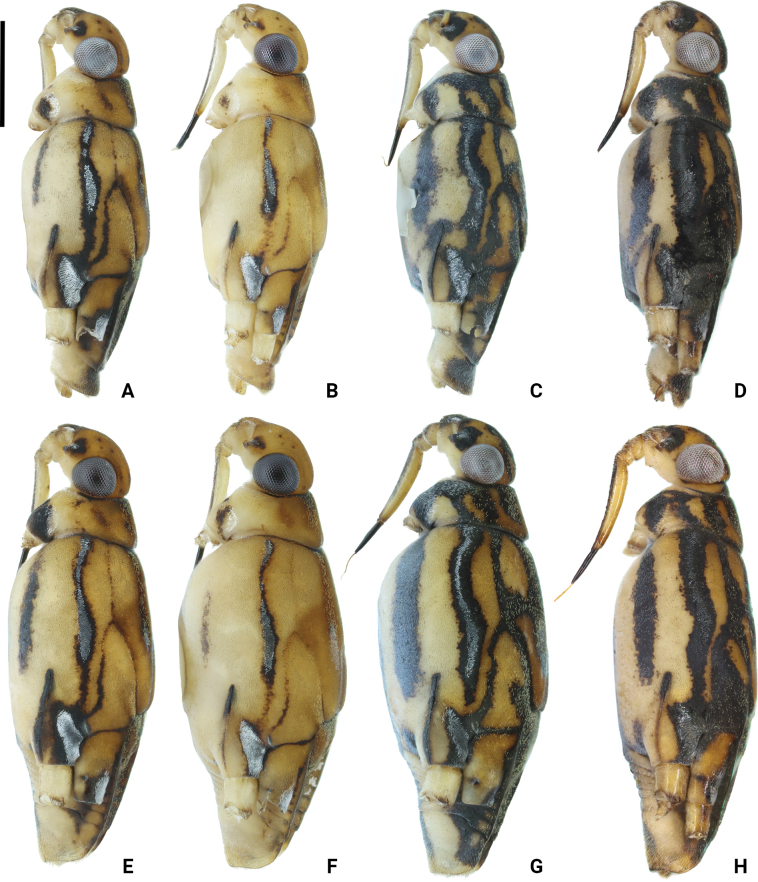 Figure 4
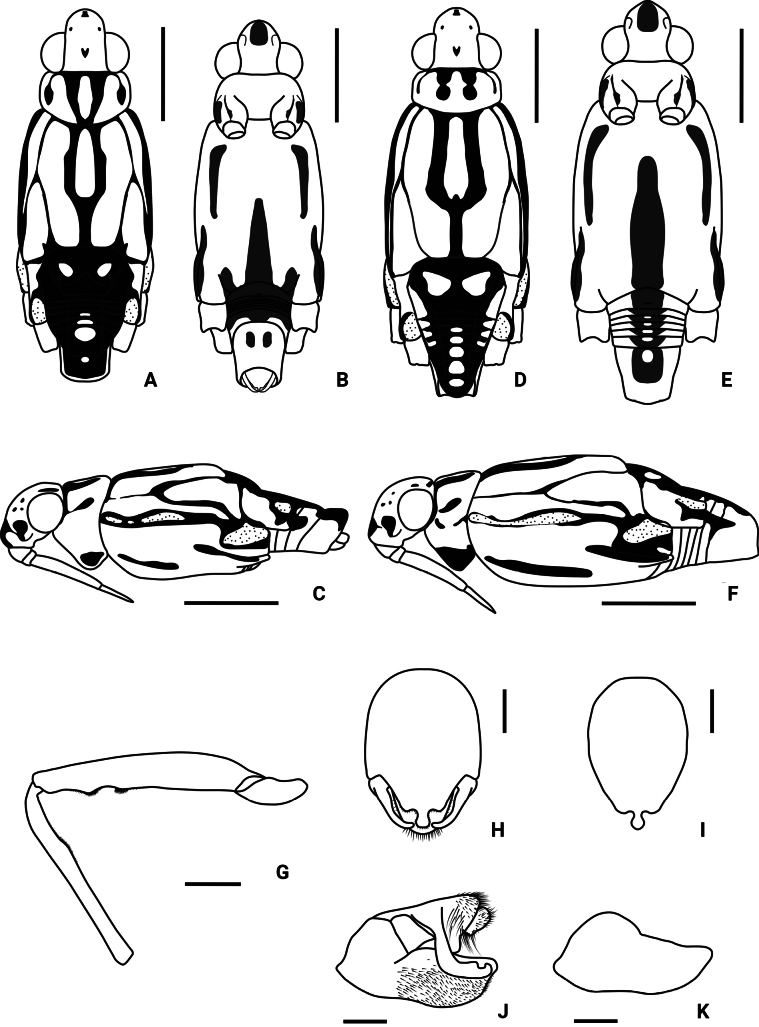 Figure 5
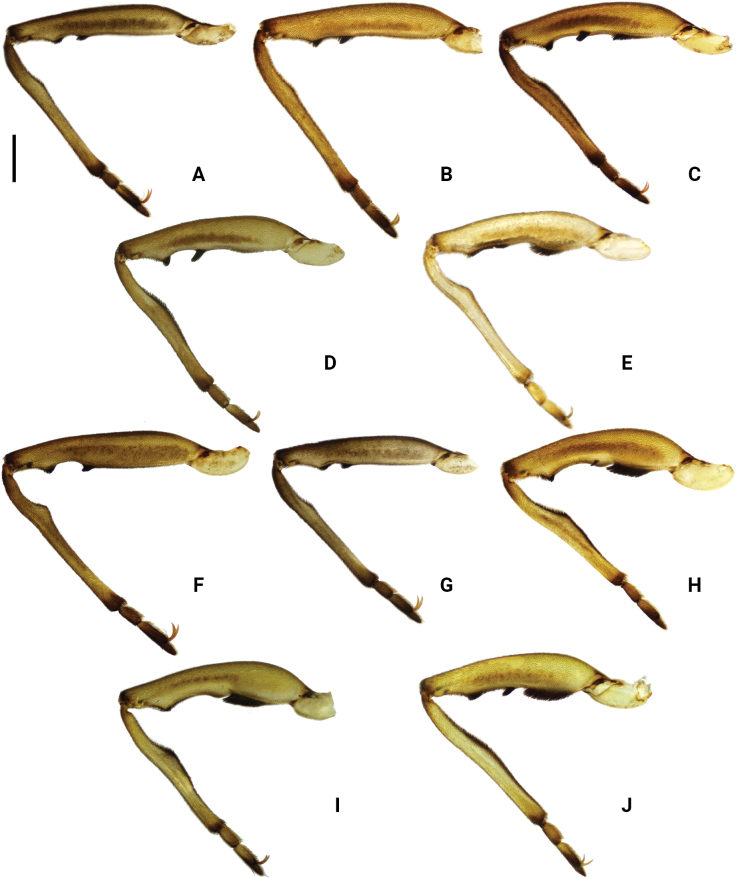 Figure 6
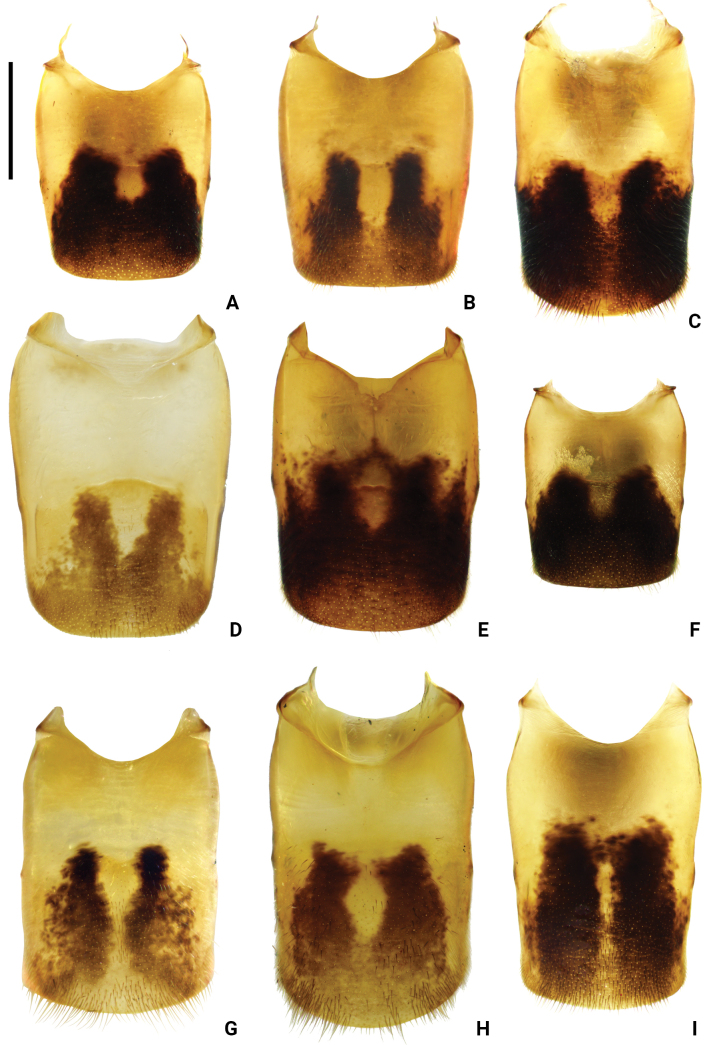 Figure 7
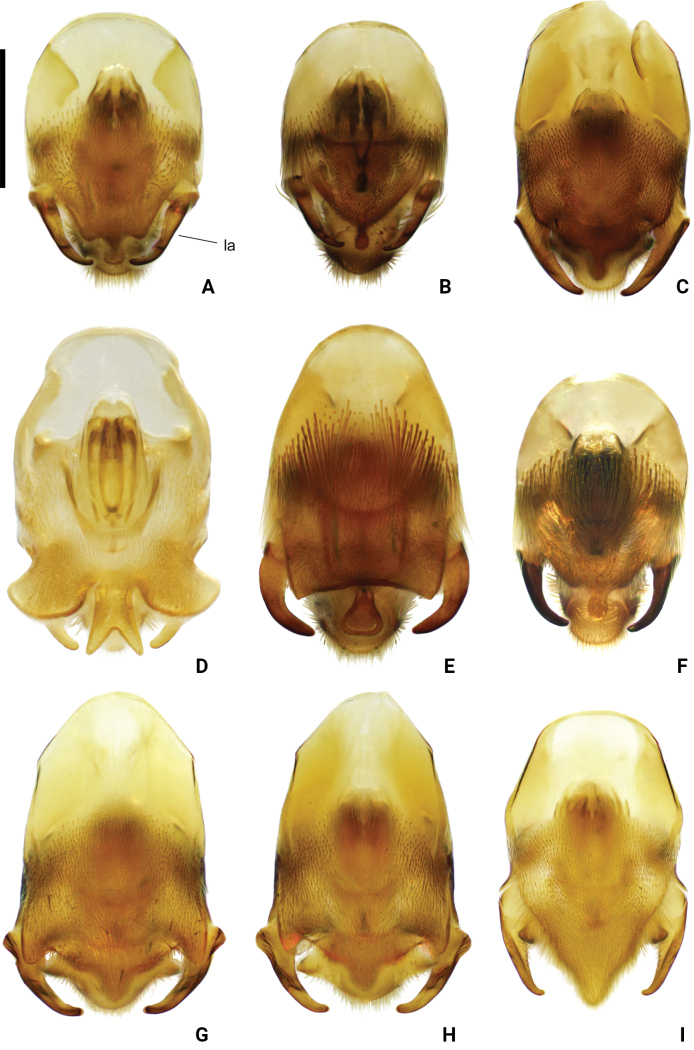 Figure 8
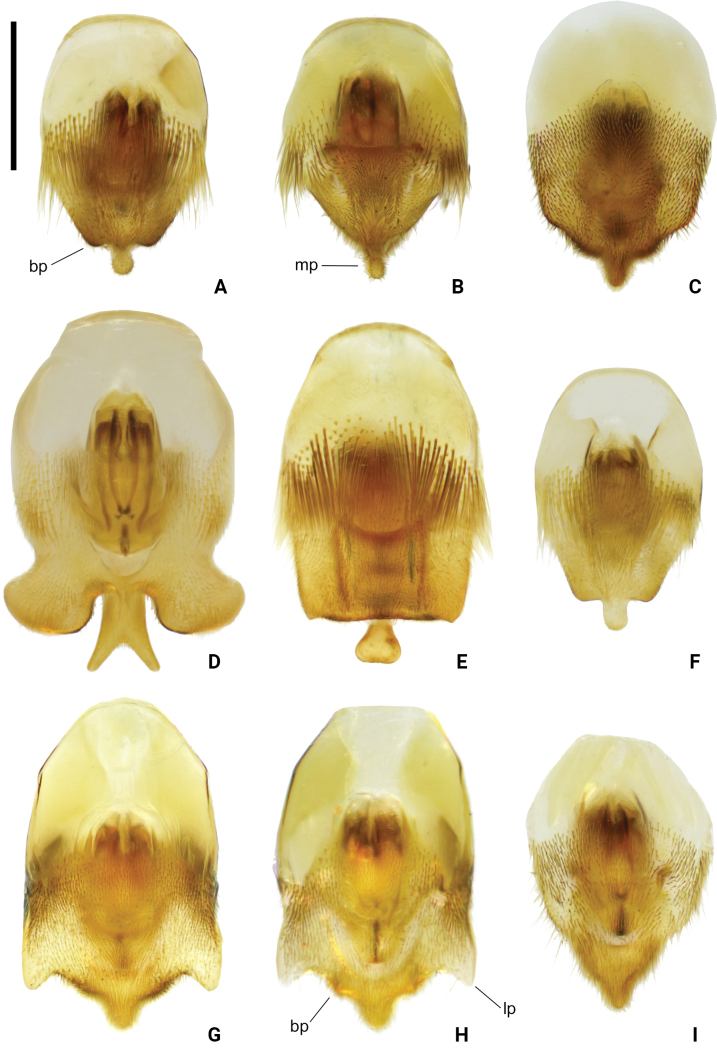 Figure 9
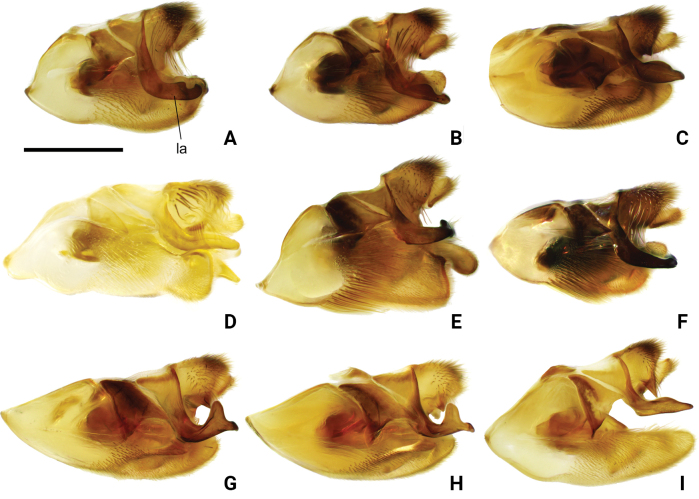 Figure 10
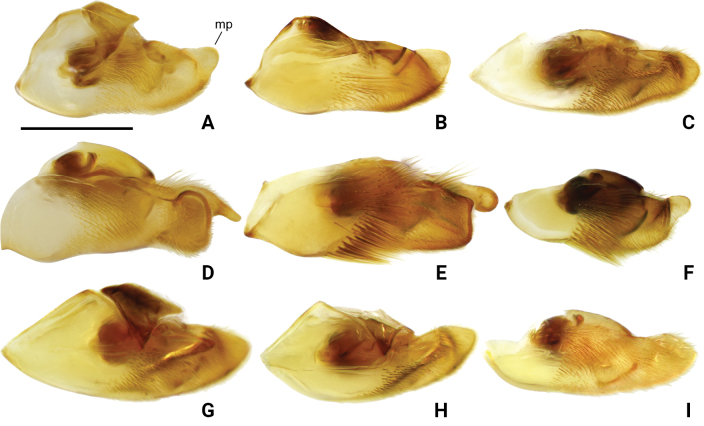 Figure 11
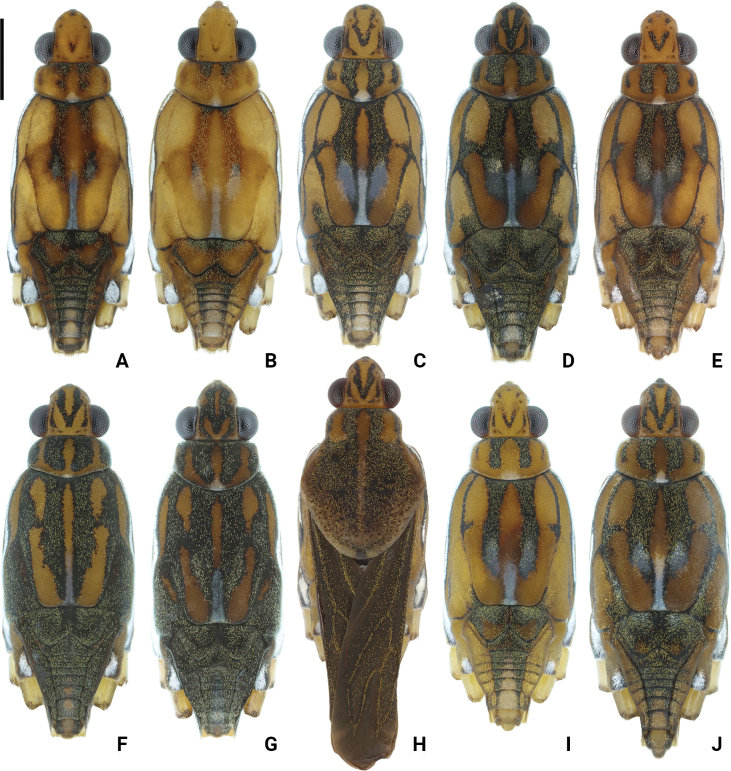 Figure 12
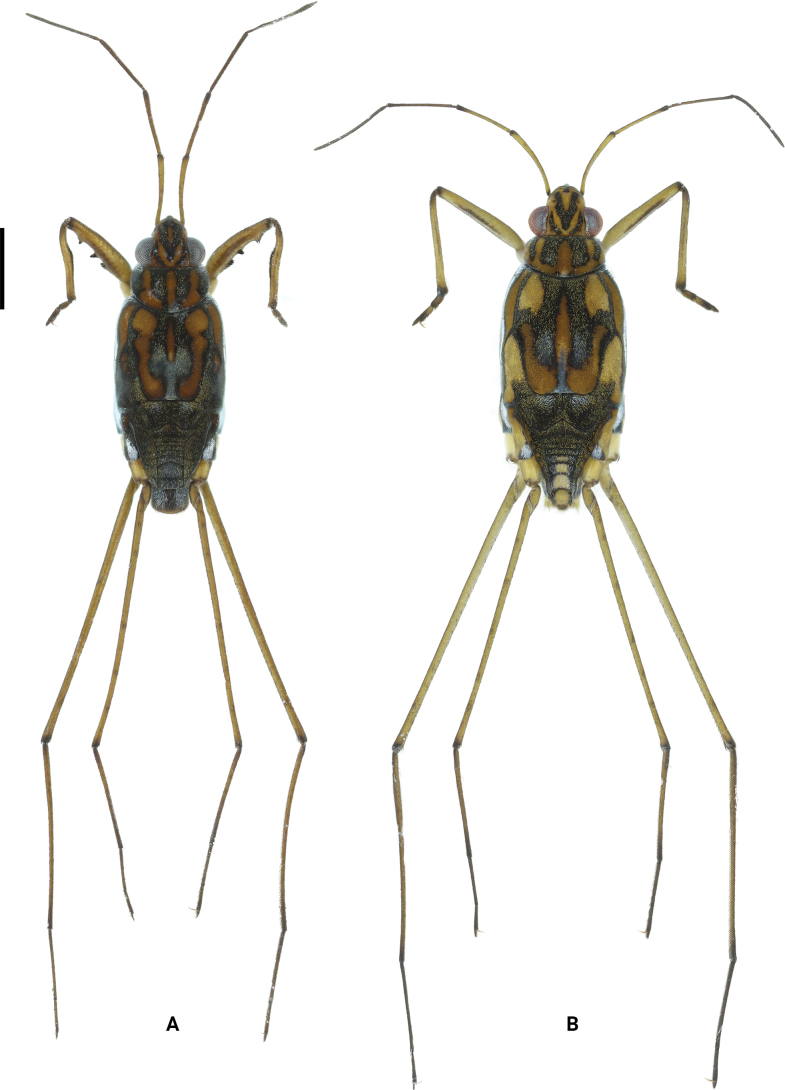 Figure 13
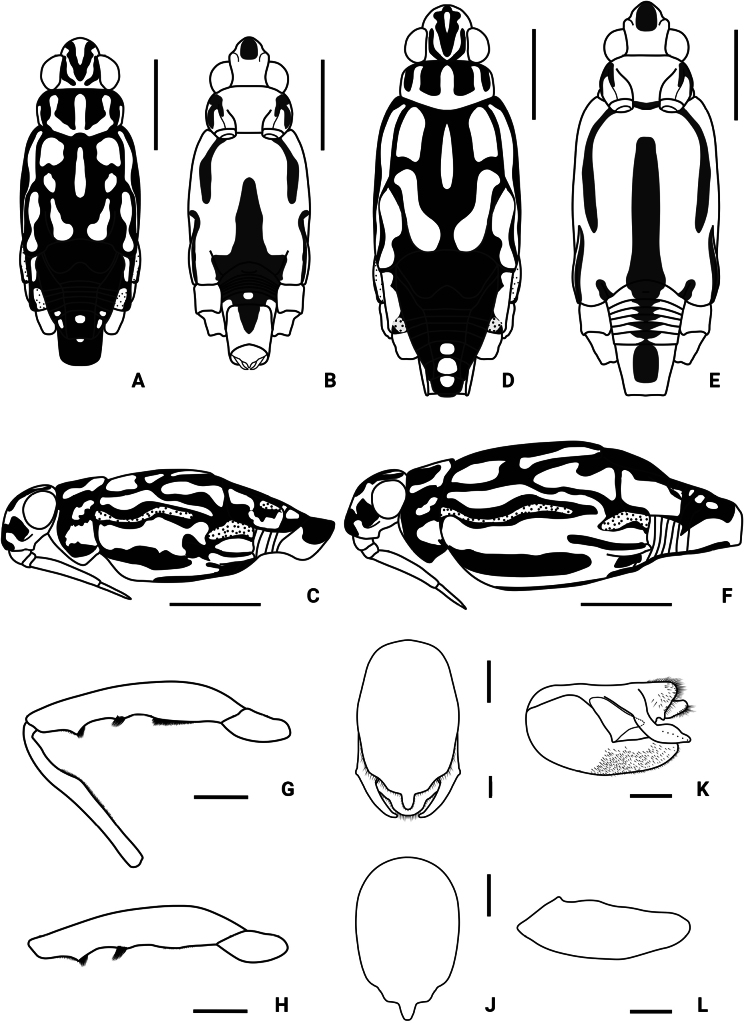 Figure 14
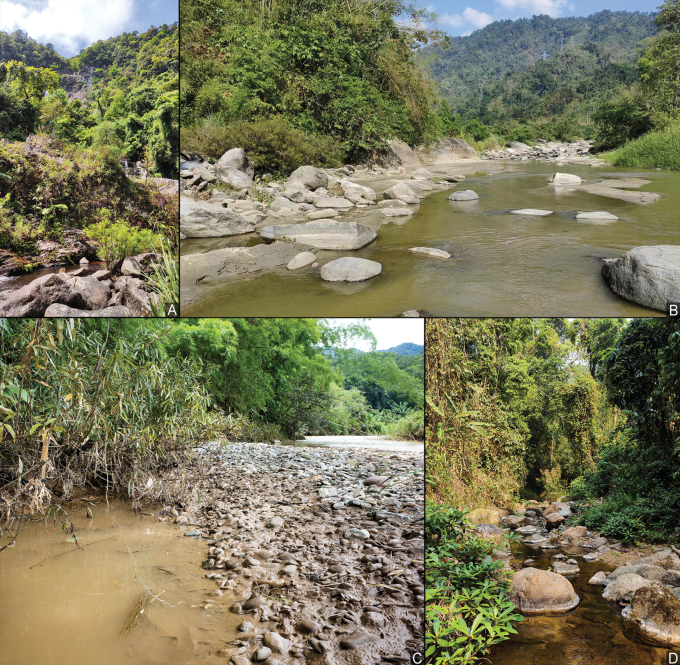 Figure 15
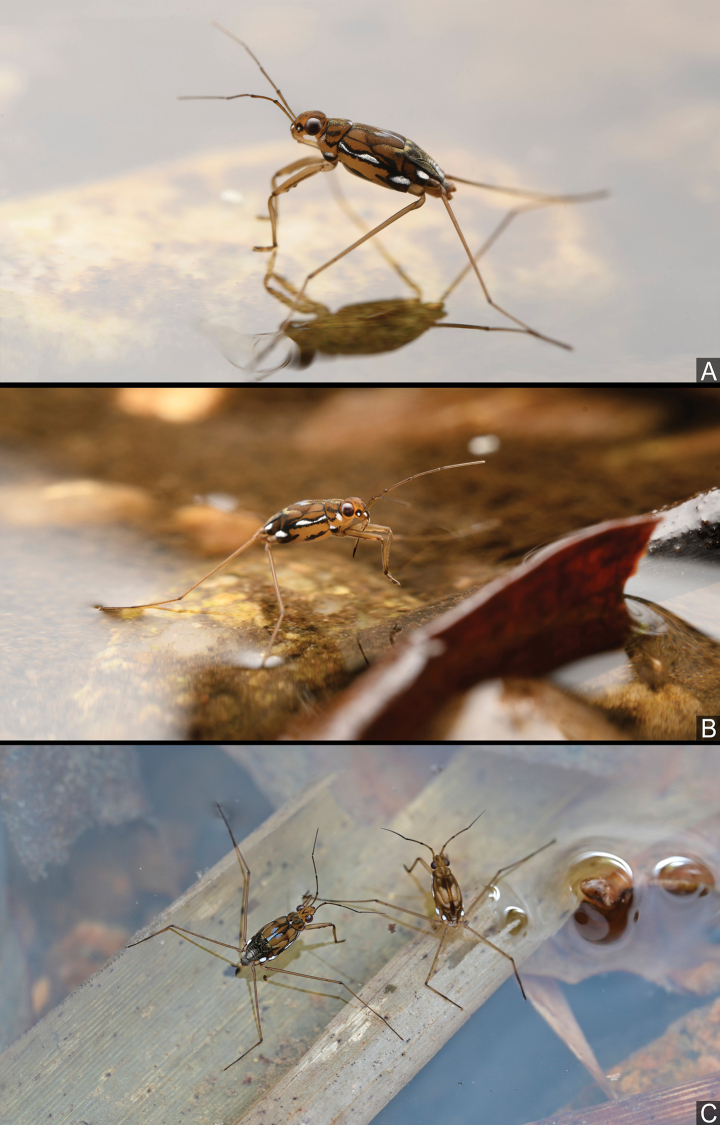 Figure 16
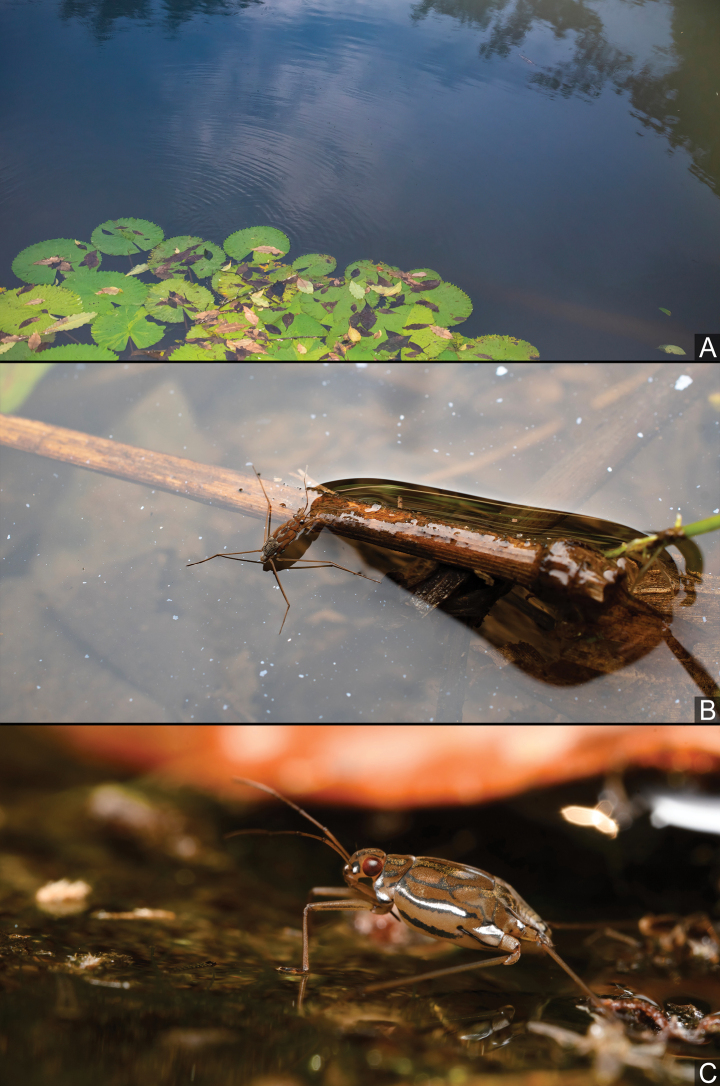 Figure 17
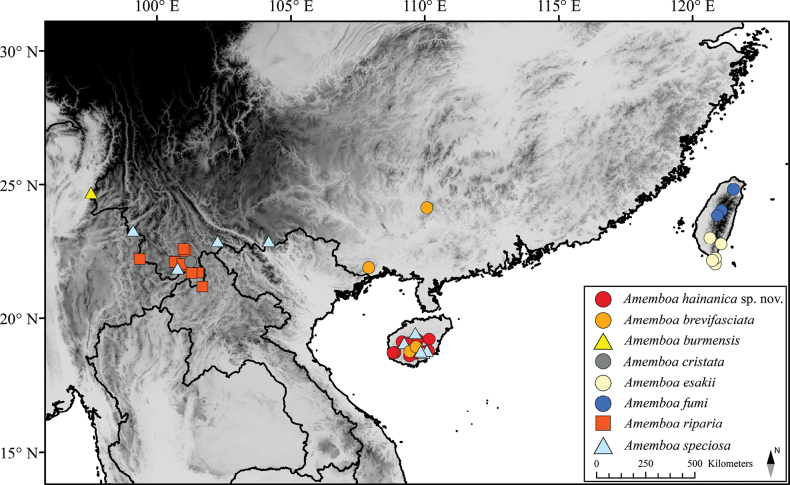 Figure 18
| 1 | Profemur with 2 elongate crests of dark setae (Fig. |
|
| – | Profemur with < 2 elongate crests of dark setae (Fig. |
|
| 2 | Ventral surface of profemur with an elongate patch of dark setae on basal 1/3 (Fig. |
|
| – | Ventral surface of profemur without dark setae on basal part (Fig. |
|
| 3 | Protibia with a relatively distinct process (Fig. |
|
| – | Protibia with a relatively indistinct process (Fig. |
|
| 4 | Median process of pygophore knob-like in ventral view (Fig. |
|
| – | Median process of pygophore broadly triangular in ventral view (Fig. |
|
| 5 | Protibia with a distinct angular process on basal part (Fig. |
|
| – | Protibia with a weakly developed blunt process on basal part (Fig. |
|
| 6 | Pygophore lacks any processes other than median process in ventral view (Fig. |
|
| – | Pygophore with a pair of small and blunt lateral process in ventral view (Fig. |
|
| 7 | Lateral black stripes on mesonotum relatively broad in dorsal view (Figs |
|
| – | Lateral black stripes on mesonotum relatively slim (Figs |
|
Peer Reviews
No public reviews on file for this paper yet. If you reviewed it on a platform where reviews are public (OpenReview, ICLR, NeurIPS, ICML), you can paste yours below so the community can read it here.
Videos
No videos yet. Explain this paper in a talk, walkthrough, or lecture? Add one.
Taxonomy
TopicsHemiptera Insect Studies · Insect-Plant Interactions and Control · Research on scale insects
Introduction
Amemboa Esaki, 1925 belongs to the water strider subfamily Eotrechinae. Members of this genus typically inhabit the edges of slow-flowing rivers or still ponds near rivers. The species of Amemboa are found in South and Southeast Asia, ranging from India to the Philippines, and exhibit a notable diversity in tropical regions (Polhemus and Andersen 1984; Zettel 1995, 1998, 2002; Zettel and Chen 1996, 1997; Zettel et al. 2007; Polhemus and Tran 2012; Basu et al. 2014; Polhemus 2017; Jehamalar et al. 2023). Jehamalar et al. (2023) classified Amemboa into 11 species groups based on the morphological characteristics of males. Prior to this study, Amemboa comprised a total of 28 described species (Jehamalar et al. 2023).
Six Amemboa species were recorded from China: Polhemus and Andersen (1984) described two species from Taiwan Island, namely A.esakii J. Polhemus & Andersen, 1984 and A.fumi Esaki, 1925. Cheng et al. (2006) reported the distribution of “A.lyra (Paiva, 1918)” in Yunnan. However, Zettel et al. (2007) re-examined the specimens of Cheng et al. (2006) and found that the profemora of males correspond to A.riparia J. Polhemus & Andersen, 1984. Amemboariparia was recognized as a synonym of A.lyra by Zettel and Chen (1996) and subsequently re-established as a valid species by Polhemus and Tran (2012). Therefore, the species reported by Cheng et al. (2006) was probably A.riparia, while A.lyra had no reliable distribution records from China. Additionally, Zettel et al. (2007) first reported the distribution of A.brevifasciata Miyamoto, 1967 and A.speciosa J. Polhemus & Andersen, 1984 in Hainan, and A.cristata Polhemus & Andersen, 1984 in Yunnan.
This study describes a new species, Amemboahainanica sp. nov., from Hainan, China. The study also reports the distribution of A.burmensis J. Polhemus & Andersen, 1984 in China for the first time. New distribution data are provided for seven Amemboa species. Diagnoses, photographs of diagnostic characteristics, a distribution map, and a key are provided for all Amemboa species distributed in China. Line drawings, in-situ habitus photographs, and photographs of habitats are also included.
Materials and methods
All measurements are given in millimeters (mm), representing the average values of the measurements taken from the type specimens. Measurements, observations, and dissections were made using a Zeiss Discovery V8 stereo microscope. Male genitalia were macerated in 5% potassium hydroxide solution (KOH) at room temperature. Photographs of male genitalic structures (pygophore and proctiger) were taken by using a Canon 90D camera equipped with a micro lens. All other photographs except for the male genitalic structures were taken with a Nikon D500 camera equipped with a micro lens and a telephoto lens. The map was prepared using ArcMap v. 10.8 software.
Dried and alcohol-preserved specimens examined in this study have been deposited in Institute of Entomology, College of Life Sciences, Nankai University, Tianjin, China (NKUM).
Taxonomic accounts
Family Gerridae Leach, 1815
Subfamily Eotrechinae Matsuda, 1960
Genus Amemboa Esaki, 1925
Amemboa
hainanica
Taxon classificationAnimaliaHemipteraGerridae
Leng, Jin & Ye sp. nov.
6F0F49B5-40CD-50F4-B2DC-81033D3F9ABB
https://zoobank.org/7D2BD0D7-CDAA-4523-90FB-0C54783AF425
Figs 1 , 2A, B , 3A , 4A, B, E, F , 5 , 6A , 7A , 8A , 9A , 10A , 11A , 12A, B , 15A , 16 , 18
Material examined.
Holotype: ♂ (apterous), China, Hainan Province, Bai-sha County, Luo-shuai Village, Xian-nv-xi; 19°5'58.4"N, 109°32'46.2"E; 324 m a.s.l.; 26 Jul. 2017; Zhen Ye & Juan-juan Yuan leg. (NKUM). Paratypes: 3 ♂♂, 3 ♀♀ (apterous), same data as holotype (NKUM) • 3 ♂♂, 3 ♀♀ (apterous), China, Hainan Province, Wan-ning City, Xing-long County, Ai-qing-gu; 18°47'54.3"N, 110°8'19.8"E; 148 m a.s.l.; 11 Aug. 2017; Juan-juan Yuan leg. (NKUM) • 1 ♂, 1 ♀ (apterous), China, Hainan Province, Bao-ting County, Qi-xian-ling National Forest Park; 18°42'12.2"N, 109°41'44.5"E; 318 m a.s.l.; 4 Aug. 2017; Zhen Ye leg. (NKUM) • 1 ♂, 1 ♀ (apterous), China, Hainan Province, Le-dong County, Jian-feng-ling, Wu-fen-he, Pool 3; 18°43'58.0"N, 108°53'9.6"E; 859 m a.s.l.; 15 Aug. 2017; Juan-juan Yuan leg. (NKUM) • 1 ♂, 1 ♀ (apterous), China, Hainan Province, Qiong-zhong County, Li-mu-shan; 19°11'11.1"N, 109°44'21.4"E; 631 m a.s.l.; 25 Jul. 2017; Zhen Ye leg. (NKUM) • 1 ♂, 1 ♀ (apterous), China, Hainan Province, Bai-sha County, Luo-shuai Village, Xian-nv-xi; 19°5'58.4"N, 109°32′46.2"E; 324 m a.s.l.; 26 Jul. 2017; Zhen Ye & Juan-juan Yuan leg. (NKUM) • 1 ♂, 1 ♀ (apterous), China, Hainan Province, Wan-ning City, Jian-feng-ling Nature Reserve, Yu-lin-gu; 18°42'30.9"N, 108°49'20.2"E; 1 Aug. 2017; Zhen Ye leg. (NKUM) • 1 ♂, 1 ♀ (apterous), China, Hainan Province, Qiong-zhong County, Beng-ling Village; 18°46'42.7"N, 109°50'29.3"E; 253 m a.s.l.; 9 Aug. 2017; Zhen Ye leg. (NKUM) • 1 ♂, 1 ♀ (apterous), China, Hainan Province, Wan-ning City, Xing-long County, Ai-qing-gu; 18°47'54.3"N, 110°8'19.8"E; 148 m a.s.l.; 11 Aug. 2017; Juan-juan Yuan leg. (NKUM).
Non-type materials: 1 ♂ (apterous), China, Hainan Province, Chang-jiang County, Ba-wang-ling Nature Reserve; 19°7'16.8"N, 109°9'38.2"E; 650 m a.s.l.; 6 Apr. 2008; Bo Cai leg. (NKUM) • 1 ♂ (apterous), China, Hainan Province, Bao-ting County, Xian-an-shi-lin; 18°36'5.8"N, 109°25'59.5"E; 571 m a.s.l.; 7 Aug. 2017; Kun Jiang & Si-ying Fu leg. (NKUM) • 2 ♂♂, 1 ♀ (apterous), China, Hainan Province, Bai-sha County, Shi-cai Village, Ying-ge-ling Nature Reserve, Nan-kai Branch Station; 19°4'23.0"N, 109°22'34.0"E; 310 m a.s.l.; 20 Jul. 2013; Yan-hui Wang leg. (NKUM) • 3 ♂♂ (apterous), China, Hainan Province, Dan-zhou City, Lu-mu-wan Waterfall; 19°13'54.6"N, 109°41'16.5"E; 202 m a.s.l.; 22 Jul. 2017; Zhen Ye leg. (NKUM) • 3 ♂♂, 8 ♀♀ (apterous), China, Hainan Province, Tun-chang County, Nan-lv-ling; 19°13'49.0"N, 110°10'20.8"E; 172 m a.s.l.; 24 Jul. 2017; Zhen Ye leg. (NKUM) • 1 ♂ (apterous), China, Hainan Province, Wu-zhi-shan City, Shui-man Township, Shi-ling-rui Bridge; 18°54'10.9"N, 109°39'23.7"E; 3 Jul. 2014; Qiang Xie leg. (NKUM) • 3 ♂♂, 6 ♀♀ (apterous), China, Hainan Province, Bai-sha County, Ying-ge-ling Nature Reserve, Nan-kai Branch Station; 19°2'1.7"N, 109°24'14.5"E; 20 Jul. 2013; Hao-yang Wu leg. (NKUM).
Diagnosis.
Color pattern as shown in Figs 1, 2A, B, 3A, 4A, B, E, F, 5A–F, 12A, B. Males: profemur moderately incrassate (Figs 5G, 6A); ventral side of the profemur with two tufts of dark setae on apical 1/2 (Figs 5G, 6A); protibia slightly curved and with an indistinct tumescence on basal 1/3 (Figs 5G, 6A); abdominal segment VIII relatively short (Fig. 8A); pygophore posteriorly with a digitate median process, also with a pair of distinct blunt processes on both sides of the median process (Figs 5H, I, 8A, 9A); median process of pygophore relatively broad in lateral view (Figs 5J, K, 10A, 11A); lateral arm of proctiger relatively slender in ventral view (Figs 5H, 8A), with a distinct subapical process in lateral view, forming a distinct subapical notch on dorsal margin (Figs 5J, 10A).
Habitus of Amemboahainanica sp. nov., apterous form in dorsal view A holotype, male B paratype, female. Scale bar: 2 mm.
Photographs of bodies of Amemboa spp., apterous males in dorsal view A, BA.hainanica sp. nov CA.brevifasciata Miyamoto, 1967 DA.burmensis J. Polhemus & Andersen, 1984 EA.cristata Polhemus & Andersen, 1984 FA.esakii J. Polhemus & Andersen, 1984 GA.fumi Esaki, 1925 H, IA.riparia J. Polhemus & Andersen, 1984 JA.speciosa J. Polhemus & Andersen, 1984. Scale bar: 1 mm.
Photographs of bodies of Amemboa spp., apterous males in ventral view AA.hainanica sp. nov. BA.brevifasciata Miyamoto, 1967 CA.burmensis J. Polhemus & Andersen, 1984 DA.cristata Polhemus & Andersen, 1984 EA.esakii J. Polhemus & Andersen, 1984 FA.fumi Esaki, 1925 G, HA.riparia J. Polhemus & Andersen, 1984 IA.speciosa J. Polhemus & Andersen, 1984. Scale bar: 1 mm.
Photographs of bodies of Amemboa spp., apterous form in lateral view A, BA.hainanica sp. nov., males CA.burmensis J. Polhemus & Andersen, 1984, male DA.fumi Esaki, 1925, male E, FA.hainanica sp. nov., females GA.burmensis, female HA.fumi, female. Scale bar: 1 mm.
Morphological features of Amemboahainanica sp. nov. A body of male, dorsal view B body of male, ventral view C body of male, lateral view D body of female, dorsal view E body of female, ventral view F body of female, lateral view G left foreleg of male, dorsal view H pygophore and proctiger of male, ventral view I pygophore of male, ventral view J pygophore and proctiger of male, lateral view K pygophore of male, lateral view. Scale bars: 1 mm (A–F); 0.2 mm (G); 0.1 mm (H–K).
Comparative notes.
Amemboahainanica sp. nov. is most similar to A.cambodiana D. Polhemus, 2017. In males of both species, the lateral arm of the proctiger in lateral view exhibits a distinct subapical notch on its dorsal margin, isolating a small, slightly recurved apical process, which gives the lateral arm a hooked appearance (Fig. 10A; also see Polhemus 2017: fig. 22). These are the only two known Amemboa species that share this morphological characteristic. Besides, the ventral side of the profemur bears two tufts of dark setae in the males of both species (Fig. 6A; also see Polhemus 2017: fig. 19). Some color patterns of both species are also similar (Figs 2A, 12A; also see Polhemus 2017: figs 14, 15). However, these two species can be distinguished by the following characteristics. The apical hook of lateral arm is more acutely pointed in A.cambodiana (see Polhemus 2017: fig. 22), while it is blunter in A.hainanica sp. nov. (Fig. 10A). The subapical process is weakly developed in A.cambodiana, while it is more distinct in A.hainanica sp. nov. (Fig. 10A; also see Polhemus 2017: fig. 22). The two species can also be separated by the shape of their pygophores, which is campanulate in A.cambodiana (see Polhemus 2017: fig. 21) and lacks the pair of lateral blunt processes seen in A.hainanica sp. nov. (Fig. 9A).
Amemboahainanica sp. nov. is also similar to A.fumi Esaki, 1925. In males of both species, the ventral side of the profemur bears two tufts of dark setae on apical 1/2, and protibia exhibits an indistinct tumescence on the basal 1/3 (Fig. 6A, G); abdominal segment VIII relatively short (Fig. 7A, F); pygophore has a digitate median process posteromedially and a pair of distinct blunt processes to either side of the median process (Fig. 9A, F). However, A.hainanica sp. nov. differs from A.fumi in the following characteristics. In males of A.hainanica sp. nov., the lateral arm of proctiger bears a distinct subapical process in lateral view (Fig. 10A), while in A.fumi, the lateral arm of proctiger lacks a process in lateral view (Fig. 10F). Additionally, although color characteristics are quite variable within Amemboa species, some generalizations can still be made based on the current specimens. In both sexes of A.hainanica sp. nov., the black marks and stripes on head, pronotum and mesonotum are more slender and weaker (Figs 2A, 4A, E, 5A, D, 12A), or nearly absent (Figs 2B, 4B, F, 12B), while they are broader and more prominent in A.fumi (Figs 2G, 12G). Moreover, the metanotum of A.hainanica sp. nov. exhibits brownish-yellow spots (Figs 2A, 4A, E, 5A, D, 12A) or is predominantly brownish-yellow (Figs 2B, 4B, F, 12B), whereas it is entirely black in A.fumi (Figs 2G, 12G).
Left forelegs of Amemboa spp. in dorsal view (males) AA.hainanica sp. nov. BA.brevifasciata Miyamoto, 1967 C, DA.burmensis J. Polhemus & Andersen, 1984 EA.cristata Polhemus & Andersen, 1984 FA.esakii J. Polhemus & Andersen, 1984 GA.fumi Esaki, 1925 H, IA.riparia J. Polhemus & Andersen, 1984 JA.speciosa J. Polhemus & Andersen, 1984. Scale bar: 0.2 mm.
Description of apterous male.
Measurements. Body length 3.68–3.96 (holotype 3.76), width 1.39–1.49 (holotype 1.39), head width 0.92–0.98, interocular width 0.43–0.44, eye length (in dorsal view) 0.39–0.43; lengths of antennal segments I–IV: 0.86–0.93: 0.78–0.82: 0.83–0.89: 1.32–1.51; pronotum: length 0.53–0.55, width 0.99–1.11; mesonotum: length 1.25–1.30, width 1.39–1.49; metanotum: length 0.44–0.48, width 1.11–1.17; lengths of leg segments (femur: tibia: tarsal segment I: tarsal segment II): fore leg: 1.24–1.30: 1.17–1.21: 0.28–0.29: 0.16–0.18, middle leg: 3.47–3.56: 2.19–2.25: 0.81–0.87: 0.40–0.43, hind leg: 3.05–3.28: 1.22–1.33: 0.48–0.53: 0.35–0.38.
Color. Body dorsally brownish yellow with black stripes (Figs 1A, 2A, B, 5A). Color pattern as shown in Figs 2A, B, 3A, 4A, B, 5A–C. Head dorsally with several tiny, discontinuous, black spots (Figs 2A, B, 5A); rostrum mainly yellow, with dorsomedian line and segment IV black (Fig. 4A, B). Pronotum with two pairs of black stripes in dorsal view (Figs 2A, 5A), sometimes the pair of lateral stripes nearly absent (Fig. 2B); proacetabulum with a pair of black or brown marks laterally, coxal cleft brown (Figs 3A, 5B). Mesonotum with broad, black stripes medially and slender, black stripes laterally (Figs 2A, 4A, 5B, C), sometimes stripes nearly absent (Figs 2B, 4B); mesopleuron with a relatively broad, black stripe medially on each side, covered by silvery setae (Figs 4A, B, 5C); mesacetabulum with broad, black mark dorsally, covered by silvery setae (Figs 2A, B, 4A, B), basal part of coxal cleft black, other part brownish-black (Figs 3A, 4A) or pale brown (Fig. 4B); mesosternum with a pair of elongate, black stripes anterolaterally, a broad, black stripe medially, and a pair of black spots posterolaterally (Figs 3A, 5B). Metanotum mainly black, with a pair of dark brown spots (Figs 2A, 5A) or mainly brownish-yellow (Fig. 2B); metapleuron dark brown or yellowish-brown (Fig. 4A, B); metacetabulum with broad, black mark dorsally, covered by silvery setae (Figs 2A, B, 4A, B); metasternum mainly black (Figs 3A, 5E). Abdominal tergites I–V black (Figs 2A, 5A) or brownish-yellow (Fig. 2B); mediotergites IV–VIII with brownish-yellow spots medially (Figs 2A, B, 5A); abdominal sterna II–VI completely black, sternite VII mainly black with a pair of yellowish-brown stripes on posterior margin (Figs 3A, 5B); abdominal segment VIII mainly yellow, dorsal part black (Figs 2A, 5A) or with brown spots (Fig. 2B), ventral part with a pair of black spots medially (Figs 3A, 5B).
Structure. Head: elongate, deflected anteriorly; antennal segment I slightly curved, stouter than other segments, with apical part slightly incrassate, antennal tubercles protruded, visible in dorsal view (Fig. 1A); compound eyes large, globular; rostrum stout, reaching anterior part of mesosternum (Fig. 2A, B). Thorax: prothorax and metathorax short, mesothorax prolonged; proacetabulum oblique, mesoacetabulum and metacetabulum almost horizontal (Figs 4A, B, 5C); profemur moderately incrassate (Figs 5G, 6A); ventral side of the profemur with two tufts of dark setae on apical 1/2 (Figs 5G, 6A); protibia slightly curved, with an indistinct tumescence on basal 1/3 (Figs 5G, 6A); protarsus stout, with large claws (Figs 5G, 6A); meso- and metafemora relatively long, stouter than meso- and metatibia (Fig. 1A); meso- and metatarsi slender (Fig. 1A); claws of middle and hind legs shorter than claw of fore leg (Fig. 1A). Abdomen: mediotergites declined, connexiva raised and convergent (Fig. 2A, B); abdominal segment VII short; abdominal segment VIII cylindriform, protruding from pregenital segments, relatively short and stout (Fig. 7A). Genitalia: pygophore posteriorly with a digitate median process (Figs 5H, I, 8A, 9A), also with a pair of distinct blunt processes on both sides of median process in ventral view (Figs 5H, I, 8A, 9A); median process of pygophore relatively broad in lateral view (Figs 5J, K, 10A, 11A); lateral arms of proctiger relatively slender in ventral view (Figs 5H, 8A), with a distinct subapical process in lateral view, forming a distinct subapical notch on the dorsal margin (Figs 5J, 10A).
Abdominal segment VIII of Amemboa spp. in dorsal view (males) AA.hainanica sp. nov. BA.brevifasciata Miyamoto, 1967 CA.burmensis J. Polhemus & Andersen, 1984 DA.cristata Polhemus & Andersen, 1984 EA.esakii J Polhemus & Andersen, 1984 FA.fumi Esaki, 1925 G, HA.riparia J. Polhemus & Andersen, 1984 IA.speciosa J. Polhemus & Andersen, 1984. Scale bar: 0.2 mm.
Pygophore and proctiger of Amemboa spp. in ventral view AA.hainanica sp. nov. BA.brevifasciata Miyamoto, 1967 CA.burmensis J. Polhemus & Andersen, 1984 DA.cristata Polhemus & Andersen, 1984 EA.esakii J. Polhemus & Andersen, 1984 FA.fumi Esaki, 1925 G, HA.riparia J. Polhemus & Andersen, 1984 IA.speciosa J. Polhemus & Andersen, 1984. Abbreviation: la = lateral arm of proctiger. Scale bar: 0.2 mm.
Pygophore of Amemboa spp. in ventral view AA.hainanica sp. nov. BA.brevifasciata Miyamoto, 1967 CA.burmensis J. Polhemus & Andersen, 1984 DA.cristata Polhemus & Andersen, 1984 EA.esakii J. Polhemus & Andersen, 1984 FA.fumi Esaki, 1925 G, HA.riparia J. Polhemus & Andersen, 1984 IA.speciosa J. Polhemus & Andersen, 1984. Abbreviations: bp = blunt process, lp = lateral process, mp = median process. Scale bar: 0.2 mm.
Pygophore and proctiger of Amemboa spp. in lateral view AA.hainanica sp. nov. BA.brevifasciata Miyamoto, 1967 CA.burmensis J. Polhemus & Andersen, 1984 DA.cristata Polhemus & Andersen, 1984 EA.esakii J. Polhemus & Andersen, 1984 FA.fumi Esaki, 1925 G, HA.riparia J. Polhemus & Andersen, 1984 IA.speciosa J. Polhemus & Andersen, 1984. Abbreviation: la = lateral arm of proctiger. Scale bar: 0.2 mm.
Description of apterous female.
Measurements. Body length 4.19–4.52, width 1.76–1.78, head width 1.00–1.02, interocular width 0.45–0.49, eye length (dorsal view) 0.44–0.48; lengths of antennal segments I–IV: 0.93–0.99: 0.80–0.88: 0.91–1.00: 1.41–1.54; pronotum: length 0.50–0.55, width 1.01–1.24; mesonotum: length 1.52–1.58, width 1.75–1.78; metanotum: length 0.50–0.56, width 1.32–1.40; lengths of leg segments (femur: tibia: tarsal segment I: tarsal segment II): fore leg: 1.29–1.44: 1.33–1.38: 0.33–0.34: 0.20–0.21, middle leg: 3.88–4.10: 2.50–2.75: 1.02–1.06: 0.46–0.48, hind leg: 3.40–3.53: 1.48–1.56: 0.56–0.64: 0.43–0.46.
Color. Color pattern as shown in Figs 1B, 5D–F, 12A, B. Similar to apterous male with the following exceptions: mesosternum lacking a pair of black spots posterolaterally (Fig. 5E); metasternum mainly yellow with median part black (Fig. 5E); metasternum yellow, with a median black mark (Fig. 5E); abdominal sternites II–VII mainly yellow with median black marks, the marks on sternites III–VII with brown spots in the center (Fig. 5E).
Structure. Similar to apterous male with some exceptions: body stouter than male; profemur slightly incrassate, without special modifications (Fig. 1B); protibia straight without special modifications (Fig. 1B). Abdominal segment VII relatively long, genital segments completely withdrawn into segment VII (Figs 5D–F, 12A, B). Proctiger simple, hind margin rounded.
Macropterous forms.
Unknown.
Etymology.
The specific epithet hainanica refers to the island of Hainan, China, the only area in which this species has so far been collected.
Distribution.
China: Hainan (Fig. 18).
Habitats.
Amemboahainanica sp. nov. is found in rivers and pools below waterfalls (Fig. 15A), actively moving on the water surface (Fig. 16A, B) and resting at the edges of still water puddles (Fig. 16C).
Amemboa
brevifasciata
Taxon classificationAnimaliaHemipteraGerridae
Miyamoto, 1967
CB065B7A-B0CA-5116-92D2-FB357057A52F
Figs 2C , 3B , 6B , 7B , 8B , 9B , 10B , 11B , 12C , 18
Material examined.
1 ♂, 2 ♀♀ (apterous), China, Guangxi Province, Lai-bin City, Jin-xiu County; 24°8'40.2"N, 110°4'49.1"E; 565 m a.s.l.; 25 Jul. 2019; Zhen Ye leg. (NKUM) • 2 ♂♂ (apterous), China, Guangxi Province, Fang-cheng-gang City, Shang-si County, Shi-wan-da-shan; 21°54'4.0"N, 107°54'22.0"E; 300 m a.s.l.; 13 Jul. 2019; Zhen Ye leg. (NKUM).
Diagnosis.
Color pattern as shown in Figs 2C, 3B, 12C. Males: profemur moderately incrassate; ventral side of the profemur with two tufts of dark setae on apical 1/2 (Fig. 6B); protibia slightly curved and with an indistinct tumescence on basal 1/3 (Fig. 6B); abdominal segment VIII relatively short (Fig. 7B); pygophore posteriorly with a digitate median process in ventral view, without other special modifications (Figs 8B, 9B); median process of pygophore relatively broad in lateral view (Figs 10B, 11B); lateral arm of proctiger moderately curve and slender in ventral view (Fig. 8B), with a weakly developed subapical process in lateral view (Fig. 10B).
Pygophore of Amemboa spp. in lateral view AA.hainanica sp. nov. BA.brevifasciata Miyamoto, 1967 CA.burmensis J. Polhemus & Andersen, 1984 DA.cristata Polhemus & Andersen, 1984 EA.esakii J. Polhemus & Andersen, 1984 FA.fumi Esaki, 1925 G, HA.riparia J. Polhemus & Andersen, 1984 IA.speciosa J. Polhemus & Andersen, 1984. Abbreviation: mp = median process. Scale bar: 0.2 mm.
Photographs of bodies of Amemboa spp., females in dorsal view, apterous form if not stated otherwise A, BA.hainanica sp. nov. CA.brevifasciata Miyamoto, 1967 DA.burmensis J. Polhemus & Andersen, 1984 EA.cristata Polhemus & Andersen, 1984 FA.esakii J. Polhemus & Andersen, 1984 GA.fumi Esaki, 1925 H, IA.riparia J. Polhemus & Andersen, 1984, macropterous form (H) and apterous form (I) JA.speciosa J. Polhemus & Andersen, 1984. Scale bar: 1 mm.
Comparative notes.
A.brevifasciata Miyamoto, 1967 is most similar to A.fumi Esaki, 1925, see comparative notes in Polhemus and Andersen (1984).
Distribution.
China: Hainan (Zettel et al. 2007), Guangxi (Fig. 18). Thailand; Vietnam; Peninsular Malaysia; Singapore; Indonesia: Sumatra (Polhemus and Andersen 1984).
Remarks.
This species was previously recorded in Hainan (Zettel et al. 2007), but we have not found it in this
distribution.
New record for China
Amemboa
burmensis
Taxon classificationAnimaliaHemipteraGerridae
J. Polhemus & Andersen, 1984
3BF0DC45-ADC1-5608-B7AB-52D116CCB190
Figs 2D , 3C , 4C, G , 6C, D , 7C , 8C , 9C , 10C , 11C , 12D , 13 , 14 , 15B , 18
Material examined.
5 ♂♂, 6 ♀♀ (apterous), China, Yunnan Province, De-hong Autonomous Prefecture, Na-bang Village; 24°42'5.8"N, 97°34'25.0"E; 207 m a.s.l.; 15 Apr. 2023; Mu Qiao, Ze-zhong Jin and Zi-he Li leg. (NKUM).
Diagnosis.
Color pattern as shown in Figs 2D, 3C, 4C, G, 12D, 13, 14A–F. Males: profemur moderately incrassate; ventral side of the profemur with two tufts of dark setae on apical 1/2 and an additional elongate crest of dark setae on basal 1/2 (Figs 6C, 14G) (sometimes raised, as in Figs 6D, 14H); protibia slightly curved and with a tumescence on basal 1/3 (Figs 6C, 14G); abdominal segment VIII relatively long (Fig. 7C); pygophore posteriorly with a short knob-like median process, and with a pair of blunt processes on both sides of the median process in ventral view (Figs 8C, 9C, 14I, J); median process of pygophore relatively broad in lateral view (Figs 10C, 11C, 14K, L). Lateral arm of proctiger relatively straight in ventral view (Figs 8C, 14I), distinctly broadened subapically in lateral view (Figs 10C, 14K), forming a blunt process (Figs 10C, 14K).
Habitus of Amemboaburmensis J. Polhemus & Andersen, 1984, apterous form in dorsal view A male B female. Scale bar: 1 mm.
Morphological features of Amemboaburmensis J. Polhemus & Andersen, 1984 A body of male, dorsal view B body of male, ventral view C body of male, lateral view D body of female, dorsal view E body of female, ventral view F body of female, lateral view G, H left forelegs of different males, dorsal view I pygophore and proctiger of male, ventral view J pygophore of male, ventral view K pygophore and proctiger of male, lateral view L pygophore of male, lateral view. Scale bars: 1 mm (A–F); 0.2 mm (G, H); 0.1 mm (I–L).
Comparative notes.
Amemboaburmensis is most similar to A.kumari (Distant, 1910) and A.cambodiana D. Polhemus, 2017, see comparative notes in Polhemus and Andersen (1984) and Polhemus (2017).
Distribution.
China: Yunnan (Fig. 18). Myanmar: Shigbwiyang (Polhemus and Andersen 1984).
Habitat.
We found A.burmensis inhabiting stagnant pools at the edges of a wide river (Fig. 15B), located near the lower altitudes of the forest in Tong-bi-guan, Yunnan.
Habitat of Amemboa spp. A habitat of A.hainanica sp. nov., a tranquil pool at the base of the waterfall B habitat of A.burmensis J. Polhemus & Andersen, 1984, a wide, rocky river C habitat of A.riparia J. Polhemus & Andersen, 1984, a muddy pool beside the river D habitat of A.riparia, a small stream in the jungle.
Remarks.
In the original description of A.burmensis, Polhemus and Andersen (1984) described the profemur of males as follows: “Fore femur moderately incrassate in basal 1/2 (fig. 36), with an elongate patch of short dark hairs on ventral side”. However, among the specimens collected from China, this elongate tuft of setae is either more distinct than the original description (Fig. 6C) or nearly absent (Fig. 6D). We speculate that this may be caused by wear of the setae, or there may be two phenotypes of this species.
Amemboa
cristata
Taxon classificationAnimaliaHemipteraGerridae
J. Polhemus & Andersen, 1984
8D9A29B1-2DEA-56C6-A578-AA495F8320FA
Figs 2E , 3D , 6E , 7D , 8D , 9D , 10D , 11D , 12E , 18
Material examined.
3 ♂♂, 4 ♀♀ (apterous), Thailand, Mae Hong Son Province, Pai, Thung Yao, Pam Bok Waterfall; 19°19'14.5"N, 98°24'18.6"E; 549 m a.s.l.; 26 Aug. 2018; Zhen Ye and Juan-juan Yuan leg. (NKUM).
Diagnosis.
Color pattern as shown in Figs 2E, 3D, 12E. Males: profemur moderately incrassate (Fig. 6E); ventral side of the profemur with one elongate crest of dark setae on apical 1/2 and an additional elongate crest of dark setae on basal 1/2 (Fig. 6E); protibia slightly curved and with a tumescence on basal 1/3 (Fig. 6E); abdominal segment VIII relatively long (Fig. 7D); pygophore posteriorly with a bifid median process and a pair of strongly produced lateral processes in ventral view (Figs 8D, 9D); median process of pygophore relatively narrow in lateral view (Figs 10D, 11D); lateral arm of proctiger relatively curved and slender in ventral view (Fig. 8D), without subapical process in lateral view (Fig. 10D)
Comparative notes.
Amemboacristata is most similar to A.incurvata; see comparative notes in Polhemus and Andersen (1984)
Distribution.
China: Yunnan (Zettel et al. 2007). Thailand; Vietnam; Peninsular Malaysia (Polhemus and Andersen 1984; Zettel and Chen 1996).
Remarks.
Zettel et al. (2007) first reported the distribution of A.cristata in Xi-shuang-ban-na, Yunnan. In this study, all the examined specimens and those used in the Figures are from Thailand.
Amemboa
esakii
Taxon classificationAnimaliaHemipteraGerridae
J. Polhemus & Andersen, 1984
328F4BA5-86D5-553B-A17C-5356D9B2190E
Figs 2F , 3E , 6F , 7E , 8E , 9E , 10E , 11E , 12F , 18
Material examined.
2 ♂♂, 4 ♀♀ (apterous), China, Taiwan Island, Gao-xiong City, Liu-gui District; 23°0'17.1"N, 120°39'32.7"E; 262 m a.s.l.; 12 Sep. 2017; Juan-juan Yuan leg. (NKUM) • 14 ♂♂, 12 ♀♀ (apterous), China, Taiwan Island, Ping-dong County, Che-cheng Village, Si-chong-xi; 22°5'29.9"N, 120°45'44.9"E; 18 Nov. 2011; Wen-jun Bu leg. (NKUM) • 1 ♂, 4 ♀♀ (apterous), China, Taiwan Island, Ping-dong County, Man-zhou Village, Lan-ren-xi; 22°2'31.5"N, 120°51'35.6"E; 9 Nov. 2016; Hua-xi Liu leg. (NKUM) • 13 ♂♂, 5 ♀♀ (apterous), China, Taiwan Island, Ping-dong County, Mu-dan Village, Shou-ka-lin-dao; 22°14'55.3"N, 120°50'44.2"E; 15 Jun. 2013; Zhen Ye leg. (NKUM) • 7 ♂♂, 5 ♀♀ (apterous), China, Taiwan Island, Ping-dong County, Shi-zi Village, Li-long-shan; 22°10'02.3"N, 120°44'32.5"E; 18 Jun. 2013; Zhen Ye leg. (NKUM) • 3 ♂♂, 6 ♀♀ (apterous), China, Taiwan Island, Tai-dong County, Bei-nan Village; 22°46'51.9"N, 121°4'28.9"E; 14 Jun. 2013; Zhen Ye leg. (NKUM).
Diagnosis.
Color pattern as shown in Figs 2F, 3E, 12F. Males: profemur moderately incrassate; ventral side of the profemur with two tufts of dark setae on apical 1/2 (Fig. 6F); protibia slightly curved and with an indistinct tumescence on basal 1/3 (Fig. 6F); abdominal segment VIII relatively long (Fig. 7E); pygophore posteriorly with a blunt T-shaped median process and a pair of right-angled lateral processes in ventral view (Figs 8E, 9E); median process of pygophore relatively narrow in lateral view (Figs 10E, 11E); posterior margin of pygophore nearly truncate ventrally (Figs 8E, 9E); lateral arm of proctiger relatively curved in ventral view (Fig. 8E), without subapical process in lateral view (Fig. 10E).
Comparative notes.
Amemboaesakii is distinct from all congeners in having a T-shaped median process and a truncate posterior margin of pygophore in ventral view (Figs 8E, 9E).
Distribution.
China: Taiwan (Fig. 18).
Amemboa
fumi
Taxon classificationAnimaliaHemipteraGerridae
Esaki, 1925
8EDD6F98-3167-581F-AC08-A925273F1235
Figs 2G , 3F , 4D, H , 6G , 7F , 8F , 9F , 10F , 11F , 12G , 18
Material examined.
3 ♂♂ (apterous), China, Taiwan Island, Nan-tou County, Ren-ai Village, Nan-shan-xi; 24°1'36.9"N, 121°5'21.0"E; 6 Jun. 2013; Zhen Ye leg. (NKUM) • 6 ♂♂, 5 ♀♀ (apterous), China, Taiwan Island, Xin-bei County, Wu-lai District, Xin-xian-bu-dao; 24°50'25.1"N, 121°32'15.0"E; 197 m a.s.l.; 6 Sep. 2017; Juan-juan Yuan leg. (NKUM) • 2 ♂♂ (apterous), China, Taiwan Island, Nan-tou County, Yu-chi Village; 23°50'58.9"N, 120°55'37.0"E; 6 Nov. 2016; Hua-xi Liu leg. (NKUM).
Diagnosis.
Color pattern as shown in Figs 2G, 3F, 4D, H, 12G. Males: profemur moderately incrassate (Fig. 6G); ventral side of the profemur with two tufts of dark setae on the apical 1/2 (Fig. 6G); protibia slightly curved and with an indistinct tumescence on basal 1/3 (Fig. 6G); abdominal segment VIII relatively short (Fig. 7F); pygophore posteriorly with a digitate median process in ventral view, also with a pair of blunt processes at lateral sides of the median process, without distinct angular lateral process (Figs 8F, 9F); median process of pygophore relatively narrow in lateral view (Figs 10F, 11F); lateral arm of proctiger relatively curved and slender in ventral view (Fig. 8F), without subapical process in lateral view (Fig. 10F).
Comparative notes.
See comparative notes under A.hainanica sp. nov.
Distribution.
China: Taiwan (Fig. 18).
Amemboa
riparia
Taxon classificationAnimaliaHemipteraGerridae
J. Polhemus & Andersen, 1984
82A2508E-3766-56BF-90FC-B1C46CD61C23
Figs 2H, I , 3G, H , 6H, I , 7G, H , 8G, H , 9G, H , 10G, H , 11G, H , 12H, I , 15C, D , 17 , 18
Material examined.
1 ♂, 1 ♀ (apterous), China, Yunnan Province, Xi-shuang-ban-na Autonomous Prefecture, Jing-hong City, Pu-wen Town; 22°30'36.5"N, 101°3'55.5"E; 880 m a.s.l.; 25 Apr. 2011; Zhen Ye leg. (NKUM) • 7 ♂♂, 6 ♀♀ (apterous), China, Yunnan Province, Xi-shuang-ban-na Autonomous Prefecture, Jing-hong City, Man-dian Village, Na-ban-he Nature Reserve; 22°7'48.5"N, 100°39'46.1"E; 629 m a.s.l.; 28 Jul. 2016; Zhen Ye leg. (NKUM) • 1 ♂ (apterous), China, Yunnan Province, Xi-shuang-ban-na Autonomous Prefecture, Jing-hong City, Meng-la County, Meng-lun Town, Ba-ka-xiao-zhai Village; 21°57'57.0"N, 101°12'16.2"E; 747 m a.s.l.; 5 Jul. 2018; Juan-juan Yuan and Yan-fei Li leg. (NKUM) • 1 ♂ (apterous), China, Yunnan Province, Xi-shuang-ban-na Autonomous Prefecture, Jing-hong City, Meng-la County, Mo-han Town; 21°11'51.0"N, 101°41'55.8"E; 17 Aug. 2014; Zhen Ye leg. (NKUM) • 3 ♀♀ (apterous), China, Yunnan Province, Xi-shuang-ban-na Autonomous Prefecture, Jing-hong City, Meng-la County, Yao-qu-yao-zu Township; 21°42'57.0"N, 101°32'32.2"E; 758 m a.s.l.; 26 Jul. 2016; Zhen Ye leg. (NKUM) • 4 ♂♂, 3 ♀♀ (apterous), China, Yunnan Province, Xi-shuang-ban-na Autonomous Prefecture, Jing-hong City, Man-dian Village, Man-dian-pu-bu; 22°7'45.1"N, 100°40'01.9"E; 660 m a.s.l.; 20 Apr. 2023; Ze-zhong Jin and Zi-he Li leg. (NKUM) • 3 ♂♂, 2 ♀♀ (apterous), China, Yunnan Province, Pu-er City, Meng-lian County, Meng-ma Town, Mang-yun Village; 22°13'50.5"N, 99°21'30.1"E; 887 m a.s.l.; 20 Jul. 2016; Zhen Ye leg. (NKUM) • 2 ♂♂, 1 ♀ (apterous), China, Yunnan Province, Xi-shuang-ban-na Autonomous Prefecture, Jing-hong City, Pu-wen Town, Cai-yang-he; 22°2'43.2"N, 100°56'10.3"E; 25 Apr. 2011; Rui Wang leg. (NKUM) • 1 ♂ (apterous), China, Yunnan Province, Pu-er City, Si-mao District, Nan-dao-he; 22°36'45.9"N, 100°59'46.6"E; 990 m a.s.l.; 15 Jul. 2018; Juan-juan Yuan leg. (NKUM) • 1 ♂ (apterous), 1 ♀ (macropterous), China, Yunnan Province, Xi-shuang-ban-na Autonomous Prefecture, Jing-hong City, Nan-la County; 21°44'25.6"N, 101°18'8.0"E; 28 Apr. 2011; Rui Wang leg. (NKUM).
Diagnosis.
Color pattern as shown in Figs 2H, I, 3G, H, 12H, I. Males: profemur incrassate (Fig. 6H, I); ventral side of the profemur with two indistinct tufts of short setae on the apical 1/2 and an additional large, elongate crest of dark setae on basal 1/2 (Fig. 6I), occasionally also with a tuft of short setae in the middle (Fig. 6H); protibia slightly curved and with a distinct tumescence on basal 1/2 (Fig. 6H, I); abdominal segment VIII relatively long (Fig. 7G, H); in ventral view, pygophore posteriorly with a short knob-like median process, a pair of distinct angular lateral processes, and a pair of indistinct blunt processes between the median process and lateral processes (Figs 8G, H, 9G; H); median process of pygophore relatively broad in lateral view (Figs 10G, H, 11G, H); lateral arm of proctiger with an angular process laterally and basally curved in ventral view (Fig. 8G, H), and in lateral view with a distinctly pointed subapical process (Fig. 10G, H).
Comparative notes.
A.riparia is most similar to A.lyra (Paiva, 1918), see comparative notes in Polhemus and Tran (2012).
Distribution.
China: Yunnan (Fig. 18). Thailand; Laos; Vietnam; Peninsular Malaysia; Singapore (Polhemus and Tran 2012).
Habitats.
We observed A.riparia inhabiting the edges of streams with extremely slow water currents (Fig. 15D), as well as on completely still ponds (Figs 15C, 17A–C).
Amemboahainanica sp. nov., live habitus in situ A an apterous male moving on the water surface B an apterous male cleaning its forelegs C an apterous male and a nymph standing on the water surface (photographed by Fan Gao). Images not to scale.
Amemboariparia J. Polhemus & Andersen, 1984, habitat and live habitus in situ A habitat of A.riparia, at the banks of a still pond next to the ravine rainforest B apterous male, dorsal view C apterous female, lateral view. Images not to scale.
Distribution map of Amemboa spp. of China.
Remarks.
Based on the reasons listed in the introduction, we believe that the “A.lyra (Paiva, 1918)” reported by Cheng et al. (2006) is actually A.riparia. Therefore, we conclude that A.lyra has not been recorded in China.
The differences between A.riparia and A.lyra have been extensively discussed by Polhemus and Tran (2012). Moreover, Polhemus and Tran (2012) discovered specimens of A.riparia with a small tuft of setae in the middle of the profemora. These specimens were collected from northern Thailand and northern Vietnam, exhibiting genitalic segments correspond to A.riparia (Polhemus and Tran 2012). Additionally, the middle setae tufts of profemur also slightly differed from those of A.lyra (Polhemus and Tran 2012).
We found several specimens with similar morphology characteristics in southern Yunnan (Figs 2H, 3G, 6G, 7G, 8G, 9G, 10G, 11G, 12H), including a couple from Jinghong City and a male from Pu’er City. These specimens also have a small tuft of setae in the middle of the male profemora. The lateral process of the pygophore (Figs 8G, 9G) and the processes on the lateral arms of the proctiger (Fig. 10g) both aligned more closely with those of A.riparia (see Polhemus and Andersen 1984: figs 77, 78; also see Polhemus and Tran 2012: fig. 4) rather than A.lyra (see Polhemus and Andersen 1984: figs 74, 75; also see Polhemus and Tran 2012: fig. 2). Given that we only found a few individuals and not a large population, we are more inclined to believe that these specimens belong to A.riparia, with the male profemur differences resulting from occasional mutations.
Amemboa
speciosa
Taxon classificationAnimaliaHemipteraGerridae
J. Polhemus & Andersen, 1984
A30A85C0-A76F-572B-B026-B0066EC623F8
Figs 2J , 3I , 6J , 7I , 8I , 9I , 10I , 11I , 12J , 18
Material examined.
5 ♂♂, 5 ♀♀ (apterous), China, Hainan Province, Dan-zhou City, Lan-yang Town, Lian-hua-ling; 19°27'6.8"N, 109°38'48.5"E; 213 m a.s.l.; 21 Jul. 2017; Zhen Ye leg. (NKUM) • 5 ♂♂, 5 ♀♀ (apterous), China, Hainan Province, Ling-shui County, Da-xing Waterfall; 18°43'54.9"N, 109°57'1.0"E; 170 m a.s.l.; 8 Aug. 2017; Zhen Ye leg. (NKUM) • 4 ♂♂ (apterous), China, Hainan Province, Qiong-zhong County, Chang-xing Village; 18°48'04.2"N, 110°4'38.2"E; 158 m a.s.l.; 11 Aug. 2017; Zhen Ye leg. (NKUM) • 1 ♂, 2 ♀♀ (apterous), China, Hainan Province, Chang-jiang County, Ba-wang-ling Nature Reserve; 19°5'0.2"N, 109°13'34.0"E; 457 m a.s.l.; 25 Jul. 2017; Zhen Ye leg. (NKUM) • 1 ♂ (apterous), China, Hainan Province, Qiong-zhong County, Beng-ling Village; 18°46'42.7"N, 109°50'29.3"E; 253 m a.s.l.; 8 Aug. 2017; Zhen Ye leg. (NKUM) • 2 ♂♂, 2 ♀♀ (apterous), China, Yunnan Province, Hong-he Autonomous Prefecture, Lv-chun County, Huang-lian-shan; 22°53'7.0"N, 102°16'16.2"E; 1500–1800 m a.s.l.; 22 Apr. 2011; Rui Wang leg. (NKUM) • 6 ♂♂, 7 ♀♀ (apterous), China, Yunnan Province, Wen-shan Autonomous Prefecture, Ma-guan County, Bao-bao-zhai Village; 22°53'7.8"N, 104°10'59.9"E; 813 m a.s.l.; 8 Aug. 2020; Zhen Ye leg. (NKUM) • 4 ♂♂, 5 ♀♀ (apterous), China, Yunnan Province, Lin-cang City, Cang-yuan County, Ban-hong Town, Nan-gun-he; 23°17'46.7"N, 99°6'18.6"E; 7 May 2011; Zhen Ye leg. (NKUM) • 8 ♂♂, 3 ♀♀ (apterous), China, Yunnan Province, Xi-shuang-ban-na Autonomous Prefecture, Jing-hong City, Man-he-hui Waterfall; 21°53'49.5"N, 100°46'3.0"E; 603 m a.s.l.; 23 Nov. 2018; Zhen Ye leg. (NKUM).
Diagnosis.
Color pattern as shown in Figs 2J, 3I, 12J. Males: profemur incrassate (Fig. 6J); ventral side of the profemur with two tufts of dark setae on the apical 1/2 and an additional large, elongate crest of dark setae on basal 1/2 (Fig. 6J); protibia slightly curved and with an indistinct tumescence medially (Fig. 6J); abdominal segment VIII relatively long (Fig. 7I); pygophore posteriorly with a median broad triangular process in ventral view, without other special modifications (Figs 8I, 9I); median process of pygophore relatively broad in lateral view (Figs 10I, 11I). Lateral arm of proctiger relatively simple, tapering towards narrow apex in ventral and lateral views (Figs 8I, 10I), relatively broadened proximally and without subapical process in lateral view (Fig. 10I).
Comparative notes.
Amemboaspeciosa J. Polhemus & Andersen, 1984 is most similar to A.intermedia Zettel & Chen, 1996; see comparative notes in Zettel and Chen (1996).
Distribution.
China: Hainan, Yunnan (Fig. 18). Thailand (Zettel and Chen 1997); Laos (Zettel 1998); Vietnam (Polhemus and Andersen 1984).
Key to species of Amemboa Esaki, 1925 of China (Males)
**: **
Supplementary Material
XML Treatment for Amemboa hainanica
XML Treatment for Amemboa brevifasciata
XML Treatment for Amemboa burmensis
XML Treatment for Amemboa cristata
XML Treatment for Amemboa esakii
XML Treatment for Amemboa fumi
XML Treatment for Amemboa riparia
XML Treatment for Amemboa speciosa
The reference list from the paper itself. Each links out to its DOI / PubMed record.
- 1Basu S Subramanian KA Polhemus DA (2014) Two new species of Amemboa Esaki (Heteroptera: Gerridae) from West Bengal, India.Zootaxa 3774(6): 567–577. 10.11646/zootaxa.3774.6.524871522 · doi ↗ · pubmed ↗
- 2Cheng L Yang CM Li D Liu H (2006) Aquatic Heteroptera (Insecta: Gerromorpha and Nepomorpha) from Xishuangbanna, Yunnan, China.The Raffles Bulletin of Zoology 54(2): 203–214.
- 3Jehamalar EE Dash S Chandra K Raghunathan C (2023) Amemboa Esaki (Hemiptera: Gerromorpha: Gerridae) of India, with descriptions of two new species and establishment of species groups of world species.Zootaxa 5239(1): 91–111. 10.11646/zootaxa.5239.1.437045110 · doi ↗ · pubmed ↗
- 4Polhemus DA (2017) An initial survey of aquatic and semi-aquatic Heteroptera (Insecta) from the Cardamom Mountains and adjacent uplands of southwestern Cambodia, with descriptions of four new species.Tijdschrift voor Entomologie 160(2): 89–138. 10.1163/22119434-00002068 · doi ↗
- 5Polhemus JT Andersen NM (1984) A revision of Amemboa Esaki with notes on the phylogeny and ecological evolution of eotrechine water striders (Insecta, Hemiptera, Gerridae).Steenstrupia (Copenhagen)10(3): 65–111.
- 6Polhemus JT Tran AD (2012) Taxonomic notes on Amemboalyra Paiva and Amemboariparia Polhemus & Andersen (Hemiptera: Heteroptera: Gerridae).Zootaxa 3341(1): 54–58. 10.11646/zootaxa.3341.1.4 · doi ↗
- 7Zettel H (1995) Zwei neue Amemboa Esaki, 1925, aus Borneo und Vietnam (Heteroptera: Gerridae).Annales Historico-Naturales Musei Nationalis Hungarici 87: 63–66.
- 8Zettel H (1998) Faunistical notes on Amemboa Esaki [Heteroptera: Gerridae] from Laos and Viet Nam, with description of a new species.Acta zoologica cracoviensia 41(2): 169–172.