Editorial: The intricate web of gastrointestinal virome, mycome and archaeome: implications for gastrointestinal diseases
Asrar Ahmad, Mohammad Ashfaq, Mudasir Rashid

Abstract
Genes, proteins, chemicals, diseases, species, mutations and cell lines named across the full text — each resolved to its canonical identifier and authoritative record.
Click any figure to enlarge with its caption.
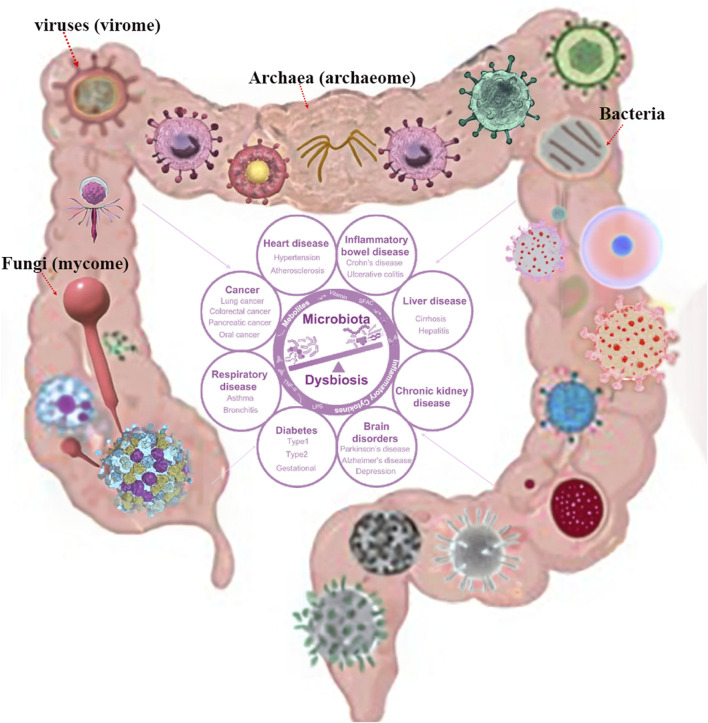 Figure 1
Peer Reviews
No public reviews on file for this paper yet. If you reviewed it on a platform where reviews are public (OpenReview, ICLR, NeurIPS, ICML), you can paste yours below so the community can read it here.
Videos
No videos yet. Explain this paper in a talk, walkthrough, or lecture? Add one.
Taxonomy
TopicsGastrointestinal disorders and treatments · Bacteriophages and microbial interactions · Diagnosis and treatment of tuberculosis
The gastrointestinal (GI) tract is a complex ecosystem containing bacteria, viruses (virome), fungi (mycome), and archaea (archaeome). It plays a significant role in ecological functioning, evolutionary changes, and host-microbiome interactions (Ogilvie and Jones, 2017; Daliri et al., 2020; Piewngam et al., 2020; Vemuri et al., 2020). Recent advances in sequencing technologies and metagenomic approaches have expanded our comprehension of the gastrointestinal-microbiome axis and its roles in maintaining gut homeostasis, health, and disease (Lepage et al., 2013; Gao et al., 2021; Lau and Yu, 2022). While bacteria have been extensively studied, the virome, mycome, and archaeome have recently gained attention. The human gut virome varies between individuals, composition and dynamics (Minot et al., 2011; Foca et al., 2015). They play a crucial role in gut regulation and contributing to disease development through interactions with the microbiota and immune cells (Ogilvie and Jones, 2017; Santiago-Rodriguez and Hollister, 2019; Hou et al., 2022; Tiamani et al., 2022). The gut mycobiome also plays a critical role in human health and disease, with potential implications for infants, obesity, inflammatory bowel disease (IBD) and neurodegenerative diseases (Forbes et al., 2018; Jain et al., 2021). The archaeome, a diverse and potentially important component of human gut host-associated microbiomes, plays an important role in gut physiology and health, in shaping the health and fitness of the animals (Gaci et al., 2014; Lurie-Weinberger and Gophna, 2015; Borrel et al., 2020; Kim et al., 2020). Studies have shown that Archaea play a key role in the pathogenesis of IBD and the risk of pediatric asthma (Barnett et al., 2019; Singh et al., 2023). However, their role in human health remains poorly understood, therefore, understanding these microbial communities offers new therapeutic approaches for GI disorders and enhances strategies for improving GI health as shown in Figure 1.
The aim of the editorial “The intricate web of gastrointestinal virome, mycobiome, and archaeome: implications for gastrointestinal diseases” is to explore the roles and interactions of the gastrointestinal microbiome in relation to gastrointestinal diseases. The objectives include reviewing current research on these microbial communities, discussing their implications for gastrointestinal health, highlighting potential therapeutic implications, and fostering a deeper understanding among healthcare professionals and researchers and suggest avenues for future research and clinical application in this evolving field. Recent studies have shown that, Postherpetic Neuralgia (PHN) is a chronic neuropathic pain syndrome caused by Herpes Zoster virus (HZV) reactivation, and it is more common in older and immunocompromised individuals, and vaccination is effective in preventing complications (Oxman et al., 2005; Mallick-Searle et al., 2016; Ferreira Sampaio et al., 2023). Additionally, it has been shown that HSV patients with peptic ulcer disease may be at a greater risk for developing PHN due to impaired cellular immunity and low nutritional status (Chen et al., 2013). Zhimin et al. have reported that the causal effect between HZV and PHN and the gut microbiota using bidirectional two-sample Mendelian randomization (MR) analysis. The study revealed the alterations in gut microbiota may influence susceptibility to HSV and the development of PHN. This research highlights the potential for specific gut microbiota to serve as a therapeutic target, offering new avenues for the prevention and treatment of viral infections and associated chronic conditions. This study highlights the importance of considering the gut microbiota not just in isolation but as a critical component in the overall immune response and susceptibility to viral infections. By understanding these causal relationships, new therapeutic strategies could be developed, focusing on modulating the gut microbiota to prevent or mitigate the effects of HSV associated PHN. Additionally, Hanjing et al. carried out the study in China (Jinjiang, Fujian), and reported the interactions between Helicobacter pylori, chronic gastritis, and the gut microbiota. They demonstrate that how Helicobacter. pylori infection and chronic gastritis are intricately linked with changes in gut microbiota composition. These findings emphasize the need for a comprehensive approach in managing Helicobacter. pylori infections and gastritis, considering their impact on the overall gut microbiota health. Moreover, gut microbiome-associated metabolites in serum can accurately distinguish colorectal cancer and adenomas from normal samples (Chen et al., 2022). Also, another study profiled the serum antibody responses of 997 healthy individuals against 244,000 peptide antigens derived from gut microbiota, data indicated that the serum antibody repertoires displayed high diversity and stability against human microbiota and identified several factors influencing the serum antibody response, such as age, gender, body mass index, and geographical location. These findings shed light on the role of the immune system in maintaining homeostasis with the gut microbiota (Vogl et al., 2021). Chen et al. present a differential analysis of serum immunology and gut microbiota in patients suffering from various gastrointestinal diseases. The study identifies distinct immunological and microbiota profiles associated with specific GI conditions, providing valuable insights into the interplay between the immune system and gut microbiota. This research highlights the potential for personalized medicine approaches in GI, tailoring treatments to the unique microbiota like recent report has shown that smart antibiotic (Lolamicin) can target a group of harmful microbes but does not disturb those that live peacefully in the gut (Munoz et al., 2024). Furthermore, Xiao et al. examine the causal relationship between the gut microbiome and liver cirrhosis through a bi-directional two-sample Mendelian randomization analysis. The results highlight significant causal links, suggesting that specific alterations in the gut microbiome may contribute to the development of liver cirrhosis. This study points out the importance of considering gut microbiota health in the prevention and management of liver diseases. Also, other evidence has shown that gut microbiome plays a significant role in liver disorders, potentially contributing to disease process and severity. Prebiotics and probiotics may be effective treatments for complications and liver cirrhosis. Additionally, the gut-liver axis plays a crucial role in liver disease, and progressive changes in the gut microbiome accompany cirrhosis. It became more severe in the setting of decompensation, with the cirrhosis dysbiosis ratio being a useful quantitative index (Bajaj et al., 2014; Giannelli et al., 2014; Qin et al., 2014; Tilg et al., 2016; Albillos et al., 2020; Li et al., 2022). This issue opens a new avenue for preventive strategies and therapeutic interventions aimed at modulating the gut microbiome to improve health and patient quality of life.
Conclusion
The intricate interplay between the gut microbiota, virome, mycome, and archaeome has profound implications for GI diseases and these studies provide a foundation for future research and potential therapeutic innovations. This editorial reveals how these microbial communities influence conditions such as HSV, chronic gastritis, liver cirrhosis and emphasize the potential of targeting gut microbiota for therapeutic interventions. Understanding the intricate web of these microorganisms opens new avenues for personalized medicine, aiming to improve GI health through advanced sequencing technologies and metagenomic analyses (Brim et al., 2017; Liang et al., 2017). We hope this issue inspires further exploration into the intricate web of the GI ecosystem and its impact on health, fostering a deeper understanding that can translate into better clinical practices and holds vast potential for unlocking new paradigms in the treatment and management of gastrointestinal diseases to improve patient outcomes.
The reference list from the paper itself. Each links out to its DOI / PubMed record.
- 1Albillos A.de Gottardi A.Rescigno M. (2020). The gut-liver axis in liver disease: pathophysiological basis for therapy. J. Hepatol. 72, 558–577. 10.1016/j.jhep.2019.10.003 31622696 · doi ↗ · pubmed ↗
- 2Bajaj J. S.Heuman D. M.Hylemon P. B.Sanyal A. J.White M. B.Monteith P. (2014). Altered profile of human gut microbiome is associated with cirrhosis and its complications. J. Hepatol. 60, 940–947. 10.1016/j.jhep.2013.12.019 24374295 PMC 3995845 · doi ↗ · pubmed ↗
- 3Barnett D. J. M.Mommers M.Penders J.Arts I. C. W.Thijs C. (2019). Intestinal archaea inversely associated with childhood asthma. J. Allergy Clin. Immunol. 143, 2305–2307. 10.1016/j.jaci.2019.02.009 30796982 · doi ↗ · pubmed ↗
- 4Borrel G.Brugere J. F.Gribaldo S.Schmitz R. A.Moissl-Eichinger C. (2020). The host-associated archaeome. Nat. Rev. Microbiol. 18, 622–636. 10.1038/s 41579-020-0407-y 32690877 · doi ↗ · pubmed ↗
- 5Brim H.Yooseph S.Lee E.Sherif Z. A.Abbas M.Laiyemo A. O. (2017). A microbiomic analysis in african Americans with colonic lesions reveals Streptococcus sp.VT 162 as a marker of neoplastic transformation. Genes (Basel) 8, 314. 10.3390/genes 8110314 29120399 PMC 5704227 · doi ↗ · pubmed ↗
- 6Chen F.Dai X.Zhou C. C.Li K. X.Zhang Y. J.Lou X. Y. (2022). Integrated analysis of the faecal metagenome and serum metabolome reveals the role of gut microbiome-associated metabolites in the detection of colorectal cancer and adenoma. Gut 71, 1315–1325. 10.1136/gutjnl-2020-323476 34462336 PMC 9185821 · doi ↗ · pubmed ↗
- 7Chen J. Y.Chang C. Y.Lan K. M.Sheu M. J.Lu C. L.Hu M. L. (2013). Is peptic ulcer disease a risk factor of postherpetic neuralgia in patients with herpes zoster? Med. Hypotheses 81, 834–838. 10.1016/j.mehy.2013.09.007 24074834 · doi ↗ · pubmed ↗
- 8Daliri E. B.Ofosu F. K.Chelliah R.Lee B. H.Oh D. H. (2020). Health impact and therapeutic manipulation of the gut microbiome. High. Throughput 9, 17. 10.3390/ht 9030017 32751130 PMC 7564083 · doi ↗ · pubmed ↗