The chloroplast genome structure of Turpinia affinis (Staphyleaceae)
Mei Zhang, Shun Yu, Roujun Wang, Shibiao Pu

TL;DR
This paper reports the chloroplast genome of Turpinia affinis, a plant used in traditional medicine, and clarifies its evolutionary relationship with other Turpinia species.
Contribution
The study provides the first chloroplast genome sequence for T. affinis and establishes its phylogenetic position within the genus.
Findings
The chloroplast genome of T. affinis is 160,769 base pairs long with a GC content of 37.3%.
T. affinis is the sister taxon to a clade containing other Turpinia species.
The genome contains 131 annotated genes, including 86 protein-coding genes.
Abstract
The species Turpinia affinis Merr. et Perry 1941 is widely distributed throughout southwestern China. In folk medicine, this species is often used as a substitute for the Chinese medicine Turpiniae Folium, whose legal origin is T. arguta (Lindl.) Seem. In order to ascertain the relationship between these two species, the chloroplast genome of T. affinis was aequenced and assembled, resulting in a typical quadripartite molecule with a length of 160,769 base pairs and an overall GC content of 37.3%. Additionally, 131 genes were annotated, comprising 86 protein-coding genes, 37 tRNA genes, and 8 rRNA genes. A maximum likelihood analysis demonstrated that the Turpinia species form a monophyletic clade, with T. affinis positioned as the sister taxon to the clade comprising the remaining species within the genus. This outcome enhances the genomic data for the genus Turpinia and will…
Genes, proteins, chemicals, diseases, species, mutations and cell lines named across the full text — each resolved to its canonical identifier and authoritative record.
Click any figure to enlarge with its caption.
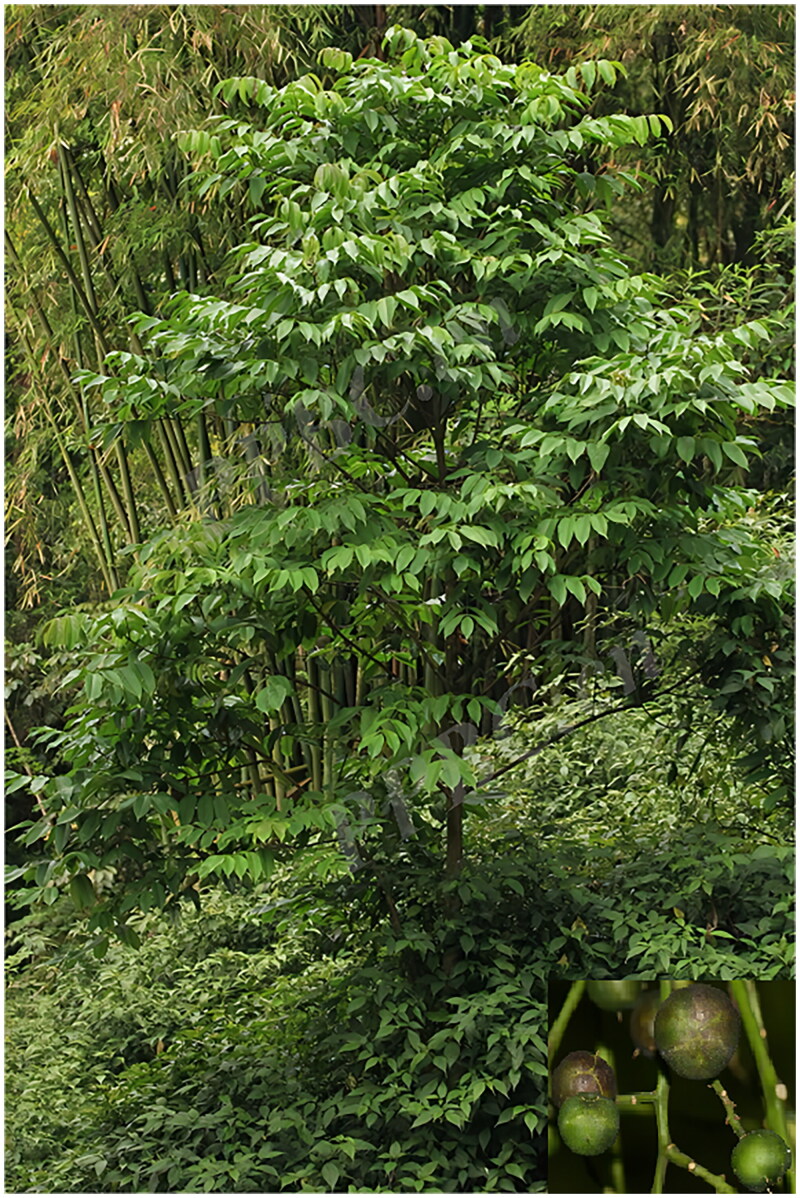 Figure 1
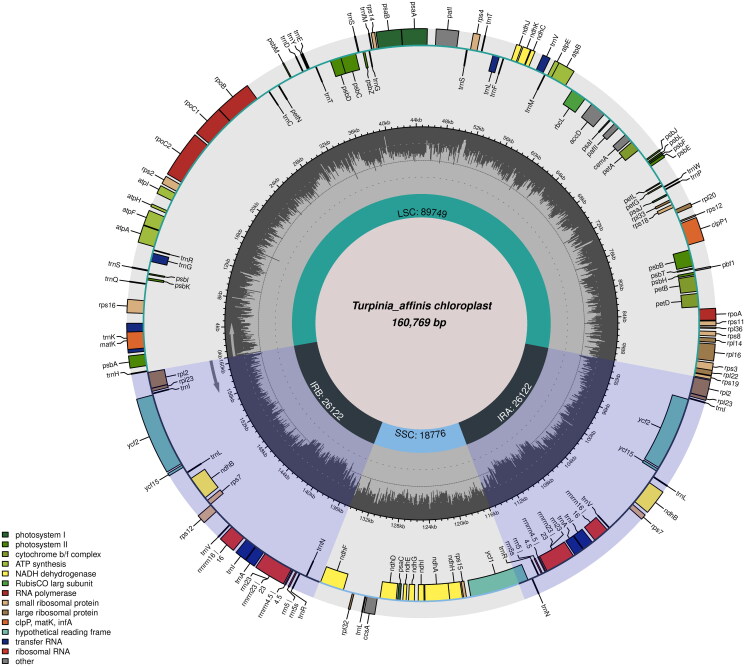 Figure 2
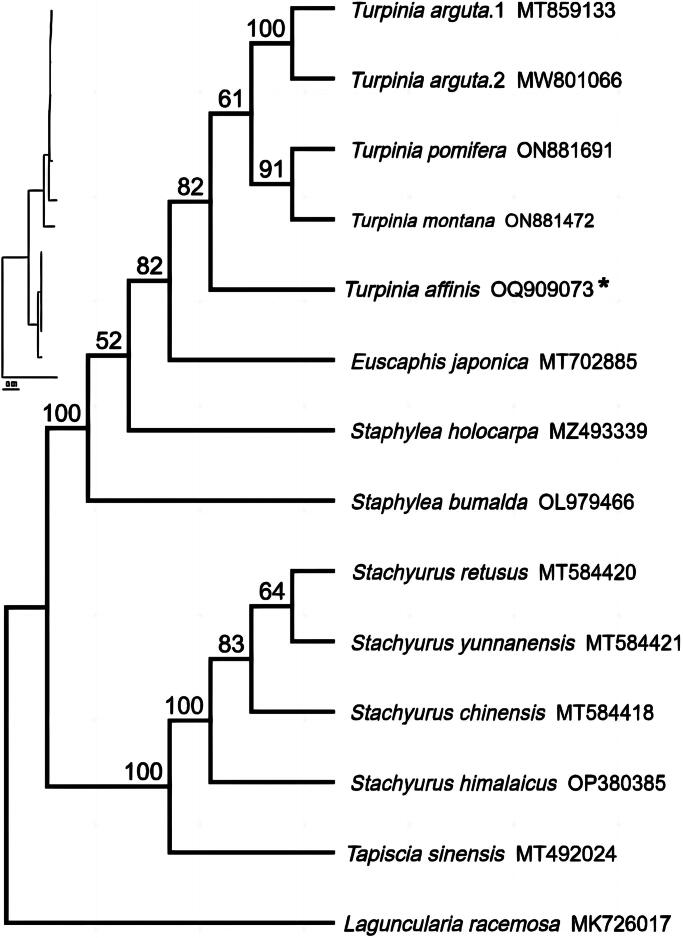 Figure 3
Peer Reviews
No public reviews on file for this paper yet. If you reviewed it on a platform where reviews are public (OpenReview, ICLR, NeurIPS, ICML), you can paste yours below so the community can read it here.
Videos
No videos yet. Explain this paper in a talk, walkthrough, or lecture? Add one.
Taxonomy
TopicsBotanical Research and Chemistry · Plant Taxonomy and Phylogenetics · Plant and fungal interactions