Novel Gammapapillomavirus type in the nasal cavity of a wild red colobus (Piliocolobus tephrosceles)
Taylor E. Weary, Kavi P. M. Mehta, Tony L. Goldberg

TL;DR
A new type of papillomavirus was found in the nasal cavity of a wild red colobus monkey in Uganda, expanding our understanding of these viruses in nonhuman primates.
Contribution
The discovery of PtepPV1, the first nonhuman primate Gammapapillomavirus in the nasal cavity, expands the host range and biological characteristics of these viruses.
Findings
PtepPV1 has a genome of 6576 bases with canonical early and late ORFs typical of gammapapillomaviruses.
The virus shares 81.0% similarity with HPV-mSK_118 in the L1 gene at the amino acid level.
PtepPV1 exhibits genomic features linked to high-risk oncogenic papillomaviruses, such as E7 gene motifs.
Abstract
Papillomaviruses (PVs) are double-stranded, circular, epitheliotropic DNA viruses causing benign warts (papillomas) or inducing dysplasia that can progress to cancer. Although they have been identified in all vertebrate taxa, most classified types are human PVs (HPVs); relatively little is known about PVs in other species. Here we characterize a novel Gammapapillomavirus type, PtepPV1, from a nasal swab of a wild red colobus (Piliocolobus tephrosceles) in Kibale National Park, Uganda. The virus has a genome of 6576 bases, encoding the seven canonical early (E) ORFs (E6, E7, E1, E2, E4, E1^E4 and E8^E2) and two late (L) ORFs (L1 and L2) of the gammapapillomaviruses, and is 81.0% similar to HPV-mSK_118, detected in a cutaneous wart from an immunocompromised human patient, in the L1 gene at the amino acid level. Alphapapillomaviruses (genus Alphapapillomavirus) cause anogenital carcinomas…
Genes, proteins, chemicals, diseases, species, mutations and cell lines named across the full text — each resolved to its canonical identifier and authoritative record.
Click any figure to enlarge with its caption.
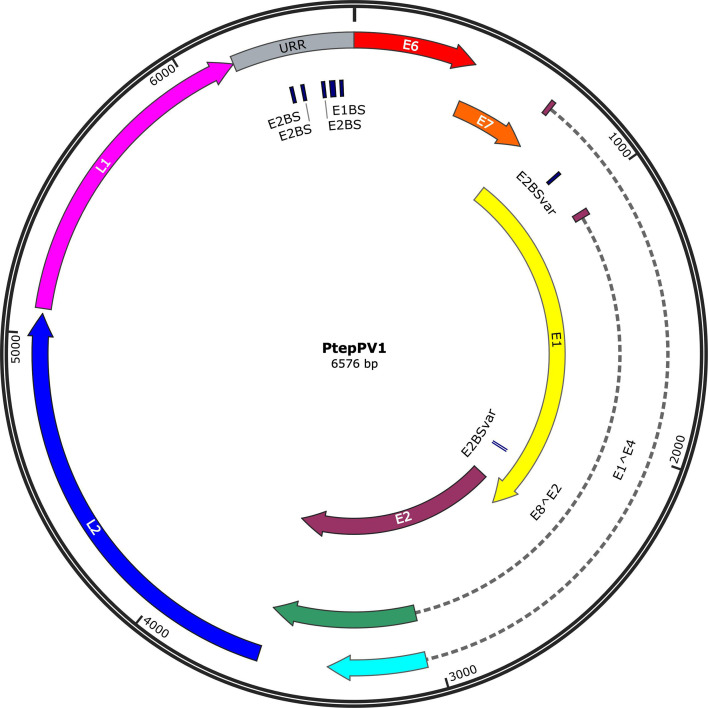 Figure 1
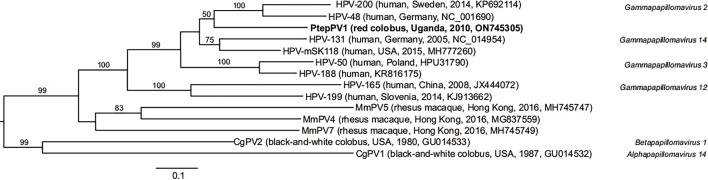 Figure 2
Peer Reviews
No public reviews on file for this paper yet. If you reviewed it on a platform where reviews are public (OpenReview, ICLR, NeurIPS, ICML), you can paste yours below so the community can read it here.
Videos
No videos yet. Explain this paper in a talk, walkthrough, or lecture? Add one.
Taxonomy
TopicsIdentification and Quantification in Food · Cervical Cancer and HPV Research · Microbial infections and disease research