The neuroanatomical organization of the hypothalamus is driven by spatial and topological efficiency
Nathan R. Smith, Shabeeb Ameen, Sierra N. Miller, James M. Kasper, Jennifer M. Schwarz, Jonathan D. Hommel, Ahmad Borzou

TL;DR
The hypothalamus organizes itself based on efficiency in both spatial arrangement and network connectivity.
Contribution
The study shows that the hypothalamus balances spatial and topological efficiency in its anatomical organization.
Findings
The sum of distances between hypothalamic sub-regions is not minimal but becomes highly efficient when weighted by connectivity strength.
The hypothalamus achieves topological efficiency comparable to optimized random configurations.
Both spatial and network-based constraints shape the organization of the hypothalamus.
Abstract
The hypothalamus in the mammalian brain is responsible for regulating functions associated with survival and reproduction representing a complex set of highly interconnected, yet anatomically and functionally distinct, sub-regions. It remains unclear what factors drive the spatial organization of sub-regions within the hypothalamus. One potential factor may be structural connectivity of the network that promotes efficient function with well-connected sub-regions placed closer together geometrically, i.e., the strongest axonal signal transferred through the shortest geometrical distance. To empirically test for such efficiency, we use hypothalamic data derived from the Allen Mouse Brain Connectivity Atlas, which provides a structural connectivity map of mouse brain regions derived from a series of viral tracing experiments. Using both cost function minimization and comparison with a…
Genes, proteins, chemicals, diseases, species, mutations and cell lines named across the full text — each resolved to its canonical identifier and authoritative record.
Click any figure to enlarge with its caption.
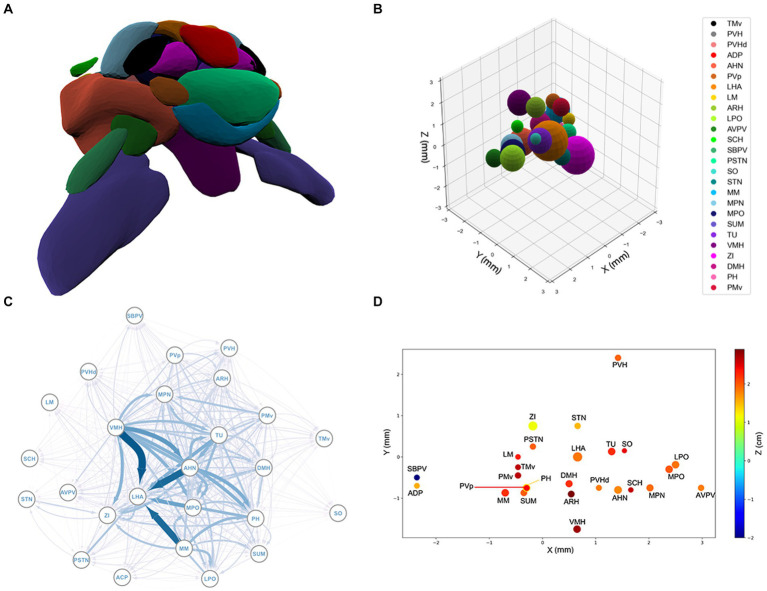 Figure 1
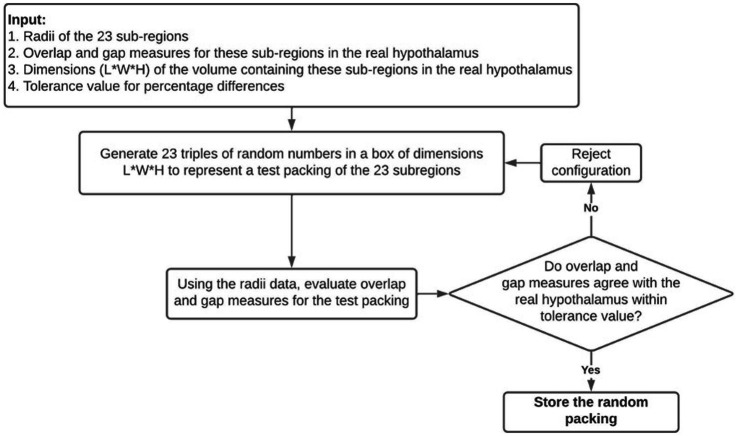 Figure 2
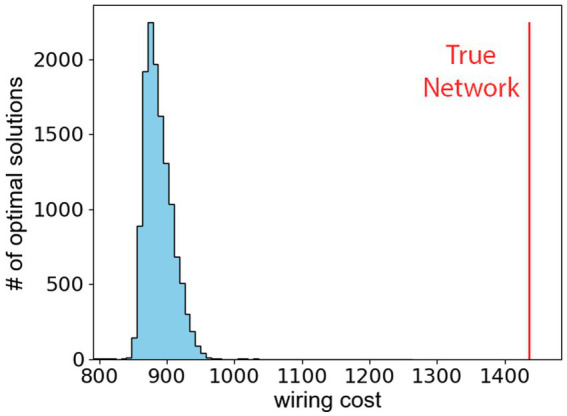 Figure 3
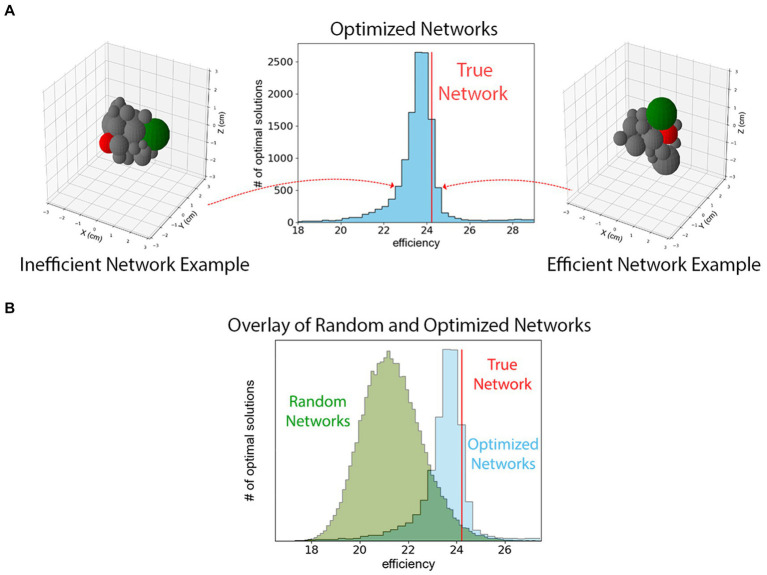 Figure 4
Peer Reviews
No public reviews on file for this paper yet. If you reviewed it on a platform where reviews are public (OpenReview, ICLR, NeurIPS, ICML), you can paste yours below so the community can read it here.
Videos
No videos yet. Explain this paper in a talk, walkthrough, or lecture? Add one.
Taxonomy
TopicsPrimate Behavior and Ecology · Neural dynamics and brain function · Olfactory and Sensory Function Studies