Twelve tips for starting and organizing a local Brain Bee anywhere
Ernesto Navarro Garcia, Sebastian Leon, Gabrielle Walcott-Bedeau, Amelia Adcock, Leandra Fernandes Procópio, Alba Peris-Yague

TL;DR
The Brain Bee is a neuroscience competition for high school students that promotes STEM engagement through exams and interactive learning.
Contribution
This paper provides 12 practical tips for starting and organizing a local Brain Bee chapter to ensure its success and sustainability.
Findings
Local Brain Bees help students explore neuroscience through exams, lab practicals, and oral competitions.
The program fosters confidence and STEM connections among high school students.
Tips are offered to ensure safe and effective operation of Brain Bee chapters.
Abstract
The Brain Bee serves as an international platform providing high school students with opportunities for undergraduate and graduate-level education in neuroscience. This annual competition welcomes participation from high school students and schools, fostering both individual- and team-based competition in a dynamic and engaging manner. The assessment involves a primary multiple-choice and short-answer exam, a secondary neuroanatomical lab practical exam, and a final oral exam administered by affiliated faculty or coordinators. During the final oral exam, the top ten students are given three chances and simultaneously respond to the same question. They write their answers on individual whiteboards until only one student remains. This unique format not only adds an element of excitement, but also allows students to build confidence within themselves and connections within STEM fields. The…
Genes, proteins, chemicals, diseases, species, mutations and cell lines named across the full text — each resolved to its canonical identifier and authoritative record.
Click any figure to enlarge with its caption.
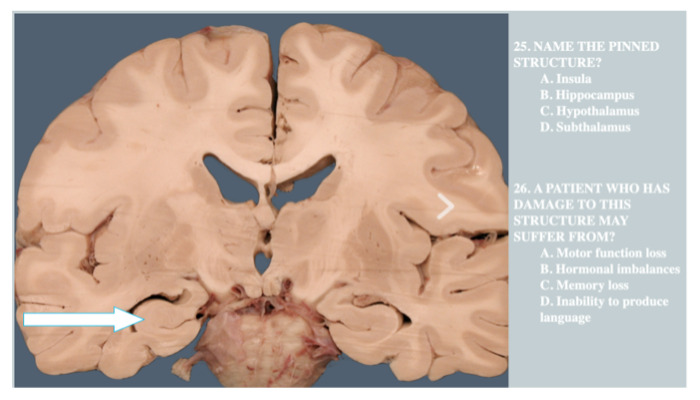 Figure 1
Peer Reviews
No public reviews on file for this paper yet. If you reviewed it on a platform where reviews are public (OpenReview, ICLR, NeurIPS, ICML), you can paste yours below so the community can read it here.
Videos
No videos yet. Explain this paper in a talk, walkthrough, or lecture? Add one.
Taxonomy
TopicsNeuroscience, Education and Cognitive Function