Introducing field-programmable gate arrays in genotype phasing and imputation
Lars Wienbrandt, David Ellinghaus

TL;DR
This paper introduces an FPGA-accelerated version of EagleImp, a tool for genotype phasing and imputation, significantly speeding up the process without sacrificing quality.
Contribution
The novel use of FPGAs to accelerate genotype phasing and imputation, achieving up to 93% faster performance.
Findings
FPGA acceleration improves EagleImp's performance by up to 93%.
Phasing and imputation quality remains unchanged with FPGA acceleration.
Users can now trade computation time for better quality using more resource-intensive settings.
Abstract
We recently developed EagleImp, a free software that combines genotype phasing and imputation in a single tool. By introducing algorithmic and technical improvements we accelerated the classical two-step approach using Eagle2 and PBWT. Here, we demonstrate how to use field-programmable gate arrays (FPGAs) to accelerate EagleImp even further by a factor of up to 93% without loss of phasing and imputation quality. Due to the speed advantage over a not accelerated processor-based implementation, the FPGA extension of EagleImp allows the user to choose a more resource-intensive parameter setting in exchange for computation time to further improve phasing and imputation quality. EagleImp and its FPGA extension are freely available at https://github.com/ikmb/eagleimp and https://github.com/ikmb/eagleimp-fpga.
Genes, proteins, chemicals, diseases, species, mutations and cell lines named across the full text — each resolved to its canonical identifier and authoritative record.
Click any figure to enlarge with its caption.
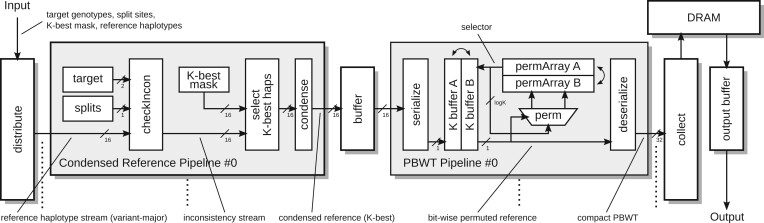 Figure 1
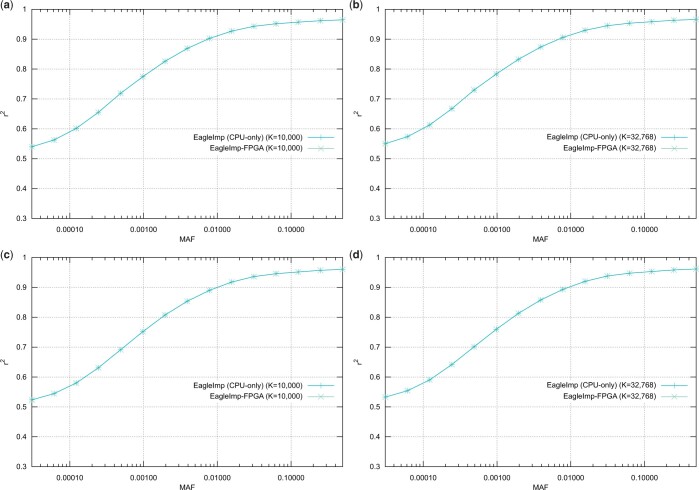 Figure 2
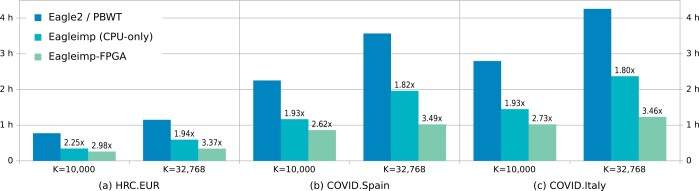 Figure 3
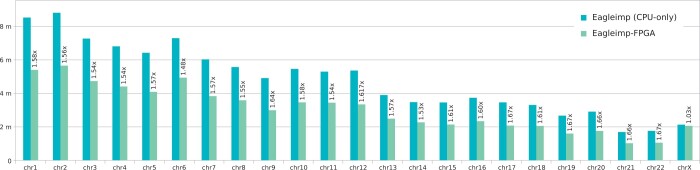 Figure 4
Peer Reviews
No public reviews on file for this paper yet. If you reviewed it on a platform where reviews are public (OpenReview, ICLR, NeurIPS, ICML), you can paste yours below so the community can read it here.
Videos
No videos yet. Explain this paper in a talk, walkthrough, or lecture? Add one.
Taxonomy
TopicsGene expression and cancer classification · Evolutionary Algorithms and Applications · Genomics and Chromatin Dynamics