The complete chloroplast genome sequence and phylogenetic analysis of Tragopogon pratensis L. (Asteraceae)
Xin-xue Zhang, Jianhu Zhang, Peng Wan, Hua Liu

TL;DR
This paper reports the full chloroplast genome of Tragopogon pratensis and shows it is closely related to T. dubius within a single evolutionary lineage.
Contribution
The first complete chloroplast genome sequence for Tragopogon pratensis and its phylogenetic placement within the genus.
Findings
The chloroplast genome of T. pratensis is 153,002 bp long with typical quadripartite structure.
Phylogenetic analysis shows T. pratensis is most closely related to T. dubius.
Tragopogon is confirmed as a monophyletic genus based on chloroplast genome data.
Abstract
Currently, the phylogenetic relationships of Tragopogon pratensis Linnaeus (1753) remain unclear. This study presents the first report on the complete chloroplast genome of T. pratensis, which is a quadripartite structure with a length of 153,002 bp and containing a large single copy (LSC, 84,225 bp) region, a small single copy (SSC, 18,407 bp) region, a pair of inverted repeats (IR, 25,185 bp) regions. A total of 134 genes are identified, including 87 protein-coding genes, 8 rRNA genes, 37 tRNA genes, and 2 pseudogenes. Phylogenetic analysis revealed that T. pratensis is most closely related to T. dubius and that Tragopogon is a monophyletic genus.
Genes, proteins, chemicals, diseases, species, mutations and cell lines named across the full text — each resolved to its canonical identifier and authoritative record.
Click any figure to enlarge with its caption.
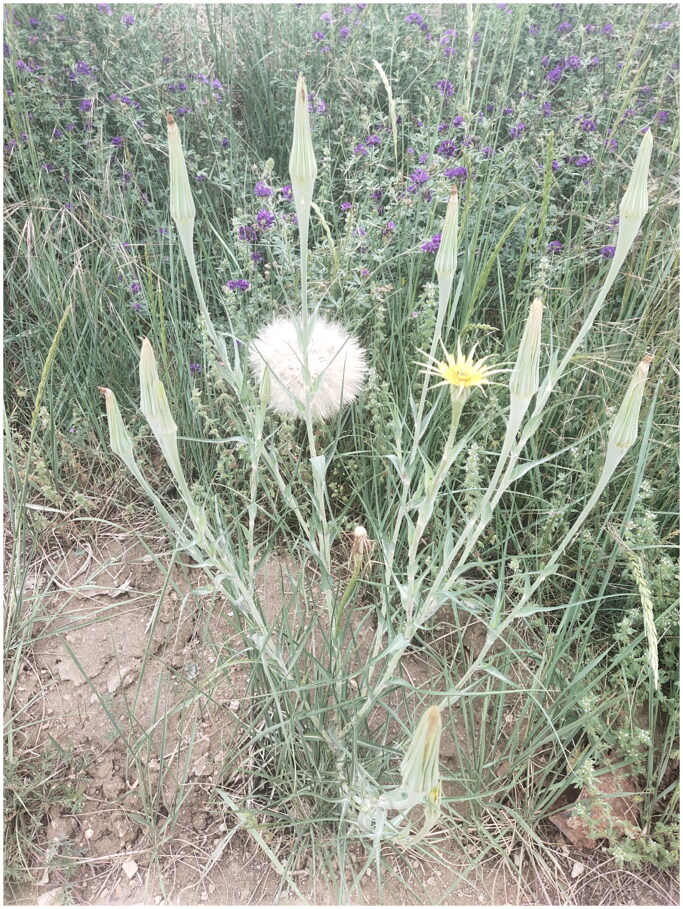 Figure 1
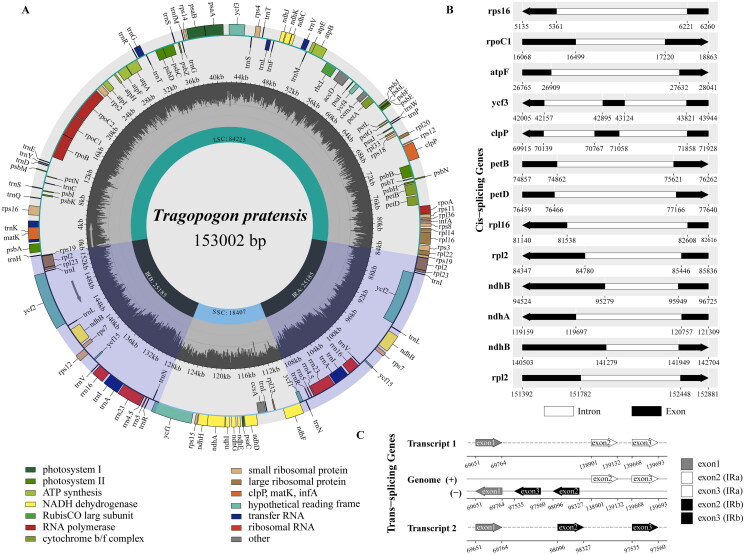 Figure 2
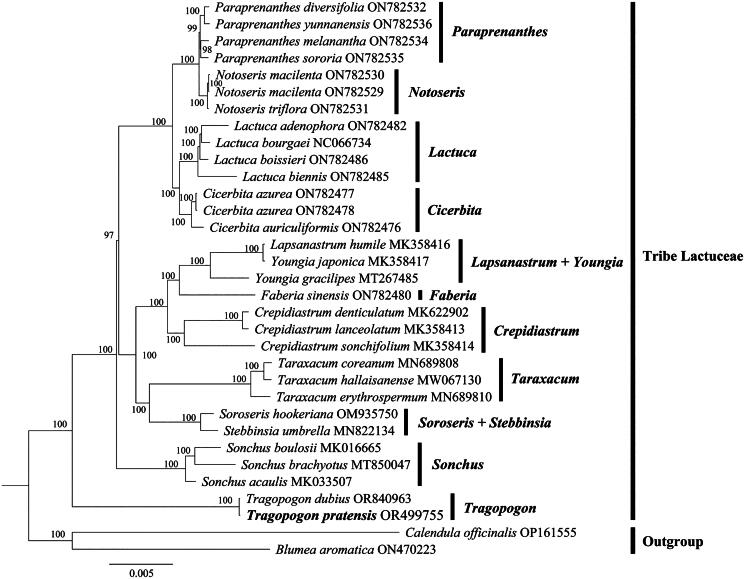 Figure 3
- —Independent Innovation in Agricultural Science and Technology of Ningxia Hui Autonomous Region-Research
- —Demonstration of Key Technologies for Utilization and Industrialization of Traditional Chinese Medicine Resources for Ecological Restoration in Central Arid Zones
Peer Reviews
No public reviews on file for this paper yet. If you reviewed it on a platform where reviews are public (OpenReview, ICLR, NeurIPS, ICML), you can paste yours below so the community can read it here.
Videos
No videos yet. Explain this paper in a talk, walkthrough, or lecture? Add one.
Taxonomy
TopicsSesquiterpenes and Asteraceae Studies · Phytochemistry and Biological Activities · Essential Oils and Antimicrobial Activity
Introduction
Tragopogon pratensis Linnaeus (1753), which belongs to the tribe Lactuceae in the family Asteraceae, is typically a biennial species but occasionally exhibits a perennial habit. It is native to Europe and North Africa and is commonly found on roadside verges, dikes, and ruderal places with varying soil types ranging from clay to sand and gravel (Qi et al. 1996, Mölken et al. 2005). Tragopogon pratensis is a monocarpic grassland species that does not propagate vegetatively nor does it form a persistent seed bank. It flowers from late May until the end of July and dies after producing seeds (Jorritsma-Wienk et al. 2007). Although T. pratensis is a diploid species, its phylogenetic relationships with T. pratensis remain unclear. Therefore, our study aims to confirm the phylogenetic relationships by reporting its complete chloroplast genome for the first time, thereby offering novel insights into its phylogenetic relationships.
Materials and methods
Fresh young leaves of T. pratensis are collected from the wild at Guyuan (106°17′ E, 35°72′ N), Ningxia, China (Figure 1), and they are dried using silica gel. Voucher specimens are deposited at Guyuan Branch, Ningxia Academy of Agricultural and Forestry Sciences (voucher specimens: zxx001, contact person: Xin-xue Zhang [email protected]). Genomic DNA is extracted by the modified cetyltrimethylammonium bromide (CTAB) method (Doyle and Doyle 1987) which is from approximately 20 mg of silica gel-dried leaf tissues. Subsequently, a paired-end (150 bp) DNA library with an insert size of approximately 400 bp is constructed using a TruSeq DNA Sample Prep Kit (Illumina, Inc., San Diego, CA, USA). The library is then sequenced on the Illumina Xten platform at BioMarker (Beijing, China), generating approximately 67.2 Mb reads and 10.0 Gb bases.
The morphological characteristics of T. pratensis. The photographs were taken by Xin-xue Zhang at guyuan (106°17′ E, 35°72′N), Ningxia, China.
The complete chloroplast genome of T. pratensis is de novo assembled using GetOrganelle toolkit (Jin et al. 2020) with the default parameters, while the complete chloroplast genome of T. dubius (OR840963.1)(Unpublished) is selected as a reference genome. To evaluate sequencing depth and coverage, BWA (Li and Durbin 2009) is employed to map the reads to reference sequence, and the depth and coverage are examined by SAMtools (Li and Durbin 2009). The high coverage and mean depth are 99.89% and 3948.3×, respectively (Figure S1). Subsequently, annotation is carried out on CPGAVAS2 online (Shi et al. 2019), followed by the generation of a circular map of T. pratensis using the CPGView online tool (Liu et al. 2023).
To determine the phylogenetic relationships of T. pratensis, we select 31 individuals from the tribe Lactuceae (Asteraceae) as ingroups, Calendula officinalis (OP161555.1, Unpublished) and Blumea aromatica (ON470223.1, Unpublished) are used as outgroups. Additionally, to test the phylogenetic relationships from different regions, we employ three datasets: (1) the complete chloroplast genome, (2) coding sequences (CDS), (3) concatenated from matK, rbcL, and trnH-psbA. The sequences are aligned using the MAFFT program (Katoh and Standley 2013). Subsequently, the phylogenetic tree is generated using IQ-TREE (Nguyen et al. 2015) through maximum likelihood (ML) method and the best-fit model of TVM + F + I + R4. In the phylogenetic tree analysis, 1000 replicates are performed to establish robust statistical support. Additionally, the SH-aLRT test (Chen et al. 2022) is employed to assess the branch support.
Results
The complete chloroplast genome of T. pratensis exhibited a typical quadripartite structure, with 153,002 bp and 37.7% GC content. It consisted of a large single copy (LSC, 84,225 bp) region, a small single copy (SSC, 18,407 bp) region, a pair of inverted repeats (IR, 25,185 bp) regions (Figure 2(A)). A total of 134 genes are annotated in the complete chloroplast genome of T. pratensis, comprising 87 protein-coding genes, 8 rRNA genes, 37 tRNA genes, and 2 pseudogenes. In addition, among these genes, nine unique protein protein-coding (rps16, rpoC1, atpF, petB, petD, rpl16, rpl2, ndhB, ndhA) contained only one intron each, but ycf3 and clpP genes with two introns (Figure 2(B)). Furthermore, rps12 gene was identified as trans-spliced gene, and two duplicated 3′ end exons in IR regions and one 5′ end exon in the LSC region (Figure 2(C)).
Schematic map of T. pratensis complete chloroplast genome (a), genes shown inside and outside the circle are transcribed clockwise and counterclockwise, respectively. Genes belonging to different functional groups are color coded. The GC and at contents are indicated by the dark grey and light grey colors in the inner circle, respectively. The structure of cis-splicing genes (B). The trans-splicing gene rps12 (C).
The phylogenetic trees exhibited different topologies which were constructed from three datasets. Phylogenetic analysis of the complete chloroplast genome, revealed that T. pratensis is most closely relative to T. dubius (BS = 100%), and it clustered within a single clade with T. dubius, indicating the monophyly of Tragopogon with a high bootstrap value (BS = 100%) (Figure 3). Additionally, the congruent conclusion is supported by the phylogenetic tree constructed using two datasets (Figure S2), respectively, where Tragopogon formed a monophyletic clade and T. pratensis is identified as the closest relative to T. dubius (BS = 100%).
Maximum likelihood (ML) phylogenetic tree based on complete chloroplast genome. The following sequences were used: Tragopogon pratensis OR499755 (this study), cicerbita auriculiformis ON782476 (Unpublished), C. azurea ON782477 (Unpublished), C. azurea ON782478 (Unpublished), crepidiastrum denticulatum MK622902 (Do et al. 2019), C. lanceolatum MK358413 (Nguyen et al. 2023), C. sonchifolium MK358414 (Unpublished), faberia sinensis ON782480 (Unpublished), lactuca adenophora ON782482 (Unpublished), L. biennis ON782485 (Unpublished), L. boissieri ON782486 (Unpublished), L. bourgaei NC066734 (Unpublished), lapsanastrum humile MK358416 (Unpublished), notoseris macilenta ON782529 (Unpublished), N. macilenta ON782530 (Unpublished), N. triflora ON782531 (Unpublished), paraprenanthes diversifolia ON782532 (Unpublished), P. melanantha ON782534 (Unpublished), P. sororia ON782535 (Unpublished), P. yunnanensis ON782536 (Unpublished), sonchus acaulis MK033507 (Cho et al. 2019), S. boulosii MK016665 (Kim et al. 2019), S. brachyotus MT850047 (Wang et al. 2021), soroseris hookeriana OM935750 (Unpublished), stebbinsia umbrella MN822134 (Lv et al. 2020), taraxacum coreanum MN689808 (Lee et al. 2020), T. erythrospermum MN689810 (Lee et al. 2020), T. hallaisanense MW067130 (Lee et al. 2021), T. dubius OR840963 (Unpublished), youngia gracilipes MT267485 (Unpublished), Y. japonica MK358417 (Unpublished), blumea aromatica ON470223 (Unpublished), calendula officinalis OP161555 (Unpublished).
Discussion and conclusion
In this study, the complete chloroplast genome of T. pratensis is a quadripartite structure with 153,002 bp, containing a large single copy (LSC) region, a small single copy (SSC) region, a pair of inverted repeats (IR) regions. This result is similar to other species in the tribe Lactuceae (Asteraceae), such as Soroseris umbrella and Ixeris repens (Lv et al. 2020; Lee et al. 2021). The present study ultimately furnishes evidence supporting the monophyly of Tragopogon, and the ITS data also suggested that Tragopogon was monophyletic (Soltis et al. 2023). Due to the limited availability of the complete chloroplast genome in the genus Tragopogon, further investigation is required to validate the monophyly of Tragopogon. Therefore, future studies should aim to increase the sample numbers to ensure the accuracy of its monophyletic.
Supplementary Material
Supplementary_Figure.docx
Figure S2.pdf
The reference list from the paper itself. Each links out to its DOI / PubMed record.
- 1Chen J, Zeng SJ, Zeng LY, Nguyen KS, Yan JW, Liu H, Xia NH. 2022. Parahellenia, a new genus segregated from Hellenia (Costaceae) based on phylogenetic and morphological evidence. Plant Divers. 44(4):389–405. doi:10.1016/j.pld.2022.02.001.35967252 PMC 9363654 · doi ↗ · pubmed ↗
- 2Cho MS, Yang JY, Yang TJ, Kim SC. 2019. Evolutionary comparison of the chloroplast genome in the woody Sonchus alliance (Asteraceae) on the Canary Islands. Genes. 10(3):217. doi:10.3390/genes 10030217.30875850 PMC 6470973 · doi ↗ · pubmed ↗
- 3Do HDK, Jung J, Hyun J, Yoon SJ, Lim C, Park K, Kim JH. 2019. The newly developed single nucleotide polymorphism (SNP) markers for a potentially medicinal plant, Crepidiastrum denticulatum (Asteraceae), inferred from complete chloroplast genome data. Mol Biol Rep. 46(3):3287–3297. doi:10.1007/s 11033-019-04789-5.30980269 · doi ↗ · pubmed ↗
- 4Doyle JJ, Doyle JL. 1987. A rapid DNA isolation procedure for small quantities of fresh leaf tissue. Phytochem Bull. 19:11–15.
- 5Jin JJ, Yu WB, Yang JB, Song Y, Depamphilis CW, Yi TS, Li DZ. 2020. Get Organelle: a fast and versatile toolkit for accurate de novo assembly of organelle genomes. Genome Biol. 21(1):241. doi:10.1186/s 13059-020-02154-5.32912315 PMC 7488116 · doi ↗ · pubmed ↗
- 6Jorritsma-Wienk LD, Ameloot E, Lenssen JPM, de Kroon H. 2007. Differential responses of germination and seedling establishment in populations of Tragopogon pratensis (Asteraceae). Plant Biol. 9(1):109–115. doi:10.1055/s-2006-924524.17058179 · doi ↗ · pubmed ↗
- 7Katoh K, Standley DM. 2013. MAFFT multiple sequence alignment software version 7: improvements in performance and usability. Mol Biol Evol. 30(4):772–780. doi:10.1093/molbev/mst 010.23329690 PMC 3603318 · doi ↗ · pubmed ↗
- 8Kim SH, Mejías JA, Kim SC. 2019. Next generation sequencing reveals the complete plastome sequence of newly discovered cliff-dwelling Sonchus boulosii (Asteraceae: cichorieae) in Morocco. Mitochondrial DNA Part B. 4(1):164–165. doi:10.1080/23802359.2018.1544865. · doi ↗