Nephrology: a flourishing field with plentiful emerging topics
Kyung Don Yoo, Chia-Ter Chao

Abstract
Genes, proteins, chemicals, diseases, species, mutations and cell lines named across the full text — each resolved to its canonical identifier and authoritative record.
Click any figure to enlarge with its caption.
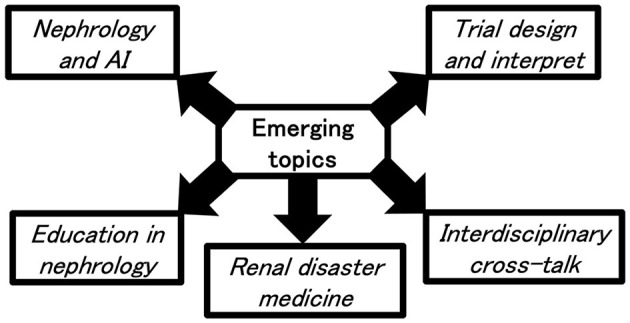 Figure 1
- —National Science and Technology Council10.13039/501100020950
- —Korean Society of Nephrology10.13039/501100014234
Peer Reviews
No public reviews on file for this paper yet. If you reviewed it on a platform where reviews are public (OpenReview, ICLR, NeurIPS, ICML), you can paste yours below so the community can read it here.
Videos
No videos yet. Explain this paper in a talk, walkthrough, or lecture? Add one.
Taxonomy
TopicsDiabetes Treatment and Management · Chronic Kidney Disease and Diabetes · Renal Diseases and Glomerulopathies
The word “nephrology”, the discipline that focuses on the biology and medical implications of studies surrounding the kidney, was first coined in 1960s based on the French word “néphrologie” and the Greek word “nephrós”. Our understandings of kidney biology evolve successively over time, from the elucidation of glomeruli, nephrons, and tubular physiology in the 19th century, to the understandings of kidney function measurement and kidney disease origins.1 Despite the expansion of relevant knowledge base, therapeutic approaches capable of retarding kidney disease progression remain quite limited; only renin-angiontensin system inhibitors (RASi) demonstrated impressive outcome-improving efficacy in randomized controlled trials (1, 2) two decades ago. Nowadays, encouraging advancements have been made in the nephrology field. We would like to briefly summarize these inspiring changes and provide personal accounts on important and emerging topics deserving particular attention in the future (Figure 1).
Impactful clinical trials and outcome diversification
We witness a rapid deployment of novel compounds for combating kidney diseases since 2015. Sodium-glucose cotransporter 2 inhibitors (SGLT2i) is among the first of its kind to exhibit renoprotective effects independent of its glycemic control capacity, as a class effect (3, 4). Subsequently, glucagon-like peptide-1 receptor agonists (GLP-1RA) (5) and newer generations of non-steroidal mineralocorticoid receptor antagonists (nsMRAs) (6) are also found to exhibit benefits in reducing the risk of composite renal outcomes in patients with chronic kidney disease (CKD). Through reducing glomerular hyperfiltration and intraglomerular pressure, optimizing afferent/efferent arteriole hemodynamics, conferring glomerular and tubular cellular metabolic benefits, attenuating kidney tissue hypoxia, these compounds pave the way toward engineering and testing the next generation of renoprotective agents (7). Aside from drugs reducing adverse kidney outcomes, there are also drugs approved for targeting immunopathology capable of managing distinct glomerulonephritis recently. Targeted release formulation of budesonide and sparsentan, an endothelin and angiotensin 2 type 1 receptor antagonist, have been shown to achieve proteinuria reduction among patients with IgA nephropathy (IgAN) (8). Small molecular and RNA-based complement inhibitors are promising candidates for ameliorating IgAN disease severities (9). These results lend support to the flourishing nature of kidney disease treatment regimens. Moreover, we can expect rising numbers of clinical trials evaluating nephrology treatments in the upcoming era. Nephrologists should familiarize themselves with the work of trialists and how to interpret trial findings, so as to select appropriate therapies for their patients. In addition, patient reported outcome measures (PROMs) gain momentum as key outcomes nephrologists should not overlook. Patients with kidney diseases may have significantly lower chance of PROM improvement compared to those without (10). Interventions aiming to increase ones' survival and chances of kidney preservation should not come at the price of worsening their symptom burden. We, at the meantime, look forward to accumulating evidence supporting softer outcomes of novel kidney disease treatments in the foreseeable future.
Crosstalk between nephrology and other disciplines
Another important field would be the intersections between nephrology and other scientific disciplines. A well-established example is geriatric nephrology, addressing the fundamentals of senescence, how an organism ages, and how to care for older adults. Existing studies have pinpointed the rising prevalence and incidence of geriatric syndromes in patients with CKD, including frailty, sarcopenia, cognitive dysfunction, and disability. Among these degenerative phenotypes, frailty deserves particular attention, as its pathogenesis intertwines with that of CKD and its adverse influences extend far beyond survival (11, 12). Identifying frailty followed by administering dedicated managements carries the potential of improving CKD patients' functional status and quality of life. Ameliorating uremic sarcopenia and malnutrition is also feasible through appropriate dietary counseling and exercise regimen prescription. Newer fields spawning from inter-disciplinary collaboration further include onconephrology, nephrocardiology, and nephro-palliative care (13). Nephrology as a discipline, builds on the development of physiology, pathology, and anatomy, but consolidates itself when maintenance dialysis is created and enters clinical practice. Thus, nephrology originates from the piecework of century-old human knowledge, grows incrementally and forms a firm scientific discipline, and now evolves further “into complexity” (14), partly assisted by the omic technology. Nephrology has now been transformed into a discipline that welcomes and actively encourages intimate collaborations with other scientific and medical fields.
Artificial intelligence (AI) applications in nephrology
AI significantly revolutionizes the modern medicine, as it provides an automated way to perform complex tasks with further enhancement enabled by self-learning from continuous data input. Nephrology researchers have been apt to incorporate AI into various aspects of this field. For instance, the Nephrotic Syndrome Study Network (NEPTUNE) group has already leveraged multi-layered analyses for kidney pathology classification and kidney disease progression risk prediction (15). The applications of AI have also been extended to evaluate and manage different diseases relevant to nephrology, such as gauging fluid balance among patients undergoing continuous renal replacement therapy (CRRT) (16), outcome prediction in peritoneal dialysis patients and kidney transplant recipients (17, 18). The ability of AI to handle complex, multidimensional data makes it particularly suitable for nephrology, a discipline with diverse influential factors interacting with each other. Other topics of nephrology in which AI has been deployed involve the optimization and individualization of dialysis prescription; healthcare records, wearable devices, and physiologic signals produced during dialysis sessions are utilized to estimate the probability of untoward medical event (19). Image reading in CKD-mineral bone disorder has also been automatized and accelerated with the assistance of AI technology (20). These topics vividly illustrate the speed of AI uptake as a tool in the research and clinical field of nephrology.
Education in nephrology
Nephrology workforce has been dwindling in multiple countries around the world, and how to increase different background trainees' interest in this discipline warrants serious attention. The search for a better education context, modality or route, and content to enhance learning efficacy assumes importance. Trainees may feel ill-prepared for the contemporary nephrology practice, especially when they are at the forefront of facing technology enabled practice innovation (21). How to uphold the value of nephrology specialty for to-be nephrologists and junior ones remains under-explored (22). This will require individualization of education approach throughout the course of training and potentially be accomplished through careful mentoring. However, literature in this topic is scarce and urgently needed.
Patients with CKD also have increasingly complex care needs, but exciting treatments were previously in lack. We now have new and further upcoming novel therapeutic choices for retarding CKD progression, but we need to intensify the spread of relevant knowledge through continuous professional development. High quality nephrology care for exceptionally complex patients at different settings cannot be achieved without successful teams led by well-educated nephrologists. Professional education focusing on fostering the continuous growth of nephrologists should take into account important education theories and preferences, as shown in prior examples (23). Let's not forget that nephrologists are frequently in work-life imbalances, as they are overwhelmed by the mounting clinical workload. We expect for more emphasis on studies designing creative strategies related to all stages of nephrology education from trainees to established specialists, and also team members. This will help the community build a stronger backbone and be resilient to more challenges ahead.
Disaster medicine in nephrology
Recently we have seen more and more natural and manmade disasters complicating the appropriate provision of nephrology care to affected patients worldwide. However, the establishment of timely response procedures is rarely emphasized or achieved. Earthquakes in South Korea, Japan, and Taiwan highlight the need for disaster preparedness in nephrology, particularly for hemodialysis units. Prior experiences suggested that effective disaster responses require both logistics and training (24). These responses include establishing clear protocols, maintaining emergency supplies, training staff in emergency procedures, and educating patients on disaster preparedness. Moreover, a coordinated response system involving local dialysis units, regional centers, and governmental agencies is crucial (24). The need for an enhanced preparedness is particularly important for regions with a high population density and a large number of dialysis population, such as Taiwan and South Korea. The potential impact of disasters on the provision of nephrology care is concerning, making robust disaster response plans more critical. Through implementing comprehensive preparedness measures, nephrology providers in high-risk regions can significantly improve their capacity to maintain continuity of care for vulnerable dialysis patients during disasters, saving lives and minimizing complications under challenging circumstances. The experience with COVID-19 underscores the need for nephrology care providers to develop and maintain specific protocols for managing infectious disease outbreaks (25). Such protocols may include measures for patient isolation, staff protection, continuity of dialysis services and proper vaccination (26).
Conclusion
Nephrology is experiencing renaissance, with exciting developments across multiple aspects. The presence of impactful clinical trials testing novel therapies, increasing opportunities for interdisciplinary collaboration, and the integration of artificial intelligence exemplify this promising trend. These advancements reshape our existing approach of nephrology care and how we conduct nephrology researches. Simultaneously, this discipline faces challenges in education and workforce development, necessitating innovative strategies to attract and retain talented members. The emerging focus on disaster medicine in nephrology, particularly in regions with high dialysis populations such as South Korea and Taiwan, highlights the need for robust preparedness plans. It is therefore crucial for practitioners to stay abreast of these developments and contribute to the growth of future nephrology. We warmly welcome potential candidates to submit relevant and impactful manuscript to this section for consideration.
Author contributions
KY: Conceptualization, Formal analysis, Funding acquisition, Investigation, Validation, Writing – original draft, Writing – review & editing. C-TC: Conceptualization, Data curation, Formal analysis, Funding acquisition, Investigation, Methodology, Project administration, Resources, Supervision, Validation, Visualization, Writing – original draft, Writing – review & editing.
The reference list from the paper itself. Each links out to its DOI / PubMed record.
- 1Brenner BM Cooper M Ede Zeeuw D Keane WF Mitch WE Parving HH. Effects of losartan on renal and cardiovascular outcomes in patients with type 2 diabetes and nephropathy. N Engl J Med. (2001) 345:861–9. 10.1056/NEJ Moa 01116111565518 · doi ↗ · pubmed ↗
- 2Lewis EJ Hunsicker LG Clarke WR Berl T Pohl MA Lewis JB. Renoprotective effect of the angitensin-receptor antagonist irbesartan in patients with nephropathy due to type 2 diabetes. N Engl J Med. (2001) 345:851–60. 10.1056/NEJ Moa 01130311565517 · doi ↗ · pubmed ↗
- 3Heerspink HJ Stefansson BV Correa-Rotter R Chertow GM Greene T Hou FF. Dapagliflozin in patients with chronic kidney disease with chronic kidney disease. N Engl J Med. (2020) 383:1436–46. 10.1056/NEJ Moa 202481632970396 · doi ↗ · pubmed ↗
- 4The EMPA-KIDNEY Collaborative Group Herrington WG Staplin N Wanner C Green JB Hauske SJ. Empagliflozin in patients with chronic kidney disease. N Engl J Med. (2023) 388:117–27. 10.1056/NEJ Moa 220423336331190 PMC 7614055 · doi ↗ · pubmed ↗
- 5Li X Song Y Guo T Xiao G Li Q. Effect of glucagon-like peptide 1 receptor agonists on the renal protection in patients with diabetes mellitus: a systematic review and meta-analysis. Diabetes Metab. (2022) 48:101366. 10.1016/j.diabet.2022.10136635760374 · doi ↗ · pubmed ↗
- 6Barrera-Chimal J Lima-Posada I Bakris GL Jaisser F. Mineralocorticoid receptor and antagonists in diabetic kidney disease – mechanistic and therapeutic effects. Nat Rev Nephrol. (2022) 18:56–70. 10.1038/s 41581-021-00490-834675379 · doi ↗ · pubmed ↗
- 7Sen T Heerspink HJL. A kidney perspective on the mechanism of action of sodium glucose co-transported 2 inhibitors. Cell Metab. (2021) 33:732–9. 10.1016/j.cmet.2021.02.01633691091 · doi ↗ · pubmed ↗
- 8Selvaskandan H Barratt J Cheung CK. Novel treatment paradigms: primary Ig A nephropathy. Kidney Int Rep. (2023) 9:203–13. 10.1016/j.ekir.2023.11.02638344739 PMC 10851020 · doi ↗ · pubmed ↗