Spinal Arachnoid Web
Maiya Smith, Morgan Ketterling, Alexander Gallaer, Rowan Kelner, Christine Raps, Allison M. Beaulieu

TL;DR
A 57-year-old man with upper back pain and numbness was diagnosed with a rare spinal condition called arachnoid web, which can be treated with surgery to prevent worsening symptoms.
Contribution
This case highlights the importance of recognizing spinal arachnoid web for timely surgical intervention.
Findings
Spinal arachnoid web was diagnosed through neurological exam and imaging.
Early surgical intervention can resolve symptoms and prevent neurological worsening.
Abstract
We describe a case of a 57-year-old male with multiple medical comorbidities who presented to the emergency department with a two-week history of upper back pain with associated numbness. Physical exam demonstrated sensory loss in a bilateral third and fourth thoracic dermatome distribution. The diagnosis of spinal arachnoid web was made based on neurological exam and imaging findings. Spinal arachnoid web is a rare diagnosis, but consideration is important, as early recognition and surgical intervention can resolve symptoms and prevent worsening neurological sequelae.
Genes, proteins, chemicals, diseases, species, mutations and cell lines named across the full text — each resolved to its canonical identifier and authoritative record.
Click any figure to enlarge with its caption.
 Image
ImagePeer Reviews
No public reviews on file for this paper yet. If you reviewed it on a platform where reviews are public (OpenReview, ICLR, NeurIPS, ICML), you can paste yours below so the community can read it here.
Videos
No videos yet. Explain this paper in a talk, walkthrough, or lecture? Add one.
Taxonomy
TopicsCerebrospinal fluid and hydrocephalus · Assisted Reproductive Technology and Twin Pregnancy · Pediatric Urology and Nephrology Studies
CASE PRESENTATION
A 57-year-old male with history of type II diabetes mellitus, renal transplant, coronary artery disease, and hypertension presented to the emergency department (ED) for numbness in his chest for two weeks, with associated upper back pain radiating to his chest bilaterally, and shortness of breath. He presented to an outpatient clinic for similar complaints one day prior and was started on a four-day course of prednisone for presumed pleurisy.
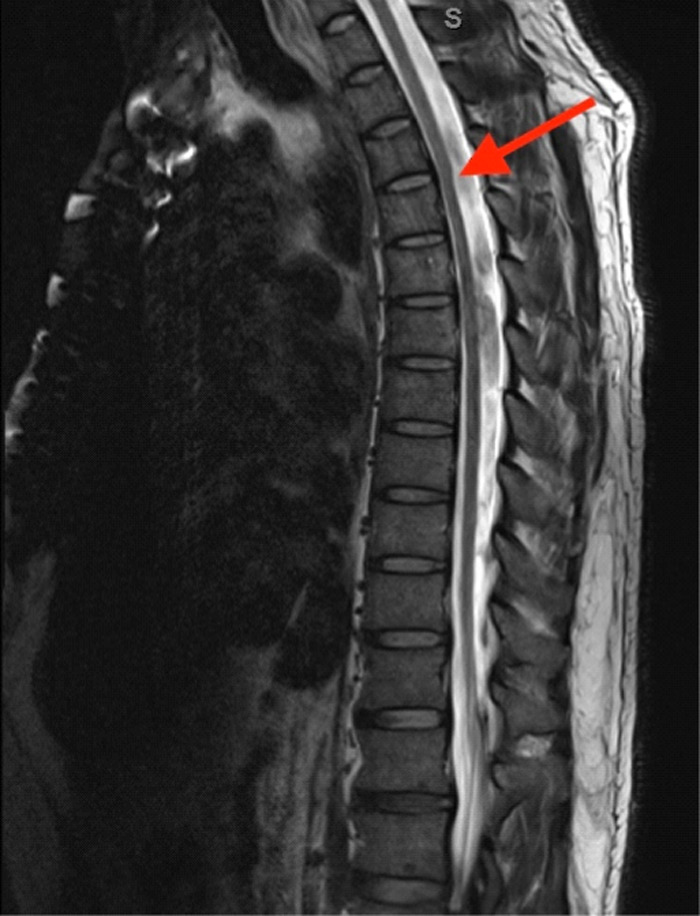
On examination in the ED, the patient was found to have decreased sensation in his third and fourth thoracic dermatome in a band-like distribution without additional neurologic deficits or skin findings. Magnetic resonance imaging (MRI) of the cervical and thoracic spine were obtained, showing a dorsal spinal arachnoid web (SAW) with slight compression of the spinal cord located at the third and fourth thoracic levels (Image, Video).
Magnetic resonance imaging with and without contrast showing focal anterior displacement of the thoracic spinal cord at the third and fourth thoracic levels (arrow). In the setting of a prominent dorsal subarachnoid space with altered cerebrospinal fluid flow dynamics, the findings demonstrate a dorsal arachnoid web.
Neurosurgery was consulted, evaluated the patient and reviewed imaging. No surgical intervention was offered at that time due to the patient’s significant comorbidities and moderate symptoms. He was discharged home from the ED with recommended close outpatient follow-up.
DISCUSSION
Spinal arachnoid web is a rare diagnosis. Within the meninges, there are three layers: the dura, arachnoid, and pia. The arachnoid is a thin membrane between the dura and pia that adheres to the brain and spinal cord.1 A SAW specifically refers to a focal thickening of the arachnoid, typically in the thoracic spine, which causes compression of the spinal cord and interferes with the free flow of spinal fluid within the dorsal subarachnoid space. It is thought that SAW represents a variant of arachnoid cyst formation. While this patient did not have radiographic evidence of syringomyelia, SAW is typically associated with syringomyelia and does not seem to be associated with trauma, hemorrhage, or inflammation.2 Presenting symptoms include back pain, upper/lower extremity weakness, and numbness.3
Imaging includes MRI or computed tomography myelography and often demonstrates a “scalpel sign” deformity at the site of the SAW, representing the focal dorsal indentation caused by the web, reminiscent of the pointed edge of a scalpel.3 However, the only definitive diagnosis for SAW is through surgical confirmation.
Spinal arachnoid web is likely under-recognized and under-diagnosed given its rarity. Diagnosis usually takes years, and treatment involves surgical lysis of the arachnoid band.2 ^–^ 4 Surgical intervention can completely resolve symptoms.2 Failure to diagnose SAW may result in worsening spinal cord function and neurologic function. Patients who have progressively worsening pain, paresthesia, or weakness in a dermatomal distribution without trauma or prior neurosurgical intervention should prompt consideration of this diagnosis. Emergency physicians need to be aware of this rare diagnosis given its possibly irreversible neurological sequelae including pain, numbness, weakness, and paralysis.2 ^–^ 4
Supplementary Information
Video.Magnetic resonance imaging with and without contrast demonstrating the “scalpel sign” seen at the third and fourth thoracic levels (arrow) due to the spinal arachnoid web.
The reference list from the paper itself. Each links out to its DOI / PubMed record.
- 1Ghannam JY Al Kharazi KA . Neuroanatomy, cranial meninges. In: Stat Pearls. Treasure Island, FL: Stat Pearls Publishing; 2024. Available at: http://www.ncbi.nlm.nih.gov/books/NBK 539882/. Accessed February 18, 2024.30969704 · pubmed ↗
- 2Paramore CG . Dorsal arachnoid web with spinal cord compression: variant of an arachnoid cyst? Report of two cases. J Neurosurg Spine. 2000;93(2):287–90.10.3171/spi.2000.93.2.028711012061 · doi ↗ · pubmed ↗
- 3Reardon MA Raghavan P Carpenter-Bailey K et al . Dorsal thoracic arachnoid web and the “scalpel sign”: a distinct clinical-radiologic entity. Am J Neuroradiol. 2013;34(5):1104–10.23348759 10.3174/ajnr.A 3432 PMC 7964642 · doi ↗ · pubmed ↗
- 4Brodbelt AR Stoodley MA . Syringomyelia and the arachnoid web. Acta Neurochir (Wien). 2003;145(8):707–11; discussion 711.14520553 10.1007/s 00701-003-0071-9 · doi ↗ · pubmed ↗