Point-of-care Ultrasound Diagnosed Intraocular Breast Metastasis
Hamzah M. Yusuf, Timothy Batchelor, Nicholas Ashenburg

TL;DR
A 60-year-old woman with eye pain and vision loss was diagnosed with breast cancer metastasis in the eye using point-of-care ultrasound.
Contribution
This case highlights the utility of point-of-care ultrasound in rapidly diagnosing rare intraocular metastasis.
Findings
POCUS identified ocular metastatic lesions of breast cancer in a patient with vision loss.
Ocular metastasis can present with varied ophthalmic symptoms and is often clinically challenging.
POCUS offers a safe and rapid diagnostic tool for directing further care in such cases.
Abstract
A 60-year-old female presented to the emergency department with unilateral eye pain and vision loss. Point-of-care ultrasound (POCUS) was performed, which demonstrated ocular metastatic lesions of breast cancer. Ocular metastasis is rare, clinically challenging, and may present with a wide range of ophthalmic symptoms. However, POCUS may safely and rapidly identify metastatic lesions to direct further care.
Genes, proteins, chemicals, diseases, species, mutations and cell lines named across the full text — each resolved to its canonical identifier and authoritative record.
Click any figure to enlarge with its caption.
 Image
ImagePeer Reviews
No public reviews on file for this paper yet. If you reviewed it on a platform where reviews are public (OpenReview, ICLR, NeurIPS, ICML), you can paste yours below so the community can read it here.
Videos
No videos yet. Explain this paper in a talk, walkthrough, or lecture? Add one.
Taxonomy
TopicsOcular Oncology and Treatments · Glaucoma and retinal disorders · Brain Metastases and Treatment
CASE PRESENTATION
A 60-year-old female with a history of recently diagnosed breast cancer with liver, lung, and bone metastases pending biopsy results presented to the emergency department with one day of progressive left eye pain, blurry vision, and central scotoma. She denied myodesopsia, photopsia, or recent eye trauma. Fluorescein staining was unremarkable. Her visual acuity was 20/30 bilaterally. She had intraocular pressures of 19 millimeters of mercury (mm Hg) bilaterally (reference range 10–20 mm Hg), and equally round and reactive pupils. She had full extraocular movement. Her slit lamp exam was notable for mild, left eye conjunctival injection.
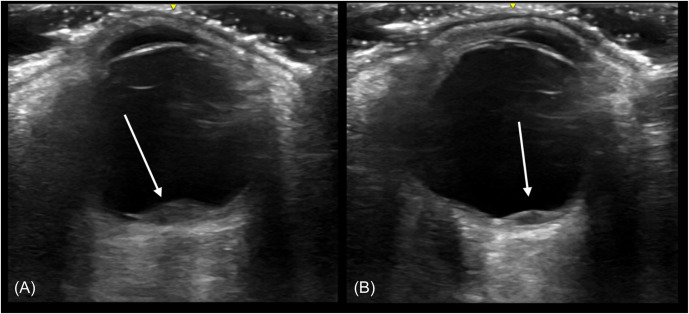
Using a linear ultrasound probe, we performed point-of-care ultrasound (POCUS) to obtain sagittal and transverse views evaluating the anterior chamber, posterior chamber, retina, lens location, and overall structure of the left eye. Two posterior masses were identified over the optic nerve (Image). Ophthalmology was consulted and, on dilated fundus exam, identified two, pale yellow choroidal lesions in close proximity to the optic nerve and optic nerve tilting, with strong concern for leptomeningeal involvement. The patient was then admitted to the hospital for enhanced imaging and facilitation of care.
Point-of-care ultrasound using liner 8-megahertz transducer in transverse view demonstrating, (A) hypoechoic lenticular-shaped optic metastasis (3.2 millimeters [mm] by 1.5 mm) over the optic nerve, and (B) a smaller lenticular-shaped metastasis (1.7 mm by 1.0 mm) with the patient in leftward gaze.
An inpatient magnetic resonance imaging study of the brain with and without contrast demonstrated hypointense nodularity in several areas within the globe, with several, scattered, small enhancing cerebral lesions. She was started on corticosteroids and offered whole brain vs stereotactic body radiation therapy, as well as external beam therapy for intraocular tumors. She was subsequently discharged for outpatient radiology-oncology care.
DISCUSSION
Ocular metastasis represents a rare and clinically challenging manifestation of advanced cancer. Breast cancer remains a more prevalent source of ocular metastasis due to its high incidence, aggressive nature, and propensity for systemic dissemination. The ocular structures, including the choroid, retina, iris, and optic nerve, serve as potential sites for secondary tumor growth, leading to visual impairment and significant morbidity.1 A POCUS exam may show a hypoechoic dome or plateau-shaped lesion typically over the choroid with minimal internal vascularization.2
Clinically, ocular metastasis can manifest as a wide range of ophthalmic symptoms, including blurred vision, pain, photophobia, metamorphopsia, or it can be asymptomatic.1 ^,^ 3 Estimating the incidence of ophthalmic metastasis has proven challenging as asymptomatic manifestations may go unnoticed, but the prevalence of ocular metastasis in metastatic breast cancer has been estimated between 9.7–30%.4 Differential diagnoses may include primary ocular malignancies, hemangioma, sclerochoroidal calcification, granuloma, and infection, underscoring the importance of accurate diagnosis to guide appropriate management strategies.
Subclinical metastasis may not indicate targeted treatment. At initial diagnosis, patients may receive systemic adjuvant treatment to eliminate micrometastatic disease and prevent further metastasis.5 Systemic treatment may include endocrine treatment, cytotoxic chemotherapy, corticosteroids, or immunotherapy. Targeted treatment to ocular metastases includes external beam radiation, which can be useful in patients with foveal involvement but may result in cataracts or radiation retinopathy.
The authors attest that their institution requires neither Institutional Review Board approval, nor patient consent for publication of this case report. Documentation on file.
The reference list from the paper itself. Each links out to its DOI / PubMed record.
- 1Wickremasinghe S Dansingani KK Tranos P et al . Ocular presentations of breast cancer. Acta Ophthalmol Scand. 2007;85(2):133–42.17305726 10.1111/j.1600-0420.2006.00737.x · doi ↗ · pubmed ↗
- 2Blasi MA Maceroni M Caputo CG et al . Clinical and ultrasonographic features of choroidal metastases based on primary cancer site: long-term experience in a single center. P Lo S ONE. 2021;16(3):e 0249210.33765045 10.1371/journal.pone.0249210 PMC 7993812 · doi ↗ · pubmed ↗
- 3Maheshwari A Finger PT . Cancers of the eye. Cancer Metastasis Rev. 2018;37(4):677–90.30203109 10.1007/s 10555-018-9762-9 · doi ↗ · pubmed ↗
- 4Barak A Neudorfer M Heilweil G et al . Decreased prevalence of asymptomatic choroidal metastasis in disseminated breast and lung cancer: argument against screening. Br J Ophthalmol. 2007;91(1):74–5.16943227 10.1136/bjo.2006.099416 PMC 1857549 · doi ↗ · pubmed ↗
- 5Cui Y Yin S Qin X et al . Advances in the treatment of intraocular malignancies: a literature review. Front Med (Lausanne). 2022;9:975565.36330064 10.3389/fmed.2022.975565 PMC 9624174 · doi ↗ · pubmed ↗