Renal Artery Aneurysm Rupture as a Dangerous Mimic of Ovarian Cyst Rupture: A Case Report
Lauren Kaplan, Kaushal H. Shah, Christie Lech, Mary-Kate Gorlick

TL;DR
A rare case of a ruptured kidney artery aneurysm was mistaken for an ovarian cyst rupture, highlighting the need for quick CT scans in similar cases.
Contribution
This case report highlights the importance of considering renal artery aneurysm rupture in the differential diagnosis of hemoperitoneum.
Findings
A woman with a history of ovarian cysts was diagnosed with a ruptured renal artery aneurysm.
Prompt CT imaging and emergency surgery led to successful treatment and recovery.
Abstract
Renal artery aneurysm rupture is a rare but morbid diagnosis, often requiring emergency surgery and nephrectomy. Clinical presentation can mimic more common pathology in non-pregnant women such as ruptured ovarian cyst. We present a case of a woman with a prior history of ovarian cyst presenting with a ruptured renal artery aneurysm. Prompt computed tomography (CT) imaging revealed a left renal artery aneurysm rupture with hemoperitoneum and renal infarct. She underwent emergency laparotomy and nephrectomy and was ultimately discharged in good condition. While ovarian cyst rupture is the most common cause of spontaneous hemoperitoneum in non-pregnant women of childbearing age, renal artery aneurysm rupture should be considered and prompt CT imaging obtained, particularly in cases of hemodynamic instability, to ensure prompt treatment.
Genes, proteins, chemicals, diseases, species, mutations and cell lines named across the full text — each resolved to its canonical identifier and authoritative record.
Click any figure to enlarge with its caption.
 Image
ImagePeer Reviews
No public reviews on file for this paper yet. If you reviewed it on a platform where reviews are public (OpenReview, ICLR, NeurIPS, ICML), you can paste yours below so the community can read it here.
Videos
No videos yet. Explain this paper in a talk, walkthrough, or lecture? Add one.
Taxonomy
TopicsAbdominal vascular conditions and treatments · Renal and Vascular Pathologies · Eosinophilic Esophagitis
INTRODUCTION
Renal artery aneurysm (RAA) is a rare diagnosis, estimated to occur in 0.09% of the general population.5 Rupture is a rare but morbid complication, often requiring emergent surgery and nephrectomy. In contrast, ovarian cyst rupture is the most common cause of spontaneous hemoperitoneum in non-pregnant women of reproductive age and is usually managed conservatively in the absence of hemodynamic compromise or associated torsion.1 ^,^ 2 We report a case of spontaneous ruptured RAA as a dangerous mimic of ovarian cyst rupture.
CASE REPORT
A 52-year-old woman with a past medical history of ovarian cysts was brought in by emergency medical services (EMS) to our emergency department (ED) for acute onset of atraumatic left lower quadrant pain. Her symptoms started abruptly while at work, which she stated felt like symptoms one year prior when she was found to have ovarian cysts and likely an ovarian cyst rupture. She endorsed lightheadedness, but she denied any shortness of breath, chest pain, cough, fevers, chills, or changes in urination.
Per EMS report, she acutely became pale and somnolent, associated with bradycardia to the 40s. In the ED she was hypotensive to 84/48 millimeters of mercury, with heart rate 84 beats per minute, oxygen saturation 100% on room air, and she was afebrile. Physical examination revealed pallor, somnolence, cool extremities, and a peritoneal abdomen. Focused assessment with sonography in trauma examination was positive for free fluid in the left upper quadrant. Pregnancy test was negative. Initial labs were notable for lactate 4.59 millimoles per liter (mmol/L) (reference range 0.50–1.60 mmol/L). Initial hemoglobin was 10 grams per deciliter (g/dL) (12.6–17.0 g/dL); hematocrit 30.5% (37.2–47.9%); platelets 317,000 per milliliter (mL) (156,000–325,000/mL); and white blood cell count 15,000/mL (3,120–8,440/mL). Coagulation factors were normal. Chemistry panel was notable for sodium 130 mmol/L (137–145 mmol/L); potassium 3.3 mmol/L (3.5–5.1 mmol/L); bicarbonate 21 mmol/L (19–27 mmol/L); blood urea nitrogen 18 milligrams (mg)/dL (7–26 mg/dL); and creatinine 1.0 mg/dL (0.70–1.30 mg/dL). Emergency physicians activated a massive transfusion protocol and paged the obstetrics and gynecology service due to concern for hemorrhagic ruptured ovarian cyst vs ovarian torsion.
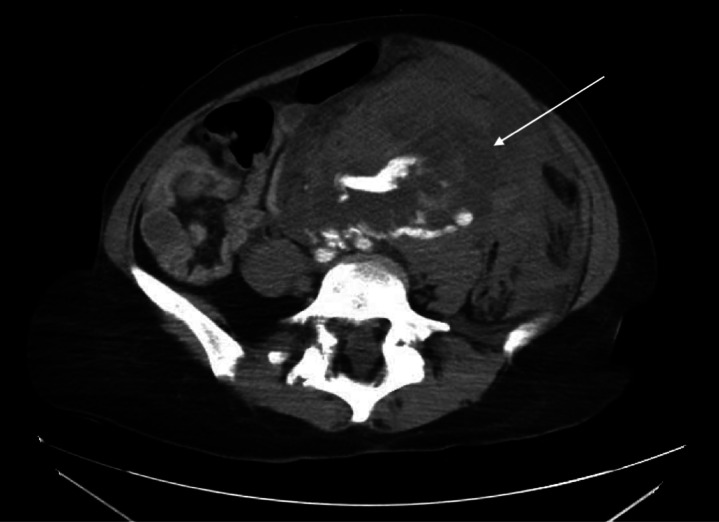
Emergent computed tomography of the abdomen and pelvis revealed a large left retroperitoneal and peritoneal hematoma secondary to left RAA rupture, as well as concern for developing splenic infarcts in the left lower renal pole (Image). The patient was taken emergently to the operating room (OR) for exploratory laparotomy within two hours of ED arrival. She underwent suprarenal cross-clamping with repair of the left renal artery and ligation of renal vessels. She returned to the OR two days later for left nephrectomy and abdominal closure. She was extubated and transferred to the floor. She was discharged home two days later in good condition.
Cross-sectional image of abdominal computed tomography showing hematoma with extravasation of contrast (arrow) as a result of ruptured left renal artery aneurysm.
DISCUSSION
Although the incidence of RAA is rare, ranging from 0.01–0.09% of the population, this case report illustrates the importance of timely diagnosis.3 ^,^ 4 Contemporary rupture rates are estimated at approximately 3%.5 They are most commonly found in women >60 years with risk factors including hypertension, fibrodysplasia, and connective tissue disorders causing arterial medial wall degeneration. Patients notably lack traditional cardiovascular risk factors such as cigarette use and diabetes.6 ^,^ 7 Aneurysms are usually asymptomatic and found incidentally on screening imaging, although patients can present with symptoms such as hypertension, flank pain, hematuria, and abdominal pain.5
As the presentation of a ruptured RAA can be identical to the more common ruptured ovarian cyst, consideration of rare serious surgical pathology should be maintained for patients with acute abdominal pain and free fluid on exam. Bradycardia in the setting of hemoperitoneum is a well described phenomenon particularly in ruptured ectopic pregnancy and can indicate hemorrhagic shock, both of which were considerations in the case reported here.8 ^,^ 9 Other emergent complications of RAA include thrombosis, embolism, and obstructive uropathy.
For non-ruptured RAA, surgical or endovascular intervention is recommended for aneurysms with a diameter exceeding two centimeters, patients with uncontrolled symptoms (ie. pain or refractory hypertension), or in women of childbearing age (as there are higher rates of rupture and mortality in pregnancy and puerperium than in the general population).3 ^,^ 6 These guidelines remain somewhat controversial given the increased incidence of aneurysms uncovered by widespread use of imaging combined with a knowledge gap of the natural progression of disease.2 ^,^ 4 Endovascular intervention through stenting or angioembolization is a safe and effective alternative to open repair, with studies suggesting a trend toward shorter hospital stays and fewer complications.10 In cases of hemodynamic compromise, exploratory laparotomy and nephrectomy are often indicated.2 ^,^ 3 ^,^ 4
CONCLUSION
This is a case of spontaneous rupture of a left renal artery aneurysm as a dangerous mimic of ovarian cyst rupture. While ovarian cyst rupture remains the most common cause of spontaneous hemoperitoneum in non-pregnant women of childbearing age, RAA should be considered with confirmation via computed tomography, particularly in cases of hemodynamic instability to ensure prompt treatment of a disease with potentially high morbidity and mortality.
The reference list from the paper itself. Each links out to its DOI / PubMed record.
- 1Lee YR . CT imaging findings of ruptured ovarian endometriotic cysts: emphasis on the differential diagnosis with ruptured ovarian functional cysts. Korean J Radiol. 2011;12(1):59.21228941 10.3348/kjr.2011.12.1.59PMC 3017885 · doi ↗ · pubmed ↗
- 2Lim WH Woods N Lamaro VP . Trends and outcomes of ruptured ovarian cysts. Postgrad Med J. 2021;98(1161):e 9.33712434 10.1136/postgradmedj-2020-138833 · doi ↗ · pubmed ↗
- 3Gonzalez J Esteban M Andres G et al . Renal artery aneurysms. Curr Urol Rep. 2014;15(1):376.24363127 10.1007/s 11934-013-0376-z · doi ↗ · pubmed ↗
- 4Villianou NG Sikara M Zisis C . Rupture of a left renal artery aneurysm: a rare abdominal emergency. Am J Emerg Med. 2016;34(2):e 347.e 3–4.10.1016/j.ajem.2015.06.04126254504 · doi ↗ · pubmed ↗
- 5Klausner JQ Lawrence PF Harlander-Locke MP et al . The contemporary management of renal artery aneurysms. J Vasc Surg 2015;61(4):978–84.25537277 10.1016/j.jvs.2014.10.107 · doi ↗ · pubmed ↗
- 6Augustin G Kulis T Kello N et al . Ruptured renal artery aneurysm in pregnancy and puerperium: literature review of 53 cases. Arch Gynecol Obstet. 2019;299(4):923–31.30739174 10.1007/s 00404-019-05087-y · doi ↗ · pubmed ↗
- 7Coleman DM Stanley JC . Renal artery aneurysms. J Vasc Surg 2015;62(3):779–85.26213273 10.1016/j.jvs.2015.05.034 · doi ↗ · pubmed ↗
- 8Snyder H . Lack of a tachycardic response to hypotension with ruptured ectopic pregnancy. Am J Emerg Med. 1990;8(1):23–6.2293828 10.1016/0735-6757(90)90288-b · doi ↗ · pubmed ↗