Introducing the Democratic Electoral Systems data, 1919-1945
Nils-Christian Bormann, Lea Kaftan, Daniela Pastarmadzhieva, Pedro Riera, Düzgün Arslantas

TL;DR
This paper introduces updated data on electoral systems in 34 democracies from 1919 to 1945, including election rules and outcomes.
Contribution
The paper provides a new dataset covering interwar electoral systems with compatibility to prior data and multiple democracy classifications.
Findings
The dataset includes 243 elections with variables on electoral rules and outcomes.
Four democracy classifications are included for user flexibility.
Identification variables allow linking to other datasets.
Abstract
This data note introduces an update to the widely-used Democratic Electoral Systems (DES) data that encompasses the period from 1919 to 1945. The data include 243 legislative lower house and presidential elections in 34 interwar democracies. Information on these elections falls into four categories: first and foremost, DES contains variables that capture the institutional rules that define how elections are organized. Second, the data captures the consequences of electoral rules in the form of summary statistics of electoral outcomes. Third, we include democracy classifications for four major democracy datasets so that users can choose their preferred democracy definition when working with the data. Finally, the DES dataset contains multiple identification variables that allow linking the DES data to a wide variety of other datasets. This update to the DES data is fully compatible with…
Genes, proteins, chemicals, diseases, species, mutations and cell lines named across the full text — each resolved to its canonical identifier and authoritative record.
Click any figure to enlarge with its caption.
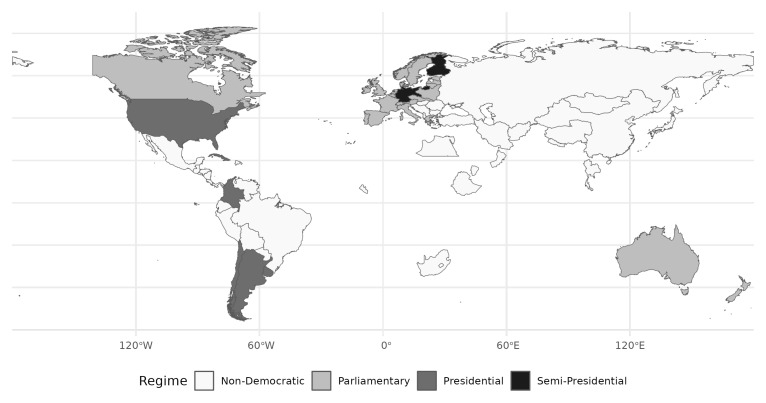 Figure 1
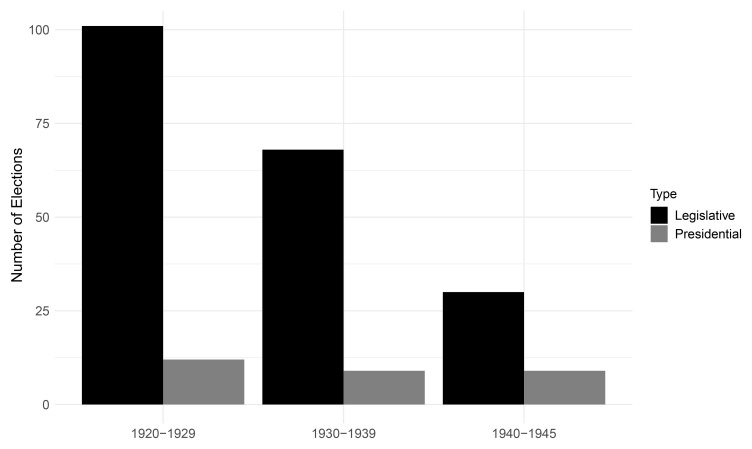 Figure 2
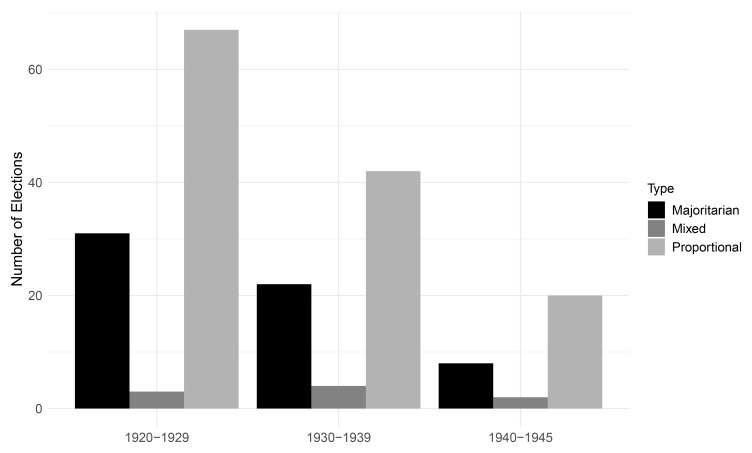 Figure 3
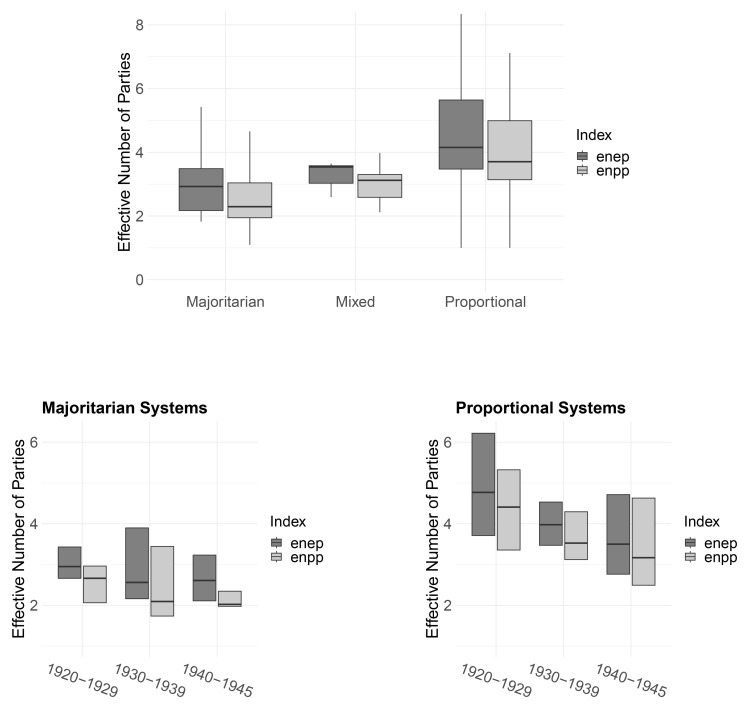 Figure 4
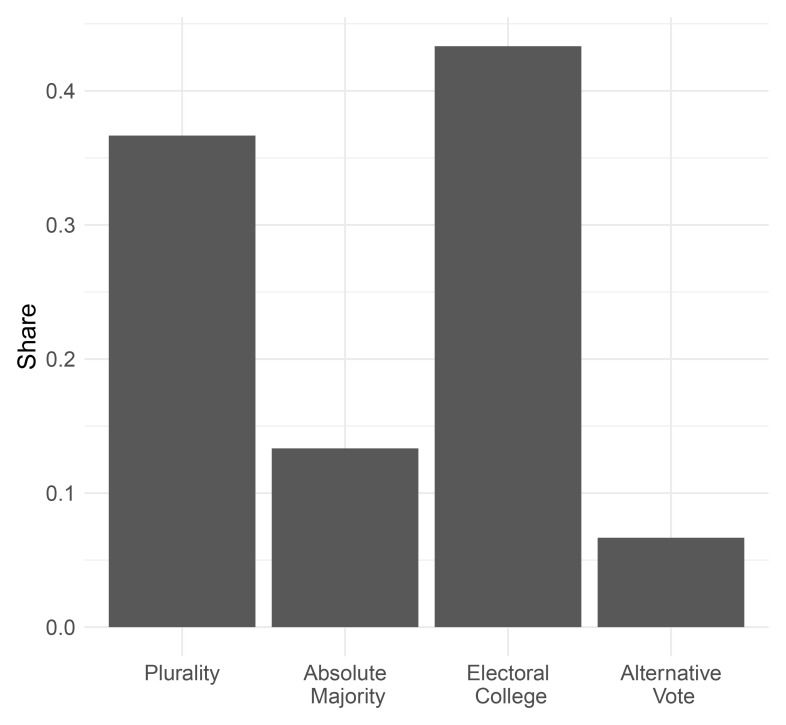 Figure 5
- —Horizon 2020 Framework Programme
Peer Reviews
No public reviews on file for this paper yet. If you reviewed it on a platform where reviews are public (OpenReview, ICLR, NeurIPS, ICML), you can paste yours below so the community can read it here.
Videos
No videos yet. Explain this paper in a talk, walkthrough, or lecture? Add one.
Taxonomy
TopicsElectoral Systems and Political Participation · Political Conflict and Governance · Politics and Society in Latin America
Introduction
We are introducing an update to the widely-used Democratic Electoral Systems (DES) data that encompasses the period from 1919 to 1945. The data include 243 legislative and presidential elections in 34 interwar democracies. Information on these elections falls into four categories: first and foremost, the DES data contains variables that capture the institutional rules that define how elections are organized. Second, the data captures the consequences of electoral rules in the form of summary statistics of electoral outcomes. Third, we include democracy classifications for four major democracy datasets so that users can easily choose their preferred democracy definition when working with the data. Finally, the DES dataset contains multiple identification variables that allow linking the DES data to a wide variety of other datasets.
This release of historical DES data is fully compatible with prior releases for the post-war period ^ 1– 3 ^. These DES versions have been used to analyse a broad range of questions in political science, economics, sociology, and related disciplines. Most recently, social scientists employed the data to explore outcomes such as affective polarization ^ 4 ^, voting preferences in general ^ 5 ^, for left and right-wing parties in particular ^ 6 ^, and public participation in policy-making ^ 7 ^. Prior versions of the data on electoral rules entered analyses of party systems ^ 8 ^, party breakdown ^ 9 ^, foreign direct investment ^ 10 ^, ethnic coalitions ^ 11 ^, the development of legislatures in Africa ^ 12 ^, and elite reactions to far right challengers ^ 13 ^. All these studies are highly pertinent to studying the future of democracy. ^ 1 ^
Although this release of the DES data covers a historical period, studies of the tumultuous interwar period might be able to teach us something about the fate of democracies today ^ 14 ^. Studying electoral choices and reforms during the interwar period can inform debates about contemporary institutional changes. Historical party systems are relevant comparison cases for studies of the effects of party fragmentation today ^ 15, 16 ^. Finally, the DES 1919–1945 release will prove a valuable resource for scholars who study the origins of electoral systems to systematically explore the diffusion of electoral rules across Europe and the Americas ^ 17 ^.
In the following, we describe how we collected the data, how we ensure data quality, and provide a range of summary statistics that describe the data.
Materials & methods
The DES data assembles and harmonizes previously scattered and analogue sources into one data set ^ 18 ^. Whenever possible, we rely on primary sources, such as official election returns from statistical or government agencies, and electoral laws. Edited volumes that unite case studies on electoral systems and electoral returns constitute crucial secondary sources ^ 19– 22 ^. We cross-referenced different sources to ensure data validity. When sources disagreed, we provide the information given by a majority of sources or contacted country experts.
Data collection relies on the experiences made in three previous rounds of post-World War II DES releases ^ 1– 3 ^ and proceeded in six steps:
- We defined the sample of elections to be included in the data. All elections must be democratic according to one of four major democracy indices: the dichotomous measure by Boix, Miller & Rosato ^ 23 ^, the dichotomous Democracy and Dictatorship (DD) classification ^ 24, 25 ^, the ordinal Polity5 index ^ 26 ^, and the continuous Varieties of Democracy (V-Dem) Polyarchy scale ^ 27 ^. Since the original DD classification only starts in 1946, we classified all elections in the data according to its rules.2. We trained student research assistants (RAs) on the coding rules of the DES data ^ 1, 3 ^. The training involved a theoretical overview of electoral rules, the introduction of relevant source material, and example classifications of two elections.3. Each RA classified the same set of ten randomly selected elections. We compared RA classifications to our own classification of these elections, and provided individual performance feedback to each RA.4. We divided the election sample between RAs according to linguistic expertise. Between ourselves and the RAs, we were able to read source material in Dutch, English, Finnish, French, German, Italian, Serbo-Croatian, Spanish, and Swedish. We encouraged RAs to contact us with questions when they were uncertain how to classify a particular variable or election. When our reading of sources could not provide an answer to unclear cases, we contacted other leading experts on electoral systems and/or particular countries to help us reach a decision.5. We randomly re-sampled about 10% of elections and reclassified them to see if systematic errors occurred, and corrected them where necessary.6. Specific variables are automatically created. For example, we compute the effective number of electoral parties ( ENEP) at each election through an algorithm that summarises election results into the overall index. For most elections, we link DES elections to electoral results collected by the authors in a different dataset, the Actions by Elites and Leaders (ABEL) data ^ 16 ^. For all other elections, we collected raw electoral results from the sources described above.7. In a final step, we ran an automated script across the entire data to check each variable for its consistency with the coding rules, which identifies typos and other data entry mistakes. The script also ensures inter-variable consistency and thereby guarantees that two variable values do not contradict each other. For example, if the variable legislative_type indicates the use of proportional representation (PR) in a particular election, we checked that the variables elecrule and tier1_formula indicate specific PR sub-types but not sub-types of any other electoral family.
The dataset comes with several identification variables that make it interoperational with other scientific and public-use datasets. Most users of the DES data are likely to link it to other country-level datasets. Thus, next to a unique variable that identifies each election ( elec_id), the dataset provides several country-identifiers, including the country name, the country abbreviation, the Alvarez, Limongi, Cheibug & Przeworski country codes ( aclp_code) ^ 24 ^ along with the widely-used Correlates of War (COW) country codes ( ccode) ^ 28 ^ and the Gleditsch & Ward (GW) country IDs ( ccode2) ^ 29 ^. Unlike identification systems of country names and different ISO country abbreviations, the COW and GW identification variables accurately trace the historical development of the international system. ^ 2 ^
Democratic Electoral Systems, 1919–1945
To accommodate different views of democracy, we classify elections according to four different democracy definitions. Two inclusive classifications identify almost all the elections in the dataset as democratic. Boix, Miller & Rosato (BMR) only use three rules in their dichotomous democracy measure, which considers all but two Spanish parliamentary elections in 1919 and 1920 as democratic ^ 23 ^. Przeworski et al.’s DD data employs four rules to distinguish democracies from dictatorships ^ 24 ^. DD neither classifies the two Spanish elections as democratic, nor four elections in San Marino. ^ 3 ^ The more complex V-Dem and Polity5 indices categorize 185 and 173 elections respectively as democratic. Users of our data thus have the choice to pick their preferred definition of democracy and the associated sample of elections, or to take an inclusive approach by picking all elections that have been classified as democratic by at least one democracy indicator. In the following, we present descriptive statistics based on the inclusive sample that categorizes any election as democratic that is recognized by at least one of the four democracy indicators.
Our data includes information on 213 legislative, lower-house and 30 presidential elections in 34 democracies between January 1st, 1919 and December 31st, 1945. Figure 1 shows the distribution of regime types across the globe. 26 states featured a parliamentary regime (light grey), two a semi-presidential form of government (black), and four were presidential (dark grey). ^ 4 ^ Geographically, the majority of democratic states were situated in Europe (25), while the rest clustered in Latin America and the Caribbean (5), in North America (2), and in the Pacific (2). ^ 5 ^
Regime types across the world.First election per country depicted.
Figure 2 depicts the frequency of legislative and presidential elections per decade. ^ 6 ^ The declining number of elections tracks the breakdown of democracy in many European states and the conquest of surviving democracies by Nazi Germany. Notably, the steeper decline in legislative compared to presidential elections contrasts with the greater instability of presidential systems in the post-World War II period ^ 30 ^. Most likely, the pattern results from the clustering of presidential regimes outside Europe, and not from an inherent vulnerability to breakdown that parliamentary systems experienced during the period (see Figure 1).
Democratic elections per decade, 1920–1945.
Legislative elections
Most of the information in the DES data focuses on legislative elections. The included variables provide different classifications of electoral families, electoral rules, their application and combination within or across different levels of aggregation or electoral tiers, the number and average size of districts, and the resulting number of parties at each election. Figure 3 displays the distribution of legislative electoral families per decade. During the interwar period, electoral rules that translate votes proportionally into seats were roughly twice as common as majoritarian systems which award seats to the candidate(s) with the highest vote total(s) in a district. Combinations of proportional and majoritarian rules, so-called mixed systems, were uncommon during the interwar period.
Legislative families per decade, 1920–1945.
Within the the broad electoral families, list PR systems were the most popular proportional rule with the D’Hondt divisor as the most common way to allocate votes into seats (59% of all PR elections). The remaining PR elections employed various quota systems, such as the Hare (17.27%), Hagenbach-Bischoff (15.83%), or Droop quota (7.19%). Single-member district pluralities or first-past-the-post elections constituted the preferred choice within the majoritarian electoral family (54.69%).
Two democracies used electoral systems that have not been used by any other state in national elections during the time period covered by any previous DES data release (1946–2020), and thus enter the DES data for the first time. Germany used the fixed quota system that distributed one seat for 60,000 votes ^ 31, 73–81^. Unlike most quota systems, which fix the number of parliamentary seats and determine the quota after counting the votes, the fixed quota system reverts this relationship. It sets the quota first and then determines the number of parliamentary seats. This practise led to an ever larger parliament as Germany’s population and electoral participation grew. The size of the German Reichstag swelled from 459 deputies in 1920 to 647 members after the final election in March 1933. The second unique system, the cumulative vote, was employed in Chile until 1921 ^ 32 ^. It is similar in all but one respect to the majoritarian block vote system, in which voters have as many votes as there are seats in multi-member districts. However, voters can award more than one vote to a candidate under the cumulative vote.
Next to detailed information on legislative electoral rules, the DES data also provide insight into the consequences of these rules in the form of party system size figures. Figure 4 presents box plots of the effective number of electoral ( enep) and parliamentary parties ( enpp) across electoral families (top) and within familes over time (bottom). ^ 7 ^ In line with theoretical predictions ^ 33 ^, majoritarian systems are associated with the smallest number of parties while PR systems are most permissive. From 1920 to 1940, the effective number of parties in PR systems decreases more steeply than in majoritarian systems (bottom panels). In part, this may be a selection effect where countries with more parties where more likely to fail. For example, four of the five democracies with the highest ( enep) scores failed in the interwar period. ^ 8 ^
Party system size by electoral system family, 1919–1945.
Presidential elections
Presidential elections constitute just over 12% of all elections in the DES, 1919–1945 data. As shown in Figure 1 presidential regimes clustered in the Americas. European democracies were overwhelmingly of parliamentary types with semi-presidential exceptions in Finland, Germany, and Ireland after 1937. This low share contrasts markedly with the post-World War II period, when more than a quarter of all elections were presidential ^ 1, 3 ^.
Mirroring the early post-World War II decades, the electoral college was the most common electoral system used in presidential elections during the interwar period, closely followed by plurality elections (see Figure 5). Absolute majority systems and the alternative vote, that was only used in Ireland, were employed in less than 20% of all presidential elections.
Presidential electoral rules, 1919–1945.
Finally, we do not find any notable association between presidential electoral rules and the number of candidates. Whereas plurality systems are associated with a smaller and less variable number of presidential candidates relative to absolute majority systems in the 20th and 21st centuries ^ 3, 34, 35 ^, we find virtually no differences between electoral rules in the period 1919–1945. This null finding may be explained by the small number of elections observed during the period that does not result in sufficient variation. Moreover, the relatively young age of many democracies implies that candidates and voters had little time to learn about the mechanical and strategic effects of electoral rules.
Conclusion
In this data note, we described an update to the Democratic Electoral Systems (DES) data that extends the coverage to the period 1919–1945. Recently, concerns about the quality and survival of contemporary European and other long-established democracies are on the rise. Our new data can help answer questions about the association of parliamentary and presidential institutions as well as party system fragmentation on one hand, and the fate of democracies in another troubled period on the other. The DES 1919–1945 data might also be of use to scholars interested in the origins of electoral rules or long-term institutional legacies.
The reference list from the paper itself. Each links out to its DOI / PubMed record.
- 1Golder M : Democratic Electoral Systems around the world, 1946–2011. Elect Stud. 2005;24(1):103–121. 10.1016/j.electstud.2004.02.008 · doi ↗
- 2Bormann NC Golder M : Democratic Electoral Systems around the world: 2001-2011. Elect Stud. 2013;32(2):360–9. 10.1016/j.electstud.2013.01.005 · doi ↗
- 3Bormann NC Golder NC : Democratic Electoral Systems around the world, 1946-2020. Elect Stud. 2022;78(3): 102487. 10.1016/j.electstud.2022.102487 · doi ↗
- 4Tichelbaecker T Gidron N Horne W : What do we measure when we measure affective polarization across countries? Public Opin Q. 2023;87(3):803–815. 10.1093/poq/nfad 033 · doi ↗
- 5Stegmaier M Linek L Marcinkiewicz K : Heterogeneity in the effects of resources, proximity, and identity on preference voting in PR systems. East Eur Polit. 2023;1–17. 10.1080/21599165.2023.2244885 · doi ↗
- 6Bol D Hunter A Fernandez GA : The psychological partisan effect of electoral systems: How ideology correlates with strategic voting. Party Politics. 2023. 10.1177/13540688231176975 · doi ↗
- 7De Francesco F Tosun J : The enactment of public participation in rulemaking: A comparative analysis. Swiss Polit Sci Rev. 2023;29(1):21–36. 10.1111/spsr.12550 · doi ↗
- 8Clark WR Golder M : Rehabilitating duverger’s theory: testing the mechanical and strategic modifying effects of electoral laws. Comp Polit Stud. 2006;39(6):679–708. 10.1177/0010414005278420 · doi ↗