Locuaz: an in silico platform for protein binders optimization
German P Barletta, Rika Tandiana, Miguel Soler, Sara Fortuna, Walter Rocchia

TL;DR
Locuaz is a computational platform that optimizes protein binders by efficiently exploring mutations and simulating interactions to improve binding affinity.
Contribution
The novel contribution is a modular and customizable platform for in silico optimization of protein binders with parallel mutation exploration.
Findings
The platform supports parallel mutation stream exploration for high-throughput screening on HPC systems.
It integrates molecular dynamics simulations and scoring functions to prioritize effective mutations.
The platform is open-source with available documentation and supplementary data.
Abstract
Engineering high-affinity binders targeting specific antigenic determinants remains a challenging and often daunting task, requiring extensive experimental screening. Computational methods have the potential to accelerate this process, reducing costs and time, but only if they demonstrate broad applicability and efficiency in exploring mutations, evaluating affinity, and pruning unproductive mutation paths. In response to these challenges, we introduce a new computational platform for optimizing protein binders towards their targets. The platform is organized as a series of modules, performing mutation selection and application, molecular dynamics simulations to sample conformations around interaction poses, and mutation prioritization using suitable scoring functions. Notably, the platform supports parallel exploration of different mutation streams, enabling in silico high-throughput…
Genes, proteins, chemicals, diseases, species, mutations and cell lines named across the full text — each resolved to its canonical identifier and authoritative record.
Click any figure to enlarge with its caption.
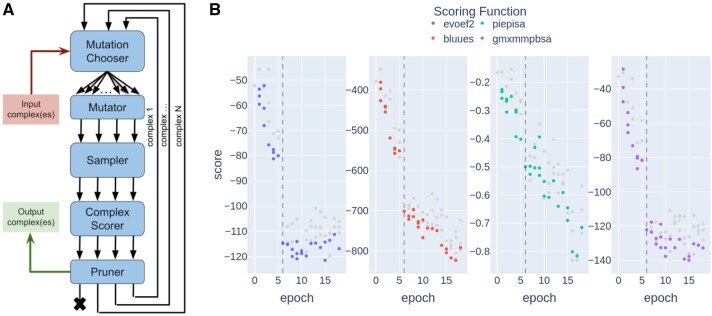 Figure 1
- —AIRC10.13039/100018202
Peer Reviews
No public reviews on file for this paper yet. If you reviewed it on a platform where reviews are public (OpenReview, ICLR, NeurIPS, ICML), you can paste yours below so the community can read it here.
Videos
No videos yet. Explain this paper in a talk, walkthrough, or lecture? Add one.
Taxonomy
TopicsSeed and Plant Biochemistry · Magnetic and Electromagnetic Effects · Agriculture, Plant Science, Crop Management
1 Introduction
The antibody (Ab) discovery process, a critical aspect of biotherapeutics development, relies on the identification of one or more starting candidates, for instance via phage display, yeast display, and hybridoma technology. The affinity maturation follows through several steps of either site-directed mutagenesis, directed evolution, or deep mutational scanning which allow assessing the impact of specific mutations on Ab function and stability (Kennedy et al. 2018). The goal is to obtain an Ab with optimal stability, high affinity and specificity toward the target. In silico approaches can be extremely useful in this context, especially when structural data of the target are available. They include knowledge-based methods, trained on sequence and structure databases, physics-based methods, and hybrid approaches, all aiming at mimicking the details of protein-protein interactions at a lower cost and a shorter time (Sormanni et al. 2018).
Many popular empirical methods belong to the Rosetta suite(Sivasubramanian et al. 2009), which has been used extensively, also in some case to optimize CDR3 sequences, producing Abs that were readily expressed and validated (Moriyama et al. 2023). For instance, Rosetta RAbD, an iterative protocol generating redesigned mutants and samples conformations via a Monte Carlo scheme using a specific energy definition, led to the discovery of an Ab with a Kd ∼20 nM (Adolf-Bryfogle et al. 2018). This result is comparable to those of experimental methods, which very rarely deliver Abs with pM binding affinity.
OSPREY (Hallen et al. 2018) is another well-established software which has proven capable of achieving a 100-fold increase in Ab affinity with just a single point mutation (Holt et al. 2023).
Physics-based approaches often rely on molecular dynamics (MD) simulations for conformational sampling. Among them, a protocol based on MD coupled with a Metropolis Montecarlo scheme using energies calculated via MMPBSA to accept sampled conformations led to an Ab with Kd ∼0.5 nM (Buratto et al. 2022). MD+FoldX is another method where the interaction energies are calculated exclusively with FoldX. It has been applied to Abs against the SARS-Cov-2 receptor binding domain identifying both mutations that could enhance Ab affinity and positions that could potentially host Ab escape mutations. (Barnes et al. 2022) In other approaches, the conformations generated via MD were selected with an acceptance criterion based on a consensus score among multiple scoring functions giving raise to an evolutive optimization protocol for nanobodies and peptides, reaching affinities comparable to those of experimental techniques (Soler et al. 2019, Ochoa et al. 2021). A later implementation exploiting replica-exchange MD allowed the de novo optimisation of Ab fragments (Soler et al. 2023).
Among the most advanced examples of knowledge-based methods, certainly those based on machine learning deserve to be mentioned, such as generative methods. In a recent effort, 1 million Abs against the HER 2 growth factor receptor have been generated in a zero-shot fashion, without any training sample binding HER 2 or one of his homologs. From these designs, 421 binders were experimentally validated and three displayed stronger binding than trastuzumab, the Ab binder licensed as a drug (Shanehsazzadeh et al. 2023). Geometric deep learning is another interesting approach which has been experimentally proven to generate optimized CDR sequences of existing Abs (Shan et al. 2022). Along the same lines, a deep learning based method trained on 10^4^ Ab variants of the antiHer2 Ab Trastuzumab, was used to pick among 10^8^ mutants achieving affinities of Kd 0.1–10 nM, thus comparable to that of the original Ab they were derived from (Mason et al. 2021), Language models too have been used to optimise Abs with Kd <1nM (Hie et al. 2023).
Overall, deep-learning based methods are very promising but need a very large training set of experimental data, which might not always be available. These results highlight that in silico methods could be key to avoid massive experimental costs. Moreover, the variety of available protocols and of their intermediate steps allows to tailor each phase of the process, such as the mutation strategy or the affinity estimation criteria.
We propose here locuaz: A flexible, python-based platform whose primary goal is to optimize the binding affinity of an Ab (fragment) towards its target. In an evolutionary framework, locuaz mutates the candidate binder, samples conformations via MD and scores the affinity of the new complex. Each of these steps can be customized by the user. Importantly, the entire mutation pipeline allows the concurrent generation of different mutation lineages in parallel. The platform can be containerized and run through different job scheduling systems, such as SLURM or PBS. It was constructed using a modular approach both by selecting features from existing Ab evolutionary protocols and by developing new ones into a unique platform, in a way to facilitate updates, customizations and extensions.
2 Materials and methods
As shown in Fig. 1A, the workflow of Locuaz is organized in functional units called Blocks, namely the Mutation Chooser, which determines which mutation has to be applied, the Mutator, which actually applies the mutation to the structure, the Sampler, which performs MD simulation to relax the system, the Complex Scorer, which evaluates the effect of the current mutation on the binding affinity, and finally the Pruner, which decides whether a lineage should be stopped because it is not promising or not. These units were envisioned to support the interchangeable use of built-in tools or of third-party external programs for each task. For example, Locuaz currently supports 9 different Scorers, 2 possibilities for the input topologies (Amber and GROMACS), GROMACS as MD engine used by the Sampler, 3 different Pruners and a highly-configurable Mutation Chooser. Different flavors of each block can be selected and combined at will, and new ones can be added, leading to a remarkable protocol flexibility.
(A) User configurable Blocks of the protocol. (B) Protocol output along the optimization of an anti-p53 Ab fragment: Average scores for all complexes generated along the protocol. Gray markers correspond to complexes that were not selected for the next epoch. Dotted line marks the first epoch of the unrestrained optimization, showing that the lifting of restrains allowed the interface to find a lower energy interaction.
The optimization process starts from a putative binder/target complex and requires as input the selection of the portion of the binder to be optimized. The workflow then envisions the identification of multiple mutations by the Mutation Chooser block. The mutation sites can be one or many, can be either completely random, or guided by biological knowledge, or by physically-based methods, such as MMPB(GB)SA, which are used to recognize which residues are contributing less to the binding affinity (Valdés-Tresanco et al. 2021). The choice of the new amino acid is also configurable. The user can choose from different amino acid probability schemes, or assign each amino acid a custom probability. The Mutation Chooser also allows custom grouping of amino acids in order to force the choice of the amino acid to be within a certain category of amino acid like” polar” or” aliphatic”, etc More information is available on the documentation.
Mutations are performed by any of the currently available Mutators (Soler et al. 2018, Tandiana et al. 2024).
After a mutation is applied, the Sampler performs MD simulations using the GROMACS engine (Abraham et al. 2015) by adopting either GROMACS topologies, or those from Amber’s Tleap (Salomon-Ferrer et al. 2013), allowing the user to include non-standard residues, organic small molecules and ions. To maximize the throughput, all available GPU and CPU resources are pooled and the simulations are distributed among parallel branches (as many as the user requested) and are queued up for concurrent execution following a Producer/Consumer strategy where, in case the number of requests cannot be fulfilled by the available resources, a “first come, first served” criterion is adopted.
Then, the sampled complex configurations are scored and their scores averaged. The score calculations are also dispatched to the available resources, as previously described, to optimize the overall efficiency.
Finally, the user-selected Pruner compares the scores of the mutated binders against the original ones and selects the subset of mutated binders that are deemed to improve affinity. If a single scoring function is used, one possibility is to adopt a Monte Carlo-based Pruner (Soler et al. 2017), giving a chance also to mutations that are predicted to lead to slightly lower affinity. If, conversely, multiple scoring functions are employed, a consensus criterion Pruner can be used to decide which mutation branch is to be continued(Soler et al. 2019). In case no mutation is retained, the original binders are reused to generate a new set of mutants.
Each cycle of this protocol is called an epoch, while simultaneous mutations give rise to different branches. A typical optimization process involves many epochs, as depicted on Fig. 1B. At each epoch a user-defined number of branches are generated, effectively forming a Directed Acyclic Graph (DAG). The width of this DAG, i.e. the number of active branches, is managed according to the available computational resources. In Locuaz we included two methods: variable-width DAG, suitable when considerable computational resources are available, and constant-width DAG, in which the creation of new branches is limited by a previously selected constant width.
3 Application to the TWIST1 system
TWIST1 is a transcription factor which promotes the MDM2-mediated degradation of p53, one of the main tumor suppressors, by interacting with its binding site on p53, known as “Twist-box.” A llama nanobody (VHH) shown to interfere with TWIST1: P 53 interaction by binding to p53 with moderate binding affinity was modelled by homology and then docked onto p53 (D’Agostino et al. 2022).
In order to improve the p53: VHH affinity, the complex was submitted to 5 epochs of optimization using positional restraints between the binder and the target. Then, 250 ns of NPT were carried out to confirm the improved stability. The most representative structure was chosen after clustering, and used to start another 13 epochs of unrestrained optimization for a total of 18 epochs. The optimisation process was monitored by plotting the 4 selected scoring functions along the epochs (Fig. 1B). In this particular example the Mutator Chooser was SPM4i, the Sampler used GROMACS topologies, the Scorers were EvoEF2, BLUUES, PIEPISA and gmxMMPBSA and the Consensus Threshold Pruner was used to select the best candidates. After the protocol run, all average scores had at least doubled and many promising candidates were recovered from the last epoch. These can then be further validated by longer MD simulations, rescored if necessary, and, finally, undergo experimental validation.
This example, as well as further details on the specific features of each Block, can be found at https://lo cuaz.readthedocs.io/en/latest/tutorialsimple.html
Further tutorials are available in the documentation, each of them providing optimal parameters for different use cases: using topologies from GROMACS, building the topology from Tleap and optimizing a protein against a small ligand.
The reference list from the paper itself. Each links out to its DOI / PubMed record.
- 1Abraham MJ , Murtola T, Schulz R et al Gromacs: High performance molecular simulations through multi-level parallelism from laptops to supercomputers. Software X 2015;1-2:19–25.
- 2Adolf-Bryfogle J , Kalyuzhniy O, Kubitz M et al Rosetta Antibody Design (R Ab D): A general framework for computational antibody design. P Lo S Comput Biol 2018;14:E 1006112. 10.1371/journal.pcbi.100611229702641 PMC 5942852 · doi ↗ · pubmed ↗
- 3Barnes JE , Lund-Andersen PK, Patel JS et al The effect of mutations on binding interactions between the SARS-Co V-2 receptor binding domain and neutralizing antibodies B 38 and CB 6. Sci Rep 2022;12:18819–2045. 10.1038/s 41598-022-23482-536335244 PMC 9637166 · doi ↗ · pubmed ↗
- 4Buratto D , Wan Y, Shi X et al In silico maturation of a nanomolar antibody against the human cxcr 2. Biomolecules 2022;12:1285.36139124 10.3390/biom 12091285 PMC 9496334 · doi ↗ · pubmed ↗
- 5D'Agostino S , Mazzega E, Praček K et al Interference of p 53: twist 1 interaction through competing nanobodies. Int J Biol Macromol 2022;194:24–31. 10.1016/j.ijbiomac.2021.11.16034863830 · doi ↗ · pubmed ↗
- 6Hallen MA , Martin JW, Ojewole A et al Osprey 3.0: open-source protein redesign for you, with powerful new features. J Comput Chem 2018;39:2494–507. 10.1002/jcc.25522.30368845 PMC 6391056 · doi ↗ · pubmed ↗
- 7Hie BLL , Shanker VRR, Xu D et al Efficient evolution of human antibodies from general protein language models. Nat Biotechnol 2023;42:275–83. 10.1038/s 41587-023-01763-237095349 PMC 10869273 · doi ↗ · pubmed ↗
- 8Holt GT , Gorman J, Wang S et al Improved hiv-1 neutralization breadth and potency of v 2-apex antibodies by in silico design. Cell Rep 2023;42:112711. 10.1016/j.celrep.2023.11271137436900 PMC 10528384 · doi ↗ · pubmed ↗