The ‘forgotten’ lateral patellofemoral ligament: The known unknown
Angelo V. Vasiliadis, Theodorakys Marín Fermín, Emmanouil Papakostas

TL;DR
The lateral patellofemoral ligament is a key stabilizer of the knee that is often overlooked and primarily injured during medical procedures.
Contribution
This paper highlights the anatomical and functional significance of the LPFL and emphasizes its reconstruction as the primary treatment for injuries.
Findings
The LPFL is a non-isometric ligament that shortens during knee flexion.
Over 90% of LPFL injuries are iatrogenic, and reconstruction is the gold standard treatment.
The LPFL is firmly attached to the lateral femoral epicondyle and patellar structures.
Abstract
Level V. The lateral patellofemoral ligament (LPFL) is an anatomical structure in the second layer of the knee joint and a stabilizer of the patella against medial dislocation. It has firm attachments to the lateral femoral epicondyle and the lateral edge of the patella and patellar tendon. LPFL is non‐isometric and decreases its length during knee flexion. Most LPFL injuries are iatrogenic (>90%), with LPFL reconstruction being the gold standard treatment option.
Genes, proteins, chemicals, diseases, species, mutations and cell lines named across the full text — each resolved to its canonical identifier and authoritative record.
Click any figure to enlarge with its caption.
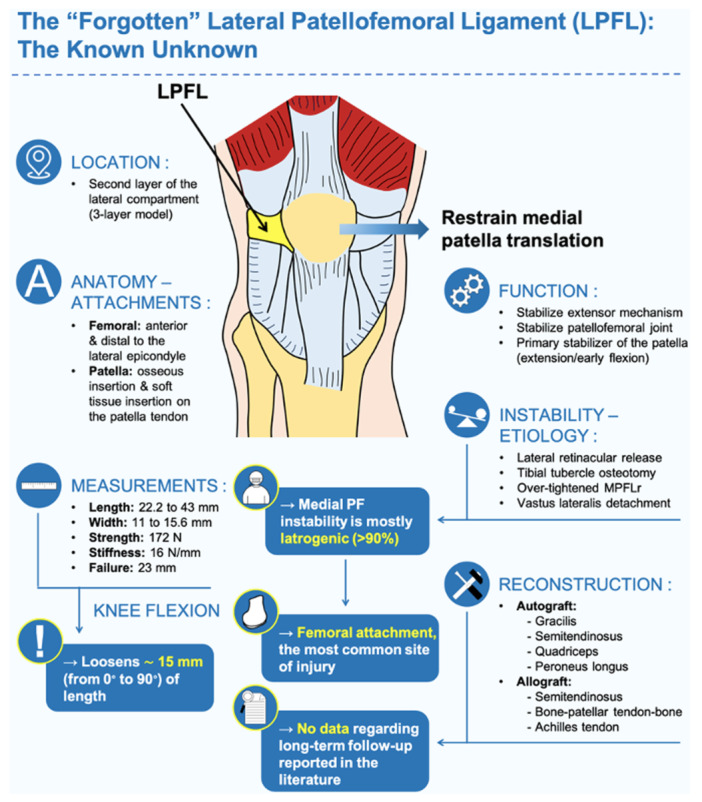 Figure 1
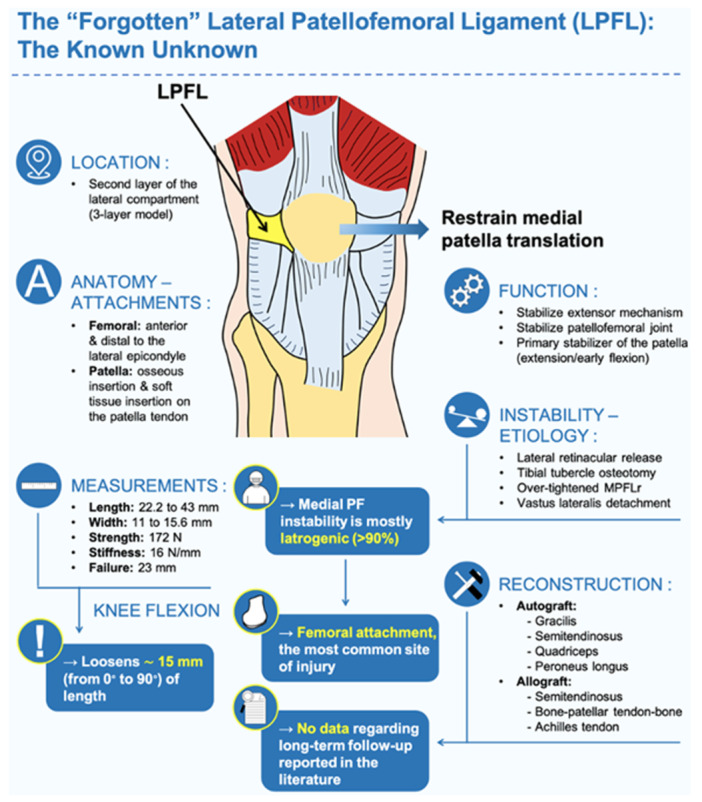 Figure 2
- —None
Peer Reviews
No public reviews on file for this paper yet. If you reviewed it on a platform where reviews are public (OpenReview, ICLR, NeurIPS, ICML), you can paste yours below so the community can read it here.
Videos
No videos yet. Explain this paper in a talk, walkthrough, or lecture? Add one.
Taxonomy
TopicsLower Extremity Biomechanics and Pathologies · Foot and Ankle Surgery · Total Knee Arthroplasty Outcomes
The patellofemoral joint is a unique and complex joint that contains anatomical key structures, playing a crucial role in the balance of the joint [3]. Remarkably, the medial patellofemoral ligament (MPFL) plays an essential role in resisting lateral migration of the patella and keeping the patella within the femoral trochlea [1, 3]. This structure has been well described in the literature [3, 7]. However, the lateral patellofemoral ligament (LPFL) (Figure 1), a primary medial stabilizer of the patella in extension and early flexion [5], remains poorly studied and understood [3, 7].
Anatomical studies have shown that the native location of the LPFL is in the second layer of a three‐layer model, between the lateral epicondyle and the patella, within the anterolateral aspect of the knee [1, 5]. The LPFL originates from an osseous area, on average, 10.8 mm anterior and 2.6 mm distal to the lateral femoral epicondyle [4, 7]. At the same time, it has a broad patellar osseous insertion and a soft tissue insertion on the patellar tendon [4]. The mean LPFL length in full extension ranges from 23.2 to 43 mm [1, 3], while the mean LPFL width ranges from 11.7 to 15.6 mm, with femoral attachment being slightly wider when the length of the LPFL increases [3, 7]. Interestingly, LPFL loosens approximately 15 mm when going from 0° to 90° of flexion [4], with greater changes observed early in flexion (from 0° to 30°) [5]. Studies have shown that the LPFL has a mean tensile strength of 172 N and a stiffness of 16 N/mm at 23 mm of displacement, with the femoral attachment being the more prone site of injury [6]. In the literature, medial patellar instability with medial subluxation of the patella is commonly described as an iatrogenic complication (>90%) [7], mainly due to lateral retinacular release [5], followed by overcorrection with medializing tibial tuberosity osteotomy, over‐tightened MPFL reconstruction and detachment of vastus lateralis from the patella [2]. To date, LPFL reconstruction (LPFLr) with different graft sources (autografts and allografts) has been considered the treatment of choice [2, 4]. However, large prospective studies assessing functional outcomes after LPFLr are needed.
CONFLICT OF INTEREST STATEMENT
The authors declare no conflict of interest.
ETHICS STATEMENT
Ethics approval and consent to participate and consent for publication are not applicable to this study.
The reference list from the paper itself. Each links out to its DOI / PubMed record.
- 1Biz, C. , Stecco, C. , Crimì, A. , Pirri, C. , Fosser, M. , Fede, C. et al. (2022) Are patellofemoral ligaments and retinacula distinct structures of the knee joint? An anatomic, histological and magnetic resonance imaging study. International Journal of Environmental Research and Public Health, 19, 1110. Available from: 10.3390/ijerph 19031110 35162134 PMC 8834464 · doi ↗ · pubmed ↗
- 2Borbas, P. , Koch, P.P. & Fucentese, S.F. (2014) Lateral patellofemoral ligament reconstruction using a free gracilis autograft. Orthopedics, 37, e 665–e 668. Available from: 10.3928/01477447-20140626-66 24992066 · doi ↗ · pubmed ↗
- 3Capkin, S. , Zeybek, G. , Ergur, I. , Kosay, C. & Kiray, A. (2017) An anatomic study of the lateral patellofemoral ligament. Acta Orthopaedica et Traumatologica Turcica, 51, 73–76. Available from: 10.1016/j.aott.2016.07.009 27516002 PMC 6197417 · doi ↗ · pubmed ↗
- 4Huddleston, H.P. , Dandu, N. , Bodendorfer, B.M. & Yanke, A.B. (2021) Lateral patellofemoral ligament reconstruction with a hamstring allograft. Video Journal of Sports Medicine, 1, 26350254211033608. Available from: 10.1177/26350254211033608. · doi ↗
- 5Kerzner, B. , Kaplan, D.J. , Fortier, L.M. , Khan, Z.A. , Mc Cormick, J.R. , Hinckel, B.B. et al. (2023) Lateral patellofemoral ligament reconstruction: anatomy, biomechanics, indications, and surgical techniques. Operative Techniques in Sports Medicine, 31, 151036. Available from: 10.1016/j.otsm.2023.151036 · doi ↗
- 6Merican, A.M. , Sanghavi, S. , Iranpour, F. & Amis, A.A. (2009) The structural properties of the lateral retinaculum and capsular complex of the knee. Journal of Biomechanics, 42, 2323–2329. Available from: 10.1016/j.jbiomech.2009.06.049 19647256 PMC 2764350 · doi ↗ · pubmed ↗
- 7Shah, K.N. , De Froda, S.F. , Ware, J.K. , Koruprolu, S.C. & Owens, B.D. (2017) Lateral patellofemoral ligament: an anatomic study. Orthopaedic Journal of Sports Medicine, 5, 232596711774143. Available from: 10.1177/2325967117741439 PMC 571831129230426 · doi ↗ · pubmed ↗