Constipation: On knife edge
Michelle M. Corrado, Melissa Wong, Laura Z. Fenton, Steven Moulton, Alexandra L. Kilgore

Abstract
Genes, proteins, chemicals, diseases, species, mutations and cell lines named across the full text — each resolved to its canonical identifier and authoritative record.
Click any figure to enlarge with its caption.
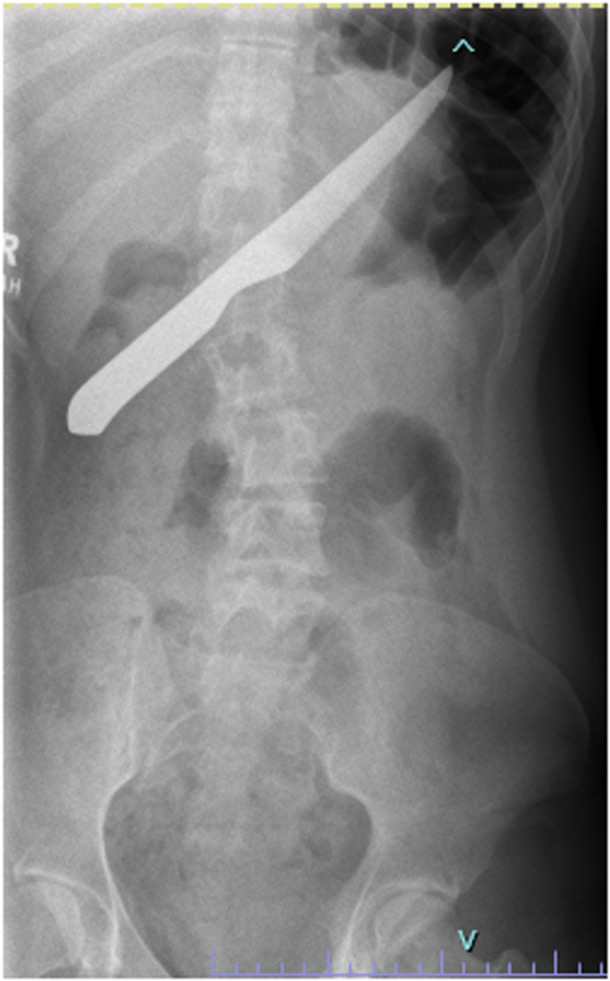 Figure 1
- —None
Peer Reviews
No public reviews on file for this paper yet. If you reviewed it on a platform where reviews are public (OpenReview, ICLR, NeurIPS, ICML), you can paste yours below so the community can read it here.
Videos
No videos yet. Explain this paper in a talk, walkthrough, or lecture? Add one.
Taxonomy
TopicsForeign Body Medical Cases · Esophageal and GI Pathology · Airway Management and Intubation Techniques
A 19‐year‐old with trisomy 21, autism spectrum disorder, developmental delays, and foreign body (FB) ingestions was followed by pediatric gastroenterology for chronic retentive constipation. The family contacted gastroenterology for concern of fecal impaction. The nonverbal patient was described as “off” with poor sleep, inappetence, and eructation. The patient had no fevers or emesis. Family endorsed daily encopresis and enuresis per baseline. Given a history of declining exams and after shared‐decision making, the provider obtained an abdominal X‐ray (AXR) to evaluate stool burden.
The AXR was notable for a radiopaque FB consistent with a steak knife measuring 23 cm in length, obliquely oriented and likely within the stomach, extending into the duodenum without pneumoperitoneum (Figure 1). There was a moderate amount of stool in the colon. Endoscopic removal was considered, but thought to pose a risk of injury to the esophagus and posterior pharynx during removal of the knife. The patient was therefore admitted for an exploratory laparotomy with gastrotomy and FB removal. The patient remained inpatient for 6 days and diet was advanced after fluoroscopic imaging demonstrated no upper gastrointestinal leak. There have been no additional FB ingestions.
It is important to consider a broad differential for gastrointestinal complaints and to specifically ask about FB ingestions, including button batteries, magnets, and chemical ingestions.1 Most FB spontaneously pass (90%) with few requiring surgical intervention (<1%).2, 3 The decision between endoscopic versus surgical removal should be made within a multidisciplinary team pending the FB object, location, and duration in the gastrointestinal tract.4
CONFLICT OF INTEREST STATEMENT
The authors declare no conflict of interest.
ETHICS STATEMENT
Consent by the parents of the patient has been obtained; they are aware of and agree with the intent for this article to be published.
The reference list from the paper itself. Each links out to its DOI / PubMed record.
- 1Kramer RE , Lerner DG , Lin T , et al. Management of ingested foreign bodies in children: a clinical report of the NASPGHAN Endoscopy Committee. J Pediatr Gastroenterol Nutr. 2015;60(4):562‐574.25611037 10.1097/MPG.0000000000000729 · doi ↗ · pubmed ↗
- 2Vishwanath G . Laparoscopic removal of large and sharp foreign bodies from the stomach. Oman Med J. 2008;23(1):42‐45.22567210 PMC 3338989 · pubmed ↗
- 3Mohamed Aboulkacem B , Ghalleb M , Khemir A , et al. Laparoscopic assisted foreign body extraction from the small bowel: a case report. Int J Surg Case Rep. 2017;41:283‐286.29545995 10.1016/j.ijscr.2017.08.047PMC 5709349 · doi ↗ · pubmed ↗
- 4Ikenberry SO , Jue TL , Anderson MA , et al. Management of ingested foreign bodies and food impactions. Gastrointest Endosc. 2011;73(6):1085‐1091.21628009 10.1016/j.gie.2010.11.010 · doi ↗ · pubmed ↗