Complete genome sequence of Cereibacter sphaeroides f. sp. denitrificans strain IL106
Emma K. Stock, Kaziah J. Terrell, Amiera A. Rayyan, John A. Kyndt

TL;DR
This paper provides the complete genome sequence of a specific strain of Cereibacter sphaeroides, highlighting its unique traits useful for bioremediation.
Contribution
The paper presents the complete genome sequence of Cereibacter sphaeroides f. sp. denitrificans strain IL106.
Findings
The complete genome of Cereibacter sphaeroides f. sp. denitrificans strain IL106 is reported.
The genome underscores unique features of this strain relevant to its bioremediation potential.
Abstract
Cereibacter sphaeroides is a non-sulfur purple bacterium, one of the most versatile and thoroughly studied species of its kind, can grow on a variety of compounds photoheterotrophically, and is often used in bioremediation. We present the complete genome of Cereibacter sphaeroides f. sp. denitrificans underscoring its unique features.
Genes, proteins, chemicals, diseases, species, mutations and cell lines named across the full text — each resolved to its canonical identifier and authoritative record.
Click any figure to enlarge with its caption.
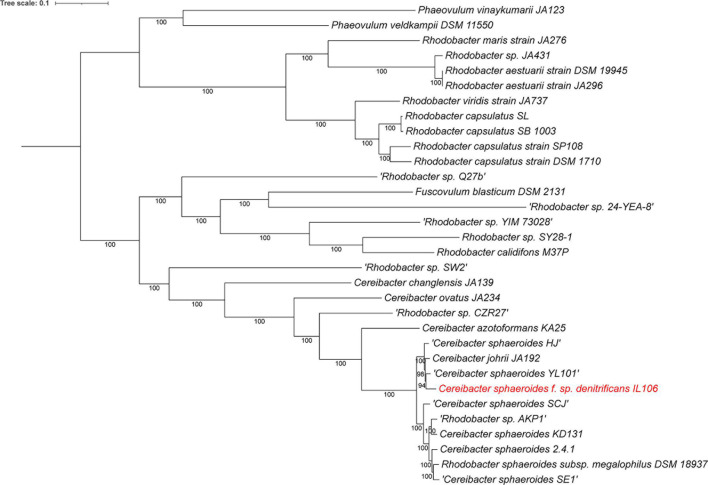 Fig 1
Fig 1| Species | Size | % GC | Coverage | N50 | CDS | tRNAs | ANI | Chrom 1 | Chrom 2 | Plasmids (Mb) | BioProject | Reference |
|---|---|---|---|---|---|---|---|---|---|---|---|---|
|
| 4.8 Mb | 69 | 183x | 32,07,152 | 4944 | 54 | - | 3.2 Mb | 1.33 Mb | 0.13; 0.12 |
| this study |
|
| 4.6 Mb | 69 | 25x | 32,63,112 | 4510 | 55 | 97.7 | 3.3 Mb | 1.19 MB | 0.09 |
| ( |
|
| 4.6 Mb | 69 | / | 31,88,609 | 4395 | 53 | 94.3 | 3.2 Mb | 0.94 Mb | 0.11; 0.11; 0.1; 0.1; 0.04 |
| ( |
|
| 4.8 Mb | 68.2 | 428x | 30,35,272 | 4974 | 55 | 84.8 | 3.0 Mb | 0.88 Mb | 0.12; 0.14; 0.18; 0.3;0.14;0.04 |
| ( |
|
| 4.4 Mb | 68.5 | 100x | 33,35,106 | 4335 | 54 | 82.2 | 3.3 Mb | 0.86 Mb | 0.19; 0.05 |
| ( |
Peer Reviews
No public reviews on file for this paper yet. If you reviewed it on a platform where reviews are public (OpenReview, ICLR, NeurIPS, ICML), you can paste yours below so the community can read it here.
Videos
No videos yet. Explain this paper in a talk, walkthrough, or lecture? Add one.
Taxonomy
TopicsGenomics and Phylogenetic Studies · Microbial Community Ecology and Physiology · Microbial Metabolism and Applications
ANNOUNCEMENT
Cereibacter (Rhodobacter) sphaeroides f. sp. denitrificans was originally isolated from a polluted lagoon pond of Asahimatsu Frozen Bean-Curd Co. in Japan (1). The type strain of Cba. sphaeroides, strain 2.4.1, does not denitrify, but strain IL106 is well known to do so (1 – 4). In our own work, we found that IL106 does not make the usual SHP and PYP proteins found in the type strain (5, 6), but has homologs found in a distant Rba. sphaeroides relative, strain CZR27. The Rhodobacter genus taxonomy was recently restructured (7) and strain IL106 is now part of the newly described Cereibacter genus. Based on 16S rRNA, it is borderline a separate species from Cba. johrii (8). To help establish the phylogenetic position of IL106 and determine the genetic features underlying its unique capabilities, the complete genome sequence was determined.
Strain IL106 was isolated on YC-agar plates and selected on deep soft agar-tube cultures with nitrate as described in reference (1). We obtained the strain from Dr. Terry Meyer, who received it directly from the original authors. Genomic DNA was prepared directly from cells frozen at −80ºC in 50% glycerol, using the GeneJET DNA purification kit (ThermoScientific). The sequencing library was prepared using the Illumina DNA Library Prep kit and sequenced by an Illumina MiniSeq. Paired-end (2 × 150 bp) sequencing generated 9,584,560 reads and 1,158.6 Mbps. Quality control of the reads was performed using FastQC (v1.0.0) within BaseSpace (Illumina), using a k-mer size of 5 and contamination filtering. Oxford Nanopore DNA library prep was performed following the Ligation Sequencing Kit (SQK-LSK110) on a FLO-MIN106D flow cell with a MinION-Mk1B instrument (9). No DNA shearing was performed. Read QC and “superaccuracy basecalling” were performed using Guppy (v6.5.7) (10). This generated 106.3 Mbps sequencing data (55,075 reads), with an average read length of 2,323 bp. An assembly of the Nanopore sequencing was performed using Flye (v2.9.1) (11) within BV-BRC (12), resulting in eight contigs and an N50 of 3,193,481 bp. This initial assembly was of poor quality (fine consistency 65.2%) with too high CDS ratio (8,990). This long-read assembly was subsequently used as a reference sequence for the assembly of the Illumina reads by Minimap2 (13). 9,263,966 reads were aligned, resulting in an accumulative 183× coverage, and four contigs with an N50 of 3,207,152 bp. The coarse and fine consistency were improved to 98.2% and 94.3%, respectively. The final assembled genome was 98% complete according to CheckM (14) (Evaluation Group R200 Rhodobacter sphaeroides ATCC 17025). Each contig had overlapping repeat regions at the ends that confirmed circularity. The genome was annotated by the NCBI Prokaryotic Genome Annotation Pipeline (PGAP) (v6.6) (15). Default parameters were used unless otherwise specified.
Cba. sphaeroides IL106 is 4.79 Mb in size and the CG content is 69% (Table 1). The genome is composed of two chromosomes and two megaplasmids. Some of the other “Rhodobacter” species have shown to have two chromosomes, including the type strain 2.4.1 and more divergent species Cba. azotoformans, Rba. sp. CZR27, and Cba. changlensis (Table 1 and (16 – 19)).
**TABLE 1: Overview of genome features of the complete genomes of Cereibacter species related to Cereibacter sphaeroides f. sp. denitrificans IL106
a
, b**
A JSpecies (21) ANI comparison of IL106 shows that Cba. johrii, HJ, and YL101 are 97%–98% identical to one another, and 94% to 2.4.1 but only 82% to CZR27. Whole-genome phylogenetic analysis of the IL106 genome using RAxML (22, 23) showed johrii, YL101, and HJ as the closest relative (Fig. 1; (20)), and separated from the 2.4.1 and azotoformans branches.
Phylogenetic tree of Cereibacter sphaeroides f. sp. denitrificans IL106 whole-genome comparison to its closest relatives. The phylogenetic tree was generated using the codon tree method within BV-BRC (11), which used PGFams as homology groups and analyzed 500 aligned proteins and coding DNA from single-copy genes using RAxML (V8) (22, 23). The support values for the phylogenetic tree are generated using 100 rounds of the “Rapid bootstrapping” option of RaxML. The branch length tree scale is defined as the mean number of substitutions per site, which is an average across both nucleotide and amino acid changes. iTOL was used for the tree visualization (24).
The reference list from the paper itself. Each links out to its DOI / PubMed record.
- 1Satoh T , Hoshino Y , Kitamura H . 1976. Rhodopseudomonas sphaeroides forma sp. denitrificans, a denitrifying strain as a subspecies of Rhodopseudomonas sphaeroides. Arch. Microbiol 108:265–269. doi:10.1007/BF 00454851 1085137 · doi ↗ · pubmed ↗
- 2Dunstan RH , Kelley BC , Nicholas DJ . 1982. Fixation of dinitrogen derived from denitrification of nitrate in a photosynthetic bacterium, Rhodopseudomonas sphaeroides forma sp. denitrificans. J Bacteriol 150:100–104. doi:10.1128/jb.150.1.100-104.1982 6977538 PMC 220086 · doi ↗ · pubmed ↗
- 3Liu H-P , Takio S , Satoh T , Yamamoto I . 1999. Involvement in denitrification of the nap KEFDABC genes encoding the periplasmic nitrate reductase system in the denitrifying phototrophic bacterium Rhodobacter sphaeroides f. sp. denitrificans. Biosci Biotechnol Biochem 63:530–536. doi:10.1271/bbb.63.530 10227138 · doi ↗ · pubmed ↗
- 4Tabata A , Yamamoto I , Matsuzaki M , Satoh T . 2005. Differential regulation of periplasmic nitrate reductase gene (nap KEFDABC) expression between aerobiosis and anaerobiosis with nitrate in a denitrifying phototroph Rhodobacter sphaeroides f. sp. denitrificans. Arch Microbiol 184:108–116. doi:10.1007/s 00203-005-0029-9 16136296 · doi ↗ · pubmed ↗
- 5Meyer TE , Kyndt JA , Cusanovich MA . 2010. Occurrence and sequence of sphaeroides heme protein and diheme cytochrome C in purple photosynthetic bacteria in the family Rhodobacteraceae. BMC Biochem 11:24. doi:10.1186/1471-2091-11-24 20587053 PMC 2909971 · doi ↗ · pubmed ↗
- 6Meyer TE , Kyndt JA , Memmi S , Moser T , Colón-Acevedo B , Devreese B , Van Beeumen JJ . 2012. The growing family of photoactive yellow proteins and their presumed functional roles. Photochem Photobiol Sci 11:1495–1514. doi:10.1039/c 2pp 25090 j 22911088 · doi ↗ · pubmed ↗
- 7Suresh G , Lodha TD , Indu B , Sasikala C , Ramana CV . 2019. Taxogenomics resolves conflict in the genus Rhodobacter: a two and half decades pending thought to reclassify the genus Rhodobacter. Front. Microbiol 10:2480. doi:10.3389/fmicb.2019.02480 31736915 PMC 6834548 · doi ↗ · pubmed ↗
- 8Girija KR , Sasikala C , Ramana CV , Spröer C , Takaichi S , Thiel V , Imhoff JF . 2010. Rhodobacter johrii sp. nov., an endospore-producing cryptic species isolated from semi-arid tropical soils. Int J Syst Evol Microbiol 60:2099–2107. doi:10.1099/ijs.0.011718-0 19854875 · doi ↗ · pubmed ↗