Complete genome sequence of Arcanobacterium wilhelmae strain DSM 102162 isolated from the genital tract of a Rhinoceros unicornis
Maria Borowiaka, Antonia Kreitlow, Burkhard Malorny, Christoph Lämmler, Jörg Rau, Madeleine Plötz, Amir Abdulmawjood

TL;DR
This paper reports the full genome of a rare bacteria found in a rhinoceros, which could help understand its potential to cause disease.
Contribution
The study provides the first complete genome sequence of Arcanobacterium wilhelmae from a diseased rhinoceros.
Findings
The genome of Arcanobacterium wilhelmae strain DSM 102162 was fully sequenced.
The isolate was obtained from a rhinoceros with suspected bacterial involvement in its illness.
The data may help improve understanding of the genus's pathogenic potential.
Abstract
Previous case reports indicate Arcanobacterium’s opportunistic pathogenic potential. However, the true diversity of the genus remains understudied. Here, we present the complete genome of Arcanobacterium wilhelmae isolated from a diseased rhinoceros, suspected to play a role in its condition. These genomic data may enable future advancements in understanding Arcanobacterium pathogenicity.
Genes, proteins, chemicals, diseases, species, mutations and cell lines named across the full text — each resolved to its canonical identifier and authoritative record.
Click any figure to enlarge with its caption.
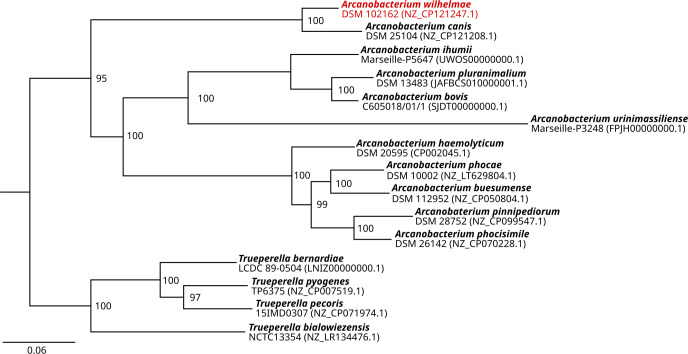 Fig 1
Fig 1Peer Reviews
No public reviews on file for this paper yet. If you reviewed it on a platform where reviews are public (OpenReview, ICLR, NeurIPS, ICML), you can paste yours below so the community can read it here.
Videos
No videos yet. Explain this paper in a talk, walkthrough, or lecture? Add one.
Taxonomy
TopicsDiphtheria, Corynebacterium, and Tetanus · Bacterial Identification and Susceptibility Testing · Microbial Metabolism and Applications
ANNOUNCEMENT
Arcanobacterium is a genus of Gram-positive, non-motile, facultative anaerobic bacteria commonly isolated from animal and human samples (1). Usually, Arcanobacterium exists as part of the normal flora of skin and mucous membranes (2). However, previous studies support that some representatives of the genus possess an opportunistic pathogenic potential and are able to cause severe infections, especially when the host suffers from immunosuppressive conditions (3). Examples have included Arcanobacterium haemolyticus, causing wound infections and pharyngitis in humans (4); Arcanobacterium canis, associated with otitis externa in a dog (5); and Arcanobacterium phocae, isolated from inflammation tissue sides from stranded marine mammals (6). The pathogenic potential of bacteria belonging to the Arcanobacterium genus and their interactions with other pathogens are generally not well understood (4).
In this study, we present the complete genome sequence of A. wilhelmae strain DSM 102162, isolated in 2012 in association with other potentially pathogenic bacteria (Streptococcus sp. and Escherichia coli) from a vaginal swab of an Asian rhinoceros (Rhinoceros unicornis) at Wilhelma Zoo and Botanical Garden, Stuttgart, Germany. The rhinoceros displayed fertility problems and vaginal discharge, raising intriguing questions about the potential role of Arcanobacterium wilhelmae in these conditions (7, 8).
The strain was retrieved from the in-house cryo-culture collection and cultivated under microaerobic conditions on sheep blood agar for 48 h at 37°C. A single genomic DNA extract was prepared using the PureLink Genomic DNA Mini kit (Thermo Fisher Scientific) following the manufacturer’s instructions and subjected to Illumina and Oxford Nanopore Technologies (ONT) sequencing and subsequent data analysis (9). Default parameters were used for all software mentioned in the following.
An Illumina sequencing library was prepared using the Illumina DNA Prep (M) Tagmentation kit and sequenced in 2× 301-bp cycles on an Illumina MiSeq sequencer (MiSeq Reagent Kit v.3). Generated short reads were trimmed using fastp v.0.22.0 (10), resulting in 0.6 million high-quality paired-end reads (≥79.1% Q30).
An ONT sequencing library was prepared using the SQK-RBK110.96 kit and sequenced on a Minion Mk1C device using an R9.4.1 (FLO-MIN106) flow cell. Generated fast5 data were subsequently basecalled using ONT guppy v.6.0.1 (https://community.nanoporetech.com/downloads) in super accuracy (SUP) mode on a graphics processing unit server. The obtained fastq data were trimmed, filtered, and quality-checked using Porechop v.0.2.4 (https://github.com/rrwick/Porechop), NanoFilt v.2.8.0, and NanoStat v.1.5.0 (11), resulting in 8,788 filtered reads (read length N 50 value: 5,395 bp, mean read quality score: 13.7).
Illumina and ONT data sets were subjected to de novo hybrid assembly via Unicycler v.0.4.8 (12 – 14). The resulting assembly included one circularized chromosome of 2,015,622 bp with a G + C content of 60.7% (determined in Geneious Prime v.2020.2.2) and was annotated using PGAP v.6.5 (15).
For phylogenetic comparison with previously reported Arcanobacterium and closely related Truperella species, a comparison of the amino acid sequence of 107 core genes was conducted using bcgTree v.1.2.0 (16) on the basis of available representative genome assemblies from National Center for Biotechnology Information. Assemblies were uniformly annotated with Prokka v.1.14.0 (17); generated .faa files were subjected to bcgTree; and the resulting maximum likelihood tree was visualized in Geneious Prime v.2020.2.2, rooted to the Truperella outgroup, and finalized in InkScape v.1.3 (Fig. 1). A. wilhelmae clusters closely with A. canis, another Arcanobacterium species suspected of pathogenic potential. This underscores the importance of further investigating the pathogenic capabilities of the Arcanobacterium genus.
Maximum likelihood phylogenetic tree illustrating the phylogenetic relationship between Arcanobacterium wilhelmae and other species within the Arcanobacterium genus, alongside closely related representatives from the Truperella genus. The tree was constructed using bcgtree v.1.2.0 and is based on the alignment of the amino acid sequence of 107 core genes (16). The numbers shown at the branches represent the bootstrap support values obtained from 100 bootstrap replicates. The scale bar represents the number of amino acid substitutions per site.
The reference list from the paper itself. Each links out to its DOI / PubMed record.
- 1Ben Khedher M , Lo CI , Diop K , Morand A , Armstrong N , Raoult D , Fenollar F . 2021. Taxonogenomics description of Arcanobacterium urinimassiliense sp. nov., a new bacterial species isolated from urine sample. New Microbes New Infect 41:100854. doi:10.1016/j.nmni.2021.100854 33854785 PMC 8027287 · doi ↗ · pubmed ↗
- 2Thomas T , Gachinmath S , Kumari P . 2022. Arcanobacterium haemolyticum: a case series. Trop Doct 52:563–566. doi:10.1177/00494755221097506 35892166 · doi ↗ · pubmed ↗
- 3Tan TY , Ng SY , Thomas H , Chan BK . 2006. Arcanobacterium haemolyticum bacteraemia and soft-tissue infections: case report and review of the literature. J Infect 53:e 69–e 74. doi:10.1016/j.jinf.2005.10.008 16316687 · doi ↗ · pubmed ↗
- 4Jost BH , Lucas EA , Billington SJ , Ratner AJ , Mc Gee DJ . 2011. Arcanolysin is a cholesterol-dependent cytolysin of the human pathogen Arcanobacterium haemolyticum. BMC Microbiol 11:239. doi:10.1186/1471-2180-11-239 22029628 PMC 3215231 · doi ↗ · pubmed ↗
- 5Hijazin M , Prenger-Berninghoff E , Sammra O , Alber J , Lämmler C , Kämpfer P , Glaeser SP , Busse HJ , Hassan AA , Abdulmawjood A , Zschöck M . 2012. Arcanobacterium canis sp. nov., isolated from otitis externa of a dog, and emended description of the genus Arcanobacterium Collins et al. 1983 emend. Yassin et al. 2011. Int J Syst Evol Microbiol 62:2201–2205. doi:10.1099/ijs.0.037150-0 22081713 · doi ↗ · pubmed ↗
- 6Johnson SP , Jang S , Gulland FMD , Miller MA , Casper DR , Lawrence J , Herrera J . 2003. Characterization and clinical manifestations of Arcanobacterium phocae infections in marine mammals stranded along the central California coast. J Wildl Dis 39:136–144. doi:10.7589/0090-3558-39.1.136 12685077 · doi ↗ · pubmed ↗
- 7Sammra O , Rau J , Wickhorst JP , Alssahen M , Hassan AA , Lämmler C , Kämpfer P , Glaeser SP , Busse HJ , Kleinhagauer T , Knauf-Witzens T , Prenger-Berninghoff E , Abdulmawjood A , Klein G . 2017. Arcanobacterium wilhelmae sp. nov., isolated from the genital tract of a rhinoceros (Rhinoceros unicornis). Int J Syst Evol Microbiol 67:2093–2097. doi:10.1099/ijsem.0.001784 28073403 · doi ↗ · pubmed ↗
- 8Sammra O , Rau J , Wickhorst J , Alssahen M , Hassan AA , Lämmler C , Prenger-Berninghoff E , Abdulmawjood A . 2018. Further characteristics of Arcanobacterium pinnipediorum DSM 28752 T and Arcanobacterium wilhelmae DSM 102162 T, two novel species of genus Arcanobacterium. Folia Microbiol (Praha) 63:695–700. doi:10.1007/s 12223-018-0610-7 29756170 · doi ↗ · pubmed ↗