Draft genome assemblies of three Klebsiella grimontii strains isolated from catheterized urine samples from the same male participant over the course of 6 months
Helen Appleberry, Warwick Price, Lorenzo Roque, Evelyn Umana, Alan J. Wolfe, Catherine Putonti, Alex Kula

TL;DR
This paper reports the draft genomes of three Klebsiella grimontii strains collected from a single person's urine over six months.
Contribution
The study provides new draft genome sequences of K. grimontii strains from longitudinal urine samples.
Findings
Three K. grimontii strains were isolated from catheterized urine samples over six months.
Draft genome sequences of these strains were assembled and reported.
The strains originated from a single male participant in a longitudinal study.
Abstract
Klebsiella grimontii is a newly identified species within the Klebsiella oxytoca complex. Here, we present the draft genome sequence of three K. grimontii strains that were isolated from catheterized urine samples collected from a participant in a longitudinal study over ~6 months.
Genes, proteins, chemicals, diseases, species, mutations and cell lines named across the full text — each resolved to its canonical identifier and authoritative record.
Click any figure to enlarge with its caption.
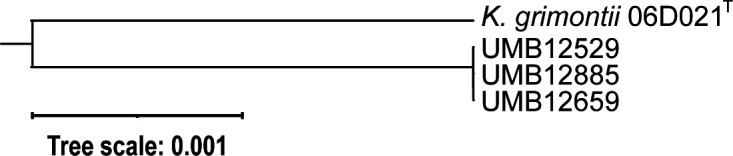 Fig 1
Fig 1| Strain | |||
|---|---|---|---|
| SRA accession No. |
|
|
|
| Assembly accession No. |
|
|
|
| No. raw reads | 2,721,256 | 1,761,298 | 3,218,480 |
| Assembly length (bp) | 6,169,055 | 6,150,323 | 6,148,987 |
| G + C (%) | 55.58 | 55.59 | 55.59 |
| No. contigs | 132 | 129 | 133 |
| Contigs N50 (bp) | 185,793 | 211,986 | 186,216 |
| Coverage (x) | 60.16 | 39.56 | 71.21 |
| Completeness (%) | 100 | 100 | 100 |
| Contamination (%) | 0.6 | 0.4 | 0.4 |
| Collection date | May 17, 2021 | July 22, 2021 | November 5, 2021 |
| Symptom status | Asymptomatic | Asymptomatic | UTI |
- —Loyola University Chicago (LUC)
Peer Reviews
No public reviews on file for this paper yet. If you reviewed it on a platform where reviews are public (OpenReview, ICLR, NeurIPS, ICML), you can paste yours below so the community can read it here.
Videos
No videos yet. Explain this paper in a talk, walkthrough, or lecture? Add one.
Taxonomy
TopicsUrinary Tract Infections Management · Antibiotic Resistance in Bacteria · Enterobacteriaceae and Cronobacter Research
ANNOUNCEMENT
Klebsiella grimontii is a newly characterized species within the Klebsiella oxytoca complex (1, 2). K. oxytoca is a common cause of urinary tract infections (UTI) (2). K. grimontii strains have been isolated from wound infections, respiratory tract infections, and antibiotic-associated hemorrhagic colitis (1) as well as urine samples (3). As part of a prior institutional review board (IRB)-approved study characterizing the urobiome of geriatric males with chronic indwelling urinary catheters, K. grimontii was isolated from a participant across three urine samples collected during this longitudinal study. These three K. grimontii-containing collections span ~6 months. Here we present the genome assemblies of K. grimontii UMB12529, UMB12659, and UMB12885.
Urine samples collected (IRB approval nos. LU212677 and LU217801) were processed using the expanded quantitative urine culture (EQUC) method (4). Each isolate was identified as K. oxytoca via matrix-assisted laser desorption ionization-time of flight mass spectrometer (MALDI-TOF MS; Bruker Daltonics, Billerica, MA), as previously described (5), and preserved at −80°C in the Loyola Urinary Education and Research Collaborative (LUEREC) collection. Samples were obtained from this collection and streaked onto tryptone soy agar (TSA) plates and incubated at 35°C with 5% CO_2_ for 24 h. Individual colonies were then grown in liquid tryptone soy medium under the same culture conditions. These liquid cultures were used for DNA extraction with Qiagen’s DNeasy Blood and Tissue kit, following the manufacturer’s Gram-positive organism protocol. Library preparation and sequencing were performed by SeqCoast (Portsmouth, NH USA). DNA libraries were constructed using the Illumina tagmentation kit and unique dual indexes and sequenced on the Illumina NextSeq2000 platform using a 300-cycle flow cell kit to produce 2 × 150 bp paired reads. Reads were processed with the Bacterial and Viral Bioinformatics Resource Center (BV-BRC) v3.35.5 webtool (6) as follows. Reads were first trimmed using Trim Galore v0.6.5 (https://github.com/FelixKrueger/TrimGalore) and assembled using Unicycler v0.4.8 (7). The draft assembly was polished with Pilon v1.23 (8), which corrects bases, fixes misassemblies, and fills gaps. Genome coverage, completeness, and contamination were computed by BV-BRC. Genome assemblies were annotated by the NCBI Prokaryotic Genome Annotation Pipeline (PGAP) v6.7 (9). BV-BRC’s Bacterial Genome Tree tool was used to compare the genomes (parameter 1000 genes); the resulting Newick-format tree was visualized using iTOL v6 (10). Variant analysis was conducted using BV-BRC by performing all pairwise comparisons of raw reads to genome assemblies; only high-quality variants were recorded. Unless otherwise specified, default parameters were used for all software.
Genome assembly statistics are shown in Table 1. The K. grimontii UMB12529, UMB12659, and UMB12885 genome assemblies are nearly identical and distinct from K. grimontii strain 06D021^T^ (Accession no. FZTC00000000) (Fig. 1). Variant analysis found that 59–75 SNPs distinguish the three genomes. The high sequence similarity suggests that the same strain of K. grimontii has persisted in the participant’s urobiome. Given the recent characterization of new species within the K. oxytoca complex, including K. grimontii, and the known shortcomings of MALDI-TOF to distinguish between these species (3), future studies are needed to disambiguate between K. oxytoca complex species and urinary tract symptoms.
Phylogenetic tree based upon 1,000 genes shared between the three K. grimontii strains presented here and the type strain for the species.
The reference list from the paper itself. Each links out to its DOI / PubMed record.
- 1Passet V , Brisse S . 2018. Description of Klebsiella grimontii sp. nov. Int J Syst Evol Microbiol 68:377–381. doi:10.1099/ijsem.0.002517 29205126 · doi ↗ · pubmed ↗
- 2Yang J , Long H , Hu Y , Feng Y , Mc Nally A , Zong Z . 2022. Klebsiella oxytoca complex: update on taxonomy, antimicrobial resistance, and virulence. Clin Microbiol Rev 35:e 0000621. doi:10.1128/CMR.00006-21 34851134 PMC 8635272 · doi ↗ · pubmed ↗
- 3Cuénod A , Wüthrich D , Seth-Smith HMB , Ott C , Gehringer C , Foucault F , Mouchet R , Kassim A , Revathi G , Vogt DR , et al. . 2021. Whole-genome sequence-informed MALDI-TOF MS diagnostics reveal importance of Klebsiella oxytoca group in invasive infections: a retrospective clinical study. Genome Med 13:150. doi:10.1186/s 13073-021-00960-5 34517886 PMC 8438989 · doi ↗ · pubmed ↗
- 4Price TK , Dune T , Hilt EE , Thomas-White KJ , Kliethermes S , Brincat C , Brubaker L , Wolfe AJ , Mueller ER , Schreckenberger PC . 2016. The clinical urine culture: enhanced techniques improve detection of clinically relevant microorganisms. J Clin Microbiol 54:1216–1222. doi:10.1128/JCM.00044-16 26962083 PMC 4844725 · doi ↗ · pubmed ↗
- 5Hilt EE , Mc Kinley K , Pearce MM , Rosenfeld AB , Zilliox MJ , Mueller ER , Brubaker L , Gai X , Wolfe AJ , Schreckenberger PC . 2014. Urine is not sterile: use of enhanced urine culture techniques to detect resident bacterial flora in the adult female bladder. J Clin Microbiol 52:871–876. doi:10.1128/JCM.02876-13 24371246 PMC 3957746 · doi ↗ · pubmed ↗
- 6Olson RD , Assaf R , Brettin T , Conrad N , Cucinell C , Davis JJ , Dempsey DM , Dickerman A , Dietrich EM , Kenyon RW , et al. . 2023. Introducing the bacterial and viral bioinformatics resource center (BV-BRC): a resource combining PATRIC, IRD and Vi PR. Nucleic Acids Res 51:D 678–D 689. doi:10.1093/nar/gkac 1003 36350631 PMC 9825582 · doi ↗ · pubmed ↗
- 7Wick RR , Judd LM , Gorrie CL , Holt KE . 2017. Unicycler: resolving bacterial genome assemblies from short and long sequencing reads. P Lo S Comput Biol 13:e 1005595. doi:10.1371/journal.pcbi.1005595 28594827 PMC 5481147 · doi ↗ · pubmed ↗
- 8Walker BJ , Abeel T , Shea T , Priest M , Abouelliel A , Sakthikumar S , Cuomo CA , Zeng Q , Wortman J , Young SK , Earl AM . 2014. Pilon: an integrated tool for comprehensive microbial variant detection and genome assembly improvement. P Lo S One 9:e 112963. doi:10.1371/journal.pone.0112963 25409509 PMC 4237348 · doi ↗ · pubmed ↗