Whole-genome sequence of Enterobacter hormaechei, isolate jjbc recovered from the gut of Plutella xylostella feeding on cabbage
Loretta Mugo-Kamiri, Lea Schäfer, Jörg T. Wennmann, Elisabeth A. Herniou, Ben Raymond

TL;DR
This paper reports the whole-genome sequence of a gut bacterium found in a cabbage-feeding pest insect.
Contribution
The study provides a new whole-genome sequence of a gut symbiont from a major agricultural pest.
Findings
The genome of Enterobacter hormaechei was sequenced using both long and short read technologies.
The bacterium is a dominant gut symbiont in Plutella xylostella, a pest known for antimicrobial resistance.
The isolate may serve as a model for studying resistance evolution in gut microbes.
Abstract
We present the whole-genome sequence of Enterobacter hormaechei (previously Enterobacter cloacae) obtained from long and short reads. It is a dominant gut symbiont of the notorious crop pest Plutella xylostella, highly prevalent in lepidopteran midguts and a useful model for the evolution of resistance to antimicrobials.
Genes, proteins, chemicals, diseases, species, mutations and cell lines named across the full text — each resolved to its canonical identifier and authoritative record.
Click any figure to enlarge with its caption.
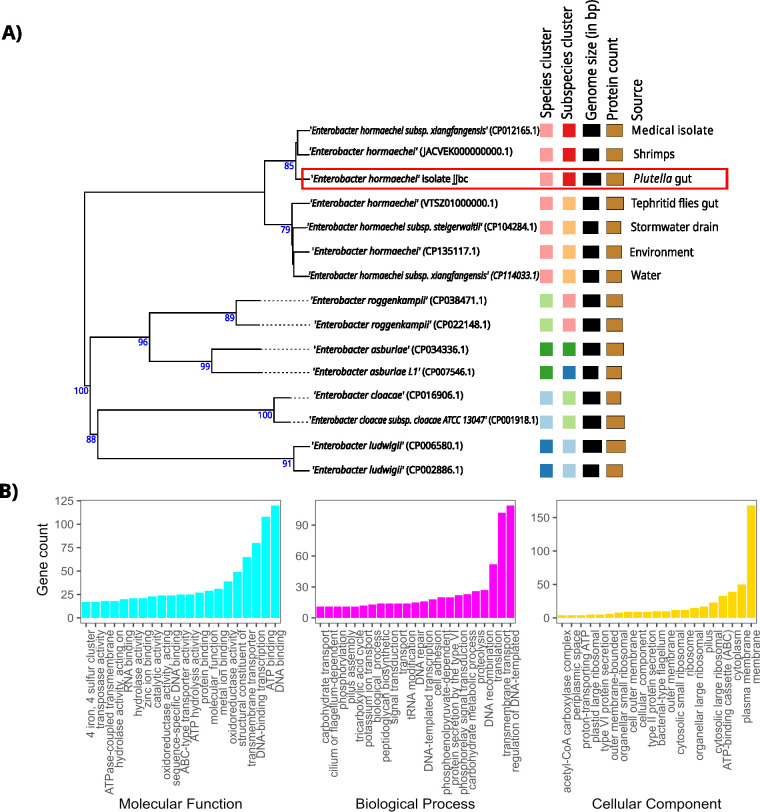 Fig 1
Fig 1| Replicon | Length (bp) | GC content (%) | Topology | GenBank accession |
|---|---|---|---|---|
| Chromosome | 4,854,432 | 55.3 | Circular |
|
| Plasmid 1 | 87,769 | 50.5 | Circular |
|
| Plasmid 2 | 82,397 | 53.2 | Circular |
|
| Plasmid 3 | 64,969 | 52.4 | Circular |
|
| Plasmid 4 | 53,743 | 50.8 | Circular |
|
- —Marie Curie Actions Horizon 2020 INSECTDOCTORS program
Peer Reviews
No public reviews on file for this paper yet. If you reviewed it on a platform where reviews are public (OpenReview, ICLR, NeurIPS, ICML), you can paste yours below so the community can read it here.
Videos
No videos yet. Explain this paper in a talk, walkthrough, or lecture? Add one.
Taxonomy
TopicsPlant Pathogenic Bacteria Studies · Genomics and Phylogenetic Studies · Plant-Microbe Interactions and Immunity
ANNOUNCEMENT
Enterobacter symbionts isolated from lepidopterans encode genes with functions such as digestion of plant cell wall carbohydrates, detoxification of plant allelochemicals, and the breakdown of insecticides (1 – 4), capabilities that are consistent with a niche as symbionts
of herbivores. The ease of use of Enterobacter hormaechei in gnotobiotic insect rearing systems and the possession of an AmpC beta-lactamase also mean that this bacterium is a valuable model for antimicrobial resistance in the Enterobactericeae (5).
E. hormaechei isolate jjbc was isolated by homogenizing Plutella xylostella larvae feeding on Chinese cabbage, Brassica pekinensis, at the Department of Zoology, University of Oxford. Homogenates were plated on Luria-Bertani (LB) agar and incubated at 30°C (6). After streaking clones, bacteria were grown in LB broth overnight at 30°C. DNA extraction from these cultures and sequencing were done at MicrobesNG (Birmingham, UK). Briefly, 40 µL of bacterial cell suspension was lysed in 120 µL of TE buffer-containing lysozyme, metapolyzyme, and RNase A. Proteinase K (final concentration 0.1 mg/mL) and SDS [final concentration 0.5% (vol/vol)] were added and incubated for 5 min at 65°C. Genomic DNA was purified using an equal volume of SPRI beads and resuspended in Elution buffer (10 mM Tris-HCl, pH 8.0). Genomic DNA libraries were prepared using the Nextera XT Library Prep Kit (Illumina, San Diego, USA) with these modifications: input DNA was increased twofold, and PCR elongation time was increased to 45 seconds. For the short reads, libraries were sequenced on a lllumina NovaSeq 6000 (Illumina, San Diego, USA) using a 250 bp paired-end protocol. For the long reads, DNA libraries were prepared using the Oxford Nanopore SQK-LSK109 and Native Barcoding EXP-NBD104/114 kits (ONT, UK) with 400–500 ng High Molecular Weight DNA, fragmented without size selection. Barcoded samples were pooled and loaded in a Library prepFLO-MIN111 (R10.3) flow cell, in a GridION (ONT, UK).
We obtained 1,172,223 Illumina reads and 13,666 ONT reads. The read quality was verified using FastQC (v. 0.12.1) (7) and NanoPlot (v. 1.42.0) (8), respectively. Genome assembly was performed using the fully automated hybrid assembly pipeline Unicycler (v. 0.5.0) (9). Default settings were used for all software (10). Manual intervention was required to resolve the following issues in the automatic assembly: (i) erroneous removal of genuine sequences during graph cleaning of the short-read assembly and (ii) collapse of inter-plasmidic repeats (11). The correction of these assembly errors resulted in a fully resolved genome consisting of one circular chromosome and four circular plasmids (Table 1), with a BUSCO completeness score of C:98.8%(S:98.6%,D:0.2%),F:0.2%,M:1.0%,n:440 (12) and a mean read depth of 110×. The closest matching species confirmed using the Type (Strain) Genome Server (TYGS) (13) is E. hormaechei (Fig. 1A). This genome was annotated using PGAP v.6.6 (14) and contains 4,951 predicted genes. Functional annotation shows multiple genes associated with carbohydrate metabolism (Fig. 1B). Using ResFinder 4.4.2 server (15), we identified two antimicrobial resistance genes: fosA for Fosfomycin resistance (96.71% alignment and 100% coverage) and blaACT-16, an AmpC beta-lactamase (99.74% alignment and 100% coverage) common in Enterobacter spp. (16).
**TABLE 1: Summary of the genome assembly statistics for E. hormaechei isolate jjbc
a**
(A) Whole-genome phylogeny generated using the TYGS server confirming isolate jjbc belongs to the species E. hormaecehei and clusters with isolates from environmental samples, shrimps, and insect guts. Colored squares show five species clusters and seven sub-species clusters and the relative genome size and protein count of different genomes. Numbers above the branches represent branch support values inferred from 100 pseudo-bootstrap replicates based on Genome BLAST Distance Phylogeny under the algorithm distance formula (18). (B) Top 20 Gene Ontology terms showing the number of genes associated with each function for the categories of molecular function, biological process, and cellular component.
The reference list from the paper itself. Each links out to its DOI / PubMed record.
- 1Yang F-Y , Saqib HSA , Chen J-H , Ruan Q-Q , Vasseur L , He W-Y , You M-S . 2020. Differential profiles of gut microbiota and metabolites associated with host shift of Plutella xylostella. Int J Mol Sci 21:1–15. doi:10.3390/ijms 21176283 PMC 750402632872681 · doi ↗ · pubmed ↗
- 2Anand AAP , Vennison SJ , Sankar SG , Prabhu DIG , Vasan PT , Raghuraman T , Geoffrey CJ , Vendan SE . 2010. Isolation and characterization of bacteria from the gut of Bombyx mori that degrade cellulose, xylan, pectin and starch and their impact on digestion. J Insect Sci 10:107. doi:10.1673/031.010.10701 20874394 PMC 3016902 · doi ↗ · pubmed ↗
- 3Gandotra S , Bhuyan PM , Gogoi DK , Kumar A , Subramanian S . 2018. Screening of nutritionally important gut bacteria from the lepidopteran insects through qualitative enzyme assays. Proc Natl Acad Sci India Sect B Biol Sci 88:329–337. doi:10.1007/s 40011-016-0762-7 · doi ↗
- 4Xia X , Sun B , Gurr GM , Vasseur L , Xue M , You M . 2018. Gut microbiota mediate insecticide resistance in the diamondback moth, Plutella xylostella (L.). Front Microbiol 9:25. doi:10.3389/fmicb.2018.00025 29410659 PMC 5787075 · doi ↗ · pubmed ↗
- 5Manktelow CJ , Penkova E , Scott L , Matthews AC , Raymond B . 2020. Strong environment-genotype interactions determine the fitness costs of antibiotic resistance in vitro and in an insect model of infection. Antimicrob Agents Chemother 64:e 01033-20. doi:10.1128/AAC.01033-20 32661001 PMC 7508608 · doi ↗ · pubmed ↗
- 6Somerville J , Zhou L , Raymond B . 2019. Aseptic rearing and infection with gut bacteria improve the fitness of transgenic diamondback moth, Plutella xylostella. Insects 10:89. doi:10.3390/insects 10040089 30925791 PMC 6523322 · doi ↗ · pubmed ↗
- 7Andrews S . 2015. Fast QC: a quality control tool for high throughput sequence data. Available from: http://www.bioinformatics.babraham.ac.uk/projects/
- 8De Coster W , D’Hert S , Schultz DT , Cruts M , Van Broeckhoven C . 2018. Sequence analysis Nano Pack: visualizing and processing long-read sequencing data. Bioinformatics 34:2666–2669. doi:10.1093/bioinformatics/bty 149 29547981 PMC 6061794 · doi ↗ · pubmed ↗