Individual factors and vection in younger and older adults: How sex, field dependence, personality, and visual attention do (or do not) affect illusory self-motion
Brandy Murovec, Julia Spaniol, Behrang Keshavarz

TL;DR
This study explores how individual factors like sex and personality affect the illusion of self-motion in virtual reality for younger and older adults.
Contribution
The study reveals sex-specific effects of field dependence on vection and highlights the role of multiple individual factors in vection susceptibility.
Findings
Females experienced longer-lasting vection compared to males in both younger and older adults.
Field dependence influenced vection intensity and duration in males but not in females.
Vection intensity was best explained by a combination of biological, perceptual, cognitive, and personality variables.
Abstract
An important aspect to an immersive experience in Virtual Reality is vection, defined as the illusion of self-motion. Much of the literature to date has explored strategies to maximize vection through manipulations of the visual stimulus (e.g., increasing speed) or the experimental context (e.g., framing of the study instructions). However, the role of individual differences (e.g., age, biological sex) in vection susceptibility has received little attention. The objective of the current study was to investigate the influence of individual-difference factors on vection perception in younger and older adults. Forty-six younger adults (Mage = 25.1) and 39 older adults (Mage = 72.4) completed assessments of personality traits, field dependence, and visual attention prior to observing a moving visual stimulus aimed at inducing circular vection. Vection was measured using self-reports of…
Genes, proteins, chemicals, diseases, species, mutations and cell lines named across the full text — each resolved to its canonical identifier and authoritative record.
Click any figure to enlarge with its caption.
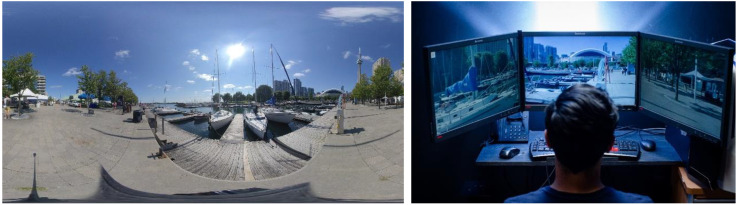 Figure 1
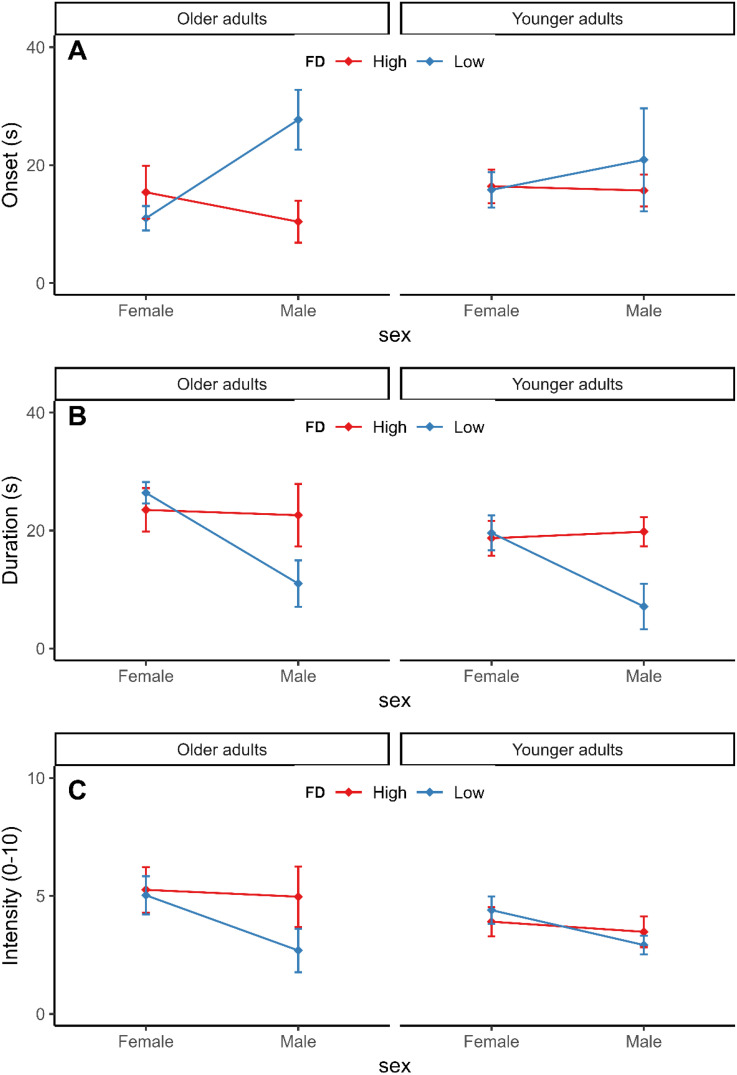 Figure 2
 Figure 3
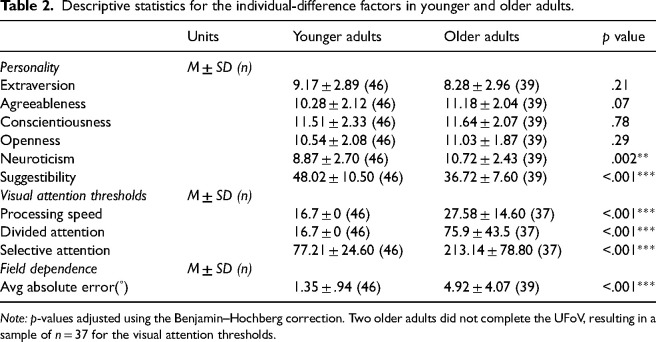 Figure 4
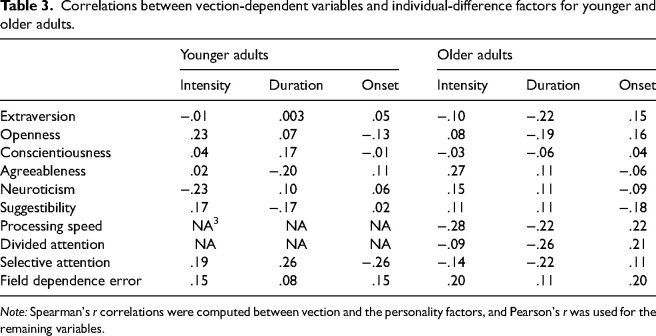 Figure 5
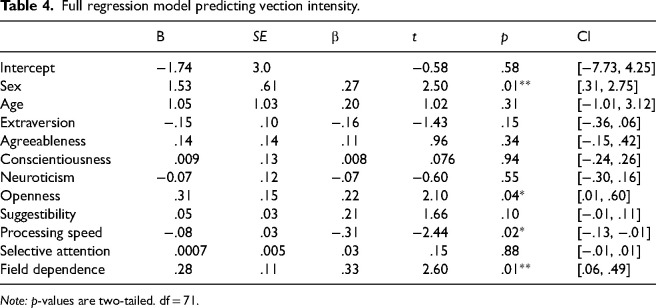 Figure 6
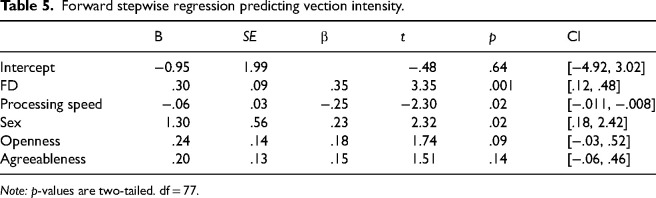 Figure 7
Peer Reviews
No public reviews on file for this paper yet. If you reviewed it on a platform where reviews are public (OpenReview, ICLR, NeurIPS, ICML), you can paste yours below so the community can read it here.
Videos
No videos yet. Explain this paper in a talk, walkthrough, or lecture? Add one.
Taxonomy
TopicsVirtual Reality Applications and Impacts · Visual perception and processing mechanisms · Tactile and Sensory Interactions