The mechanism for the specificity of gaze direction: Inhibiting background location
Airui Chen, Weixia Han, Wei Wang, Bo Dong

TL;DR
This study explores how gaze direction influences perception by investigating the role of inhibiting background location in a Stroop task.
Contribution
The study identifies 'inhibiting background location' as a novel cognitive mechanism for gaze direction specificity.
Findings
Gaze cues did not induce a Stroop effect when identifying target direction.
Both gaze and arrow cues induced a Stroop effect when judging congruence with background location.
Inhibiting background location may explain gaze direction specificity.
Abstract
The experiment combined the spatial Stroop paradigm to examine the effect of background location on the perception of arrow or gaze direction in the vertical dimension by manipulating the congruence between the target direction and background location, and to validate a possible cognitive mechanism for gaze direction specificity – inhibiting background location. The results showed that when subjects were required to identify the target direction in a Stroop task (Experiment 1), the gaze cue failed to induce the Stroop effect. However, when subjects were required to judge the congruence between the target direction and the background location (Experiment 2), the gaze cue and the arrow cue both induced the Stroop effect. This suggests that “ inhibiting background location” is responsible for the elimination of the spatial Stroop effect by gaze direction, which may one of the mechanisms…
Genes, proteins, chemicals, diseases, species, mutations and cell lines named across the full text — each resolved to its canonical identifier and authoritative record.
Click any figure to enlarge with its caption.
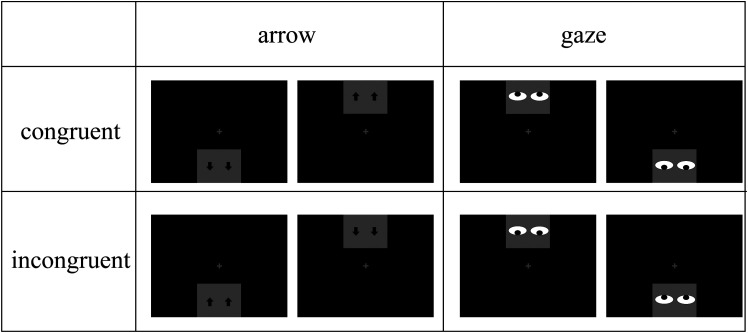 Figure 1
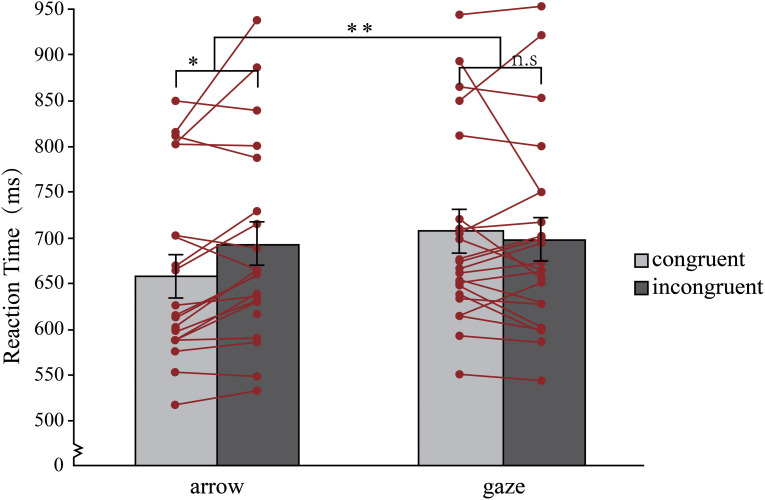 Figure 2
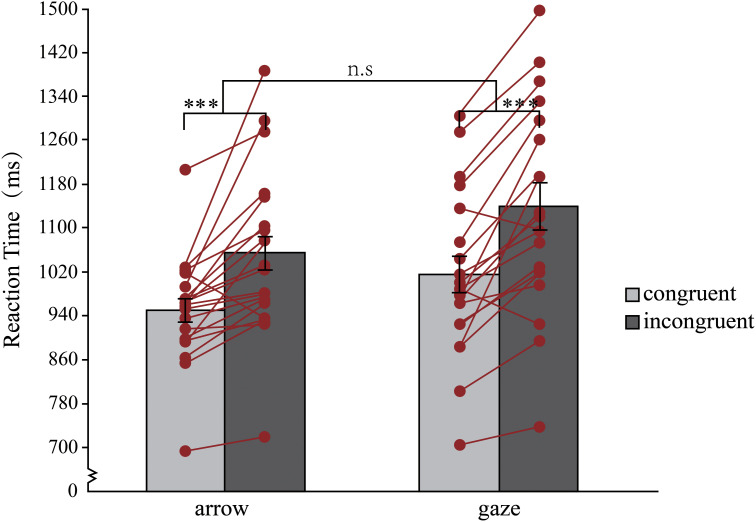 Figure 3
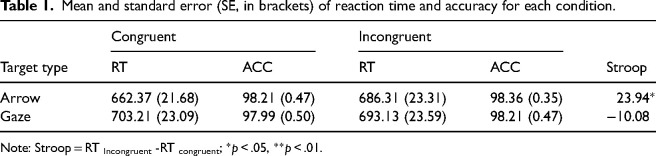 Figure 4
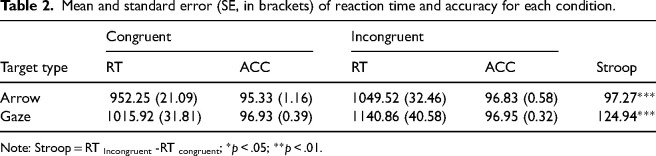 Figure 5
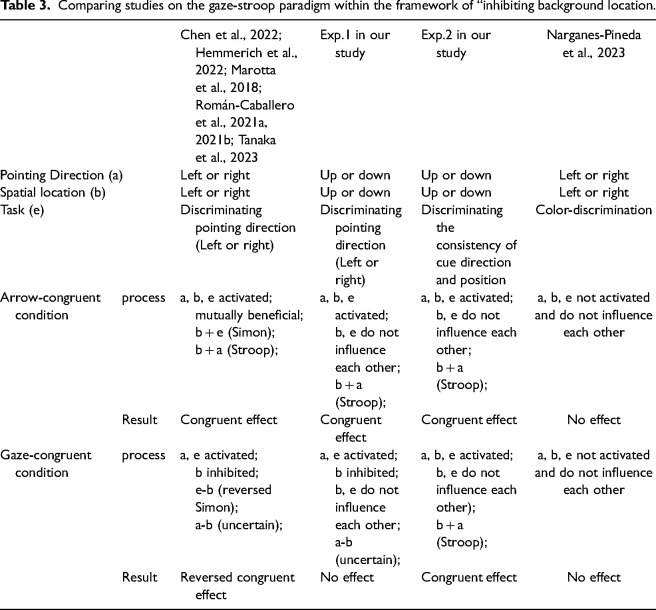 Figure 6
Peer Reviews
No public reviews on file for this paper yet. If you reviewed it on a platform where reviews are public (OpenReview, ICLR, NeurIPS, ICML), you can paste yours below so the community can read it here.
Videos
No videos yet. Explain this paper in a talk, walkthrough, or lecture? Add one.
Taxonomy
TopicsFace Recognition and Perception · Visual perception and processing mechanisms · Multisensory perception and integration