Germination characteristics associated with nicosulfuron resistance in Amaranthus retroflexus L
Yingying Zhang, Xian Xu, Bochui Zhao, Binghua Li, Zhizun Qi, Yu Wang, Guiqi Wang, Yaofa Li, Zhaofeng Huang, Xiaomin Liu

TL;DR
This study examines how nicosulfuron-resistant Amaranthus retroflexus seeds germinate differently under various environmental conditions.
Contribution
The study identifies germination differences between nicosulfuron-resistant and -sensitive Amaranthus retroflexus populations under abiotic stress.
Findings
Nicosulfuron-sensitive seeds had higher germination rates and indices than resistant seeds under stress conditions.
Resistant seeds showed delayed germination, possibly due to altered biochemical compositions.
Deep inversion tillage may help control nicosulfuron-resistant Amaranthus retroflexus.
Abstract
Nicosulfuron-resistant biotype (R) and -sensitive biotype (S) Amaranthus retroflexus L. seeds were subjected to different temperature, light, salt, osmotic potential, pH value and burial depth treatments. The difference in germination response of two populations to the above abiotic environmental factors was used to study the fitness cost of nicosulfuron-resistance evolution in A. retroflexus. The aim is to find a powerful tool for weed control in the presence of evolutionary resistance selection. The results of this experiment showed that the germination rate and germination index in S population were generally higher than that in R population. When the salt stress was 80 mM, the water potential was -0.1 Mpa ~ -0.4 Mpa, and under strong acid and alkali conditions, the germination index in S population was prominently higher than that in R population (p<0.05). The delayed seed…
Genes, proteins, chemicals, diseases, species, mutations and cell lines named across the full text — each resolved to its canonical identifier and authoritative record.
Click any figure to enlarge with its caption.
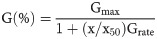 Figure 1
 Figure 2
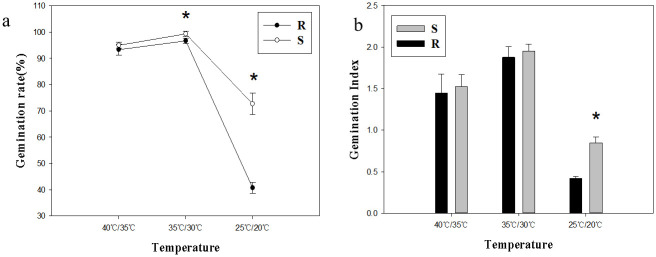 Figure 3
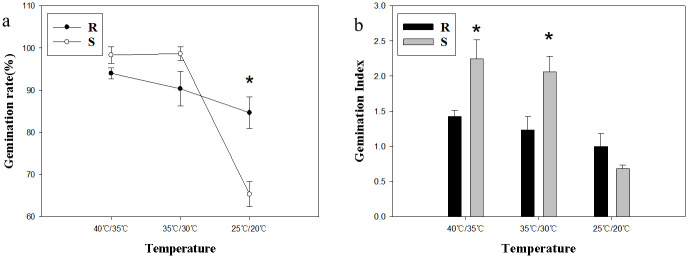 Figure 4
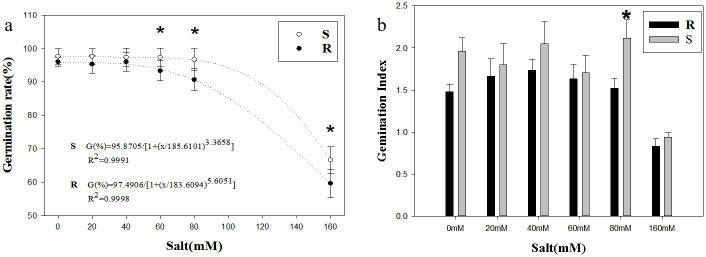 Figure 5
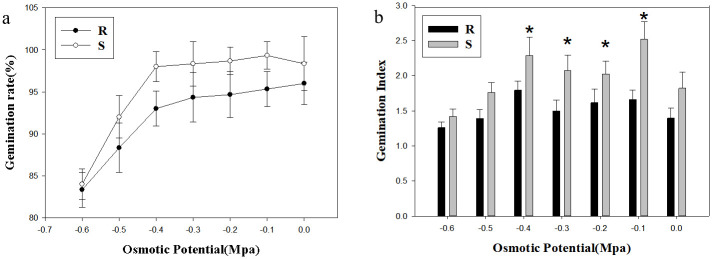 Figure 6
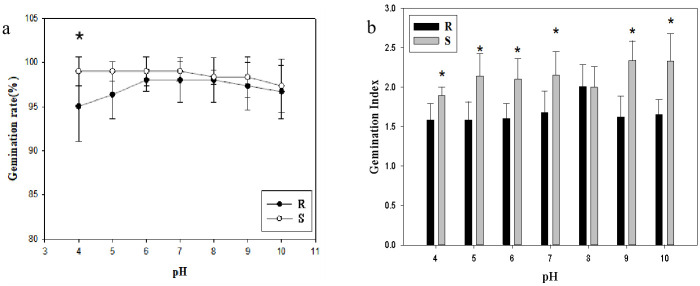 Figure 7
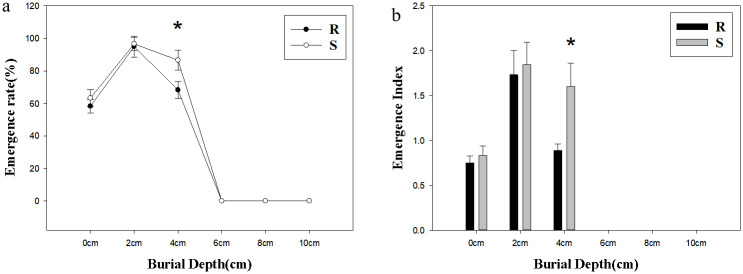 Figure 8
Peer Reviews
No public reviews on file for this paper yet. If you reviewed it on a platform where reviews are public (OpenReview, ICLR, NeurIPS, ICML), you can paste yours below so the community can read it here.
Videos
No videos yet. Explain this paper in a talk, walkthrough, or lecture? Add one.
Taxonomy
TopicsAllelopathy and phytotoxic interactions · Weed Control and Herbicide Applications · Plant Parasitism and Resistance