Authors reply regarding “A‐V‐V‐A response to single atrial premature depolarization in a narrow QRS tachycardia: What is the mechanism?”
Shingo Yoshimura, Yosuke Nakatani, Kenichi Kaseno, Kohki Nakamura, Shigeto Naito

TL;DR
The authors explain why a specific heart rhythm is more likely caused by a reentrant tachycardia rather than a junctional ectopic tachycardia.
Contribution
The paper clarifies the mechanism of a narrow QRS tachycardia following an atrial premature depolarization.
Findings
Ventriculoatrial block after an atrial premature depolarization cannot be explained by junctional ectopic tachycardia.
Atrioventricular nodal reentrant tachycardia is a more plausible mechanism in this case.
Abstract
We respond to a letter by Dr. A. Goyal. If the tachycardia were junctional ectopic tachycardia (JET), the occurrence of the ventriculoatrial block following an atrial premature depolarization could not be explained. Therefore, we conclude that atrioventricular nodal reentrant tachycardia was more likely than JET.
Genes, proteins, chemicals, diseases, species, mutations and cell lines named across the full text — each resolved to its canonical identifier and authoritative record.
Click any figure to enlarge with its caption.
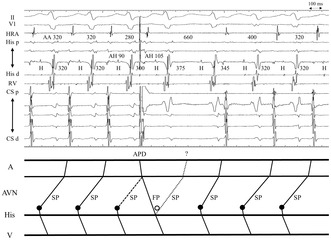 Figure 1
Peer Reviews
No public reviews on file for this paper yet. If you reviewed it on a platform where reviews are public (OpenReview, ICLR, NeurIPS, ICML), you can paste yours below so the community can read it here.
Videos
No videos yet. Explain this paper in a talk, walkthrough, or lecture? Add one.
Taxonomy
TopicsCardiac Arrhythmias and Treatments · Atrial Fibrillation Management and Outcomes · Cardiac electrophysiology and arrhythmias