Comparison of Fractional Flow Reserve and Resting Full-Cycle Ratio in the Functional Assessment of Coronary Artery Stenosis in Patients with Non-ST-Segment Elevation Acute Coronary Syndrome
Yumeng Lei, Mao Jiang, Xu Liu, Shuaiyong Zhang, Mengyao Li, Yunfei Wang, Ming Chen, Nan Guo, Yongxing Liu, Xufen Cao, Liqiu Yan

TL;DR
This study compares two methods for assessing heart artery blockages in patients with a specific type of heart condition and finds that one method is more variable when a certain artery is involved.
Contribution
Identifies left anterior descending artery involvement as a key predictor of discrepancies between FFR and RFR measurements in NSTE-ACS patients.
Findings
80% concordance between fractional flow reserve (FFR) and resting full-cycle ratio (RFR) measurements.
Left anterior descending artery (LAD) lesions showed significantly lower consistency between FFR and RFR compared to non-LAD lesions.
LAD involvement independently predicts diagnostic discrepancies between FFR and RFR in NSTE-ACS patients.
Abstract
This study investigated factors influencing discrepancies between fractional flow reserve (FFR) and resting full-cycle ratio (RFR) in the functional assessment of coronary artery stenosis in patients with non-ST-segment elevation acute coronary syndrome (NSTE-ACS). We included 320 diseased vessels from 253 consecutive patients with NSTE-ACS. Vessels were categorized into four groups based on FFR ≤0.80 and RFR ≤0.89 thresholds: group 1 concordant negative (RFR–/FFR–), group 2 positive RFR and negative FFR (RFR+/FFR–), group 3 negative RFR and positive FFR (RFR–/FFR+), and group 4 concordant positive (RFR+/FFR+). Univariate and multivariate logistic regression analyses were conducted to identify predictors of diagnostic discrepancy between FFR and RFR. Of the 320 diseased vessels, 182 (56.9%) were in group 1 (RFR–/FFR–), 33 (10.3%) in group 2 (RFR+/FFR–), 31 (9.7%) in group…
Genes, proteins, chemicals, diseases, species, mutations and cell lines named across the full text — each resolved to its canonical identifier and authoritative record.
Click any figure to enlarge with its caption.
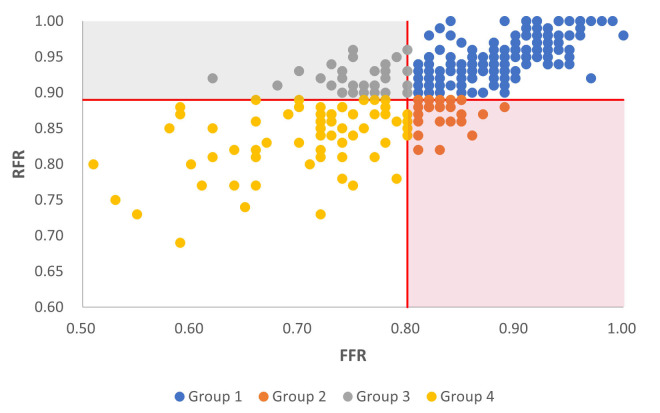 Figure 1
 Figure 2
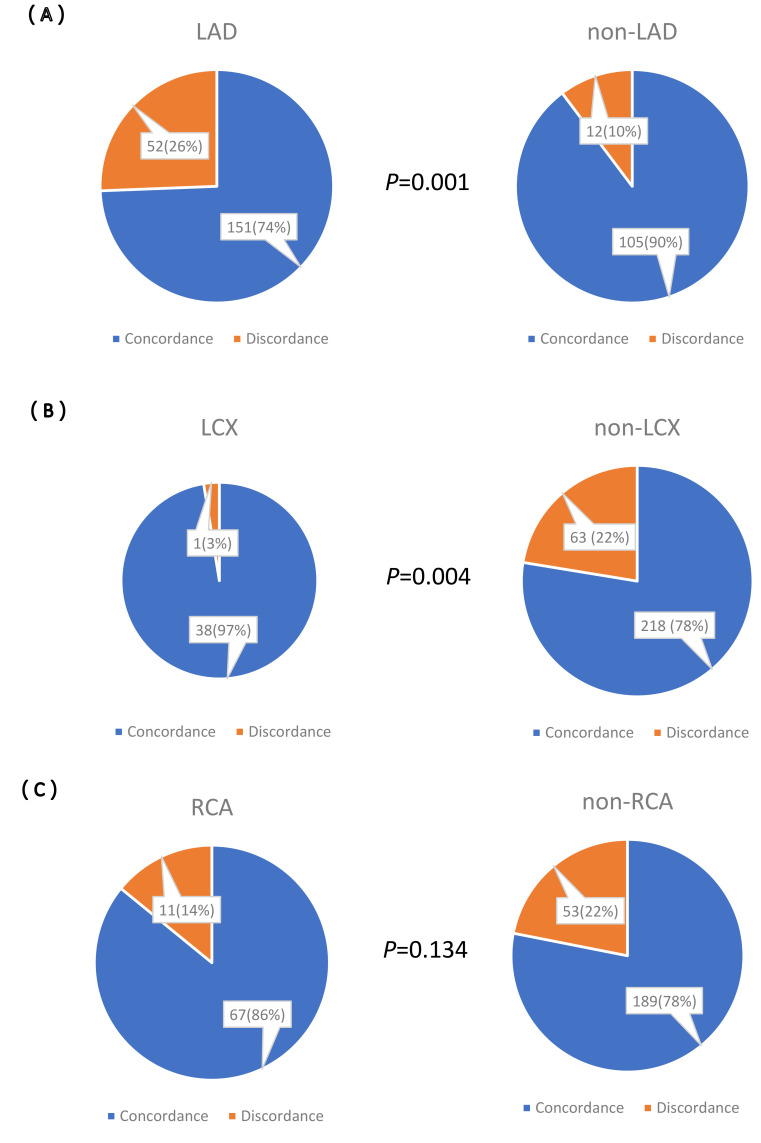 Figure 3
Peer Reviews
No public reviews on file for this paper yet. If you reviewed it on a platform where reviews are public (OpenReview, ICLR, NeurIPS, ICML), you can paste yours below so the community can read it here.
Videos
No videos yet. Explain this paper in a talk, walkthrough, or lecture? Add one.
Taxonomy
TopicsCoronary Interventions and Diagnostics · Acute Myocardial Infarction Research · Cardiac Imaging and Diagnostics