LYNSU: automated 3D neuropil segmentation of fluorescent images for Drosophila brains
Kai-Yi Hsu, Chi-Tin Shih, Nan-Yow Chen, Chung-Chuan Lo

TL;DR
LYNSU is a fast and accurate automated method for segmenting 3D neuropils in Drosophila brains from fluorescent images, avoiding the need for brain template alignment.
Contribution
A novel two-stage automated segmentation method (LYNSU) that achieves high accuracy with minimal training data and enables individual-level brain analysis.
Findings
LYNSU achieves 99.4% accuracy in neuropil localization using YOLOv7 and 3D U-Net for segmentation.
Segmentation accuracy reaches up to 3D IoU of 0.869, comparable to manual annotations.
Applied to 8,703 brains, LYNSU revealed 10.14% with over 10% volume asymmetry in mushroom bodies.
Abstract
The brain atlas, which provides information about the distribution of genes, proteins, neurons, or anatomical regions, plays a crucial role in contemporary neuroscience research. To analyze the spatial distribution of those substances based on images from different brain samples, we often need to warp and register individual brain images to a standard brain template. However, the process of warping and registration may lead to spatial errors, thereby severely reducing the accuracy of the analysis. To address this issue, we develop an automated method for segmenting neuropils in the Drosophila brain for fluorescence images from the FlyCircuit database. This technique allows future brain atlas studies to be conducted accurately at the individual level without warping and aligning to a standard brain template. Our method, LYNSU (Locating by YOLO and Segmenting by U-Net), consists of two…
Genes, proteins, chemicals, diseases, species, mutations and cell lines named across the full text — each resolved to its canonical identifier and authoritative record.
Click any figure to enlarge with its caption.
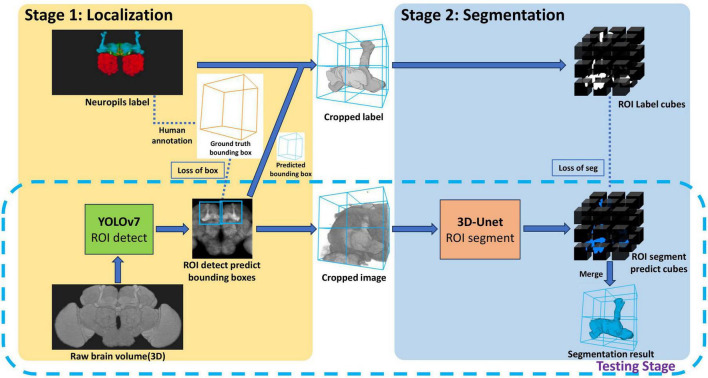 Figure 1
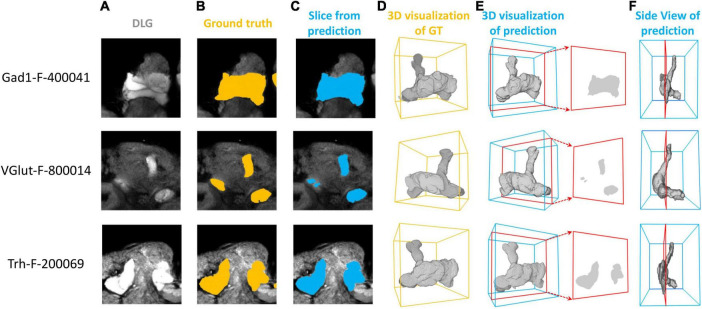 Figure 2
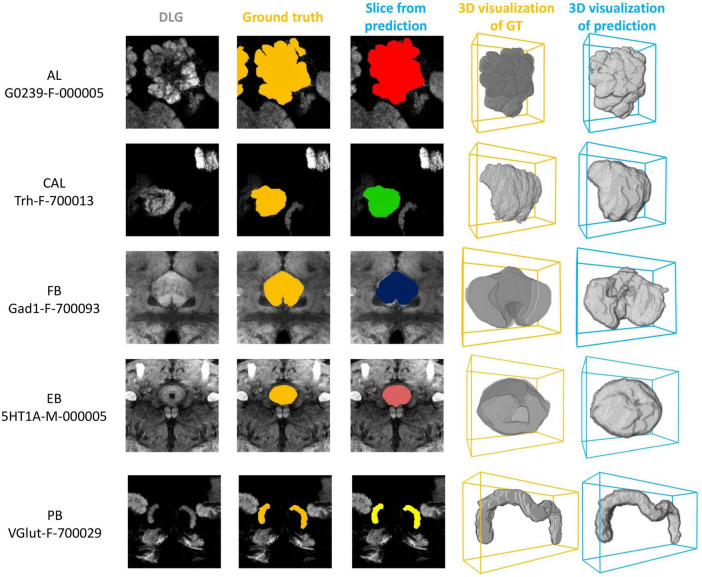 Figure 3
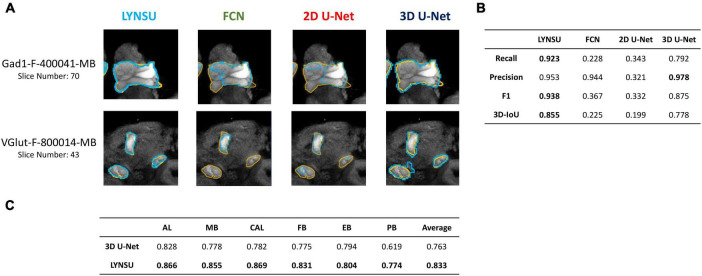 Figure 4
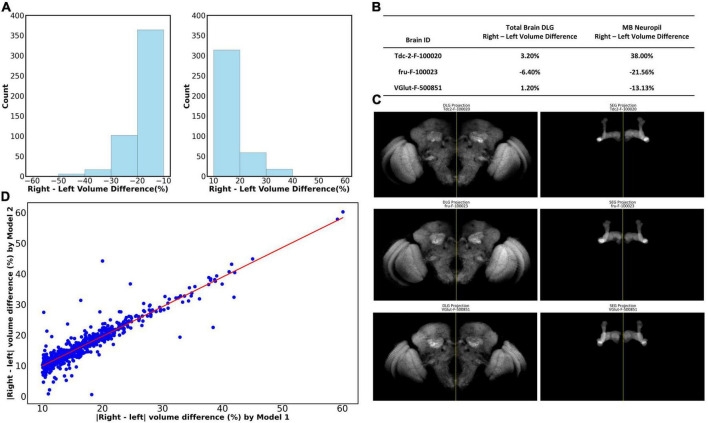 Figure 5
Peer Reviews
No public reviews on file for this paper yet. If you reviewed it on a platform where reviews are public (OpenReview, ICLR, NeurIPS, ICML), you can paste yours below so the community can read it here.
Videos
No videos yet. Explain this paper in a talk, walkthrough, or lecture? Add one.
Taxonomy
TopicsNeurobiology and Insect Physiology Research · Cell Image Analysis Techniques · Advanced Fluorescence Microscopy Techniques