Surgical timing for asphyxiating thoracic dystrophy
Xingfei Chen, Huilan Ye, Run Dang, Yiyu Yang

TL;DR
A 4-year-old girl with asphyxiating thoracic dystrophy had severe complications after surgery, highlighting the importance of timing for corrective operations.
Contribution
The study emphasizes the need for careful evaluation of surgical timing in young children with asphyxiating thoracic dystrophy.
Findings
Corrective surgery for asphyxiating thoracic dystrophy is optimal between 6 and 12 years old.
Children under 6 years old face higher risks and require careful evaluation before surgery.
Early surgical intervention can lead to severe respiratory complications.
Abstract
This report describes a 4-year-old girl diagnosed with asphyxiating thoracic dystrophy who experienced severe respiratory distress and multiple complications after undergoing a corrective operation for a thoracic deformity. The optimal age for children with asphyxiating thoracic dystrophy to receive a corrective operation is between 6 and 12 years old. For children under 6 years old, the decision to undergo an operation should be carefully evaluated. A 4-year-old female presented with a progressive thoracic wall deformity existent since birth, accompanied by growth retardation and tachypnoea after exercise, with recurrent lung infections over the past 6 months.
Genes, proteins, chemicals, diseases, species, mutations and cell lines named across the full text — each resolved to its canonical identifier and authoritative record.
Click any figure to enlarge with its caption.
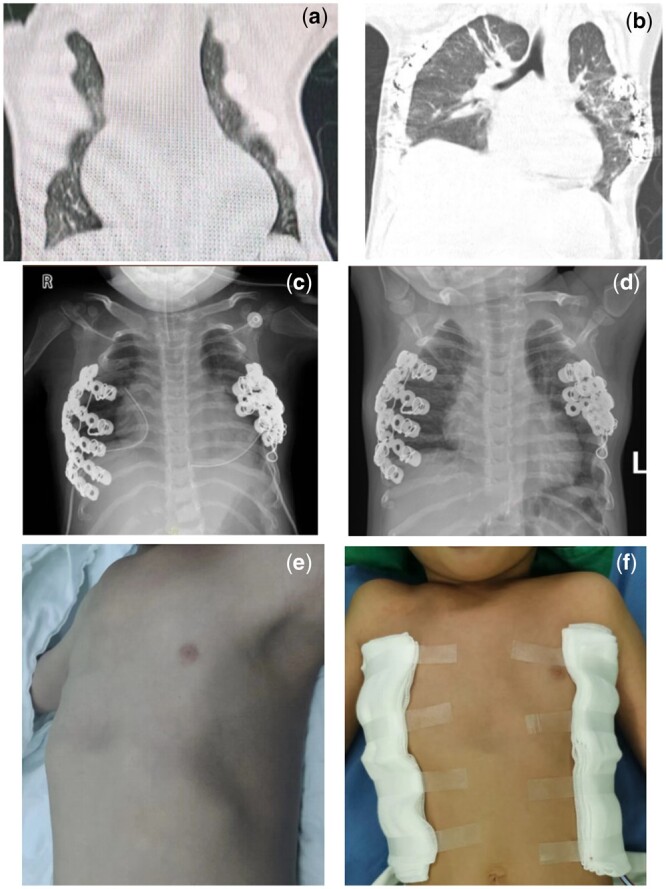 Figure 1
Peer Reviews
No public reviews on file for this paper yet. If you reviewed it on a platform where reviews are public (OpenReview, ICLR, NeurIPS, ICML), you can paste yours below so the community can read it here.
Videos
No videos yet. Explain this paper in a talk, walkthrough, or lecture? Add one.
Taxonomy
TopicsCongenital Diaphragmatic Hernia Studies · Craniofacial Disorders and Treatments · Neonatal Respiratory Health Research