Takakia possesses a key marker of embryophyte sporopollenin
Dae-Yeon Suh, Damanpreet K Sraan, Neil W Ashton

TL;DR
This paper identifies a unique protein in the moss Takakia that marks the presence of sporopollenin, a key component in spore and pollen walls of land plants.
Contribution
The study confirms the presence of ASCL in Takakia and its absence in algae, establishing a molecular marker for sporopollenin.
Findings
Takakia lepidozioides possesses ASCL, a marker for sporopollenin in embryophyte spores and pollen.
Algae with sequenced genomes lack ASCL and thus do not produce sporopollenin.
ASCL is a distinguishing feature of land plant spore walls.
Abstract
The enigmatic moss, Takakia lepidozioides , possesses a particular type III polyketide synthase, ASCL (Anther-Specific Chalcone synthase-Like), that is an identifying marker for genuine sporopollenin in the walls of embryophyte spores and pollen grains. By contrast, a survey of all algae with sequenced genomes confirms that they do not possess ASCL and, therefore, their spore walls are not composed of sporopollenin.
Genes, proteins, chemicals, diseases, species, mutations and cell lines named across the full text — each resolved to its canonical identifier and authoritative record.
Click any figure to enlarge with its caption.
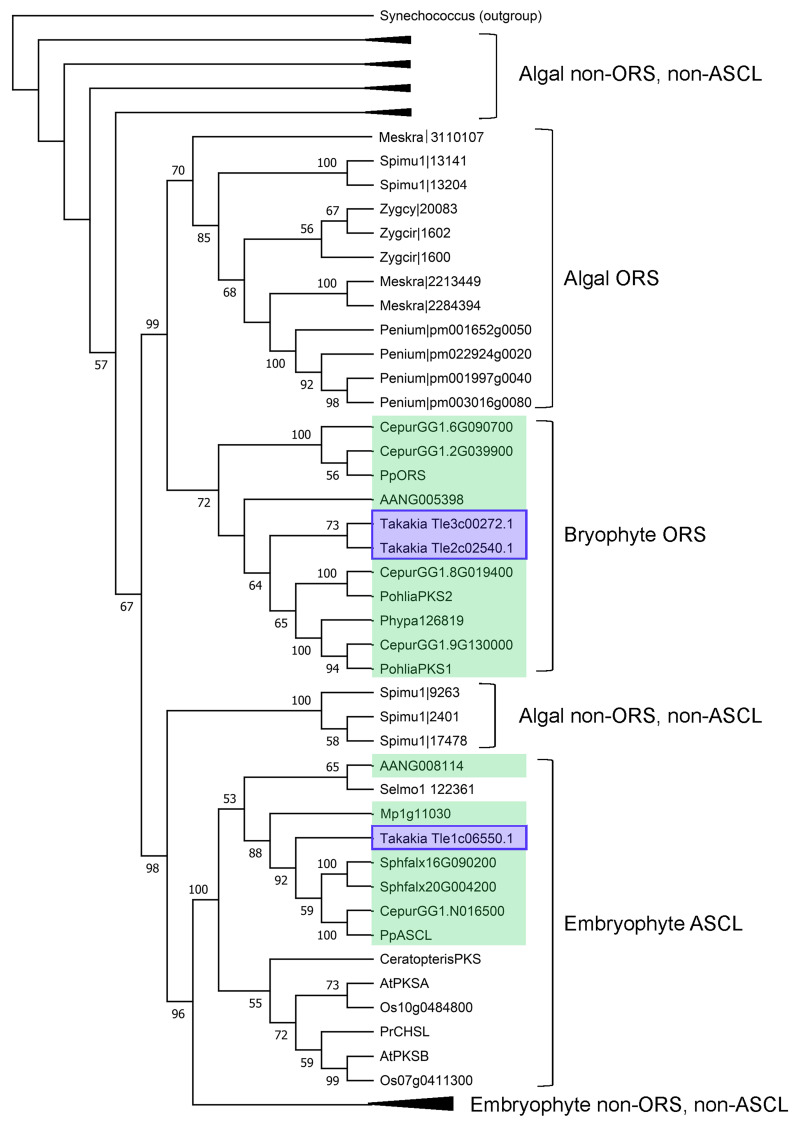 Figure 1
Peer Reviews
No public reviews on file for this paper yet. If you reviewed it on a platform where reviews are public (OpenReview, ICLR, NeurIPS, ICML), you can paste yours below so the community can read it here.
Videos
No videos yet. Explain this paper in a talk, walkthrough, or lecture? Add one.
Taxonomy
TopicsFern and Epiphyte Biology · Marine and coastal plant biology