Hydroxyurea mobile directly observed therapy versus standard monitoring in patients with sickle cell anemia: a phase 2 randomized trial
Philip Sasi, Abel Makubi, Raphael Z. Sangeda, Mariam Y. Ngaeje, Bruno P. Mmbando, Joseph Soka, Caterina Rosano, Alex S. Magesa, Sharon E. Cox, Julie Makani, Enrico M. Novelli

TL;DR
A study tested if using smartphones to monitor hydroxyurea treatment improves adherence in sickle cell anemia patients, but found no significant improvement.
Contribution
The study is the first to evaluate mobile Directly Observed Therapy (m-DOT) for hydroxyurea adherence in sickle cell anemia in sub-Saharan Africa.
Findings
m-DOT did not significantly increase hydroxyurea adherence compared to standard monitoring.
Adherence remained high in both groups, with no safety concerns.
The study recommends larger trials with longer follow-up to further assess m-DOT effectiveness.
Abstract
Sickle cell anemia (SCA) prevalence remains high in sub-Saharan Africa. Long-term treatment with hydroxyurea (HU) increases survival, however, poor adherence to treatment could limit effectiveness. Whilst HU treatment adherence is currently high, this might decrease over time. We conducted a single-center, randomized, open-label, parallel group phase 2 controlled clinical trial to determine whether mobile Directly Observed Therapy (m-DOT) increases HU treatment adherence (NCT02844673). Eligible participants were adults with homozygous SCA. People on a chronic blood transfusion program, with hemoglobin (Hb) A levels greater than 20% of the total Hb, total Hb less than 4 g/dL, pregnant or HIV positive were excluded. After a 3-month pre-treatment period participants were randomized to either m-DOT or standard monitoring arm. All participants received smart mobile phones and were treated…
Genes, proteins, chemicals, diseases, species, mutations and cell lines named across the full text — each resolved to its canonical identifier and authoritative record.
Click any figure to enlarge with its caption.
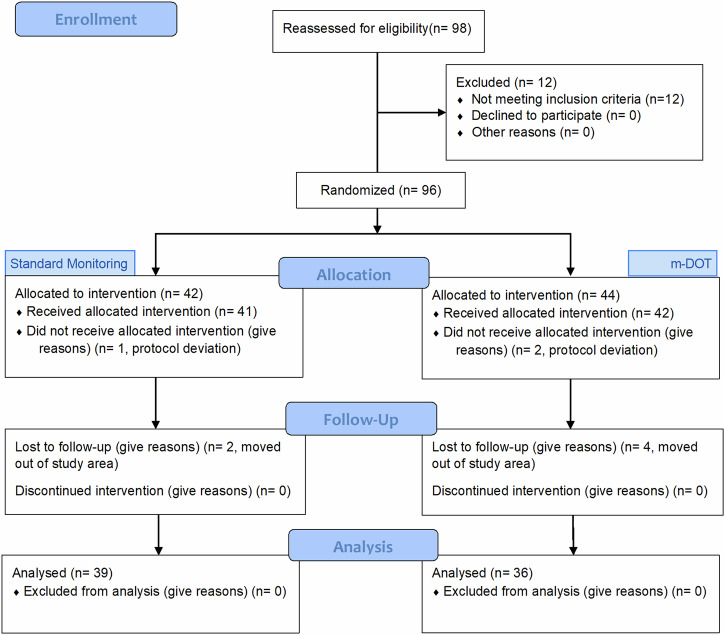 Figure 1
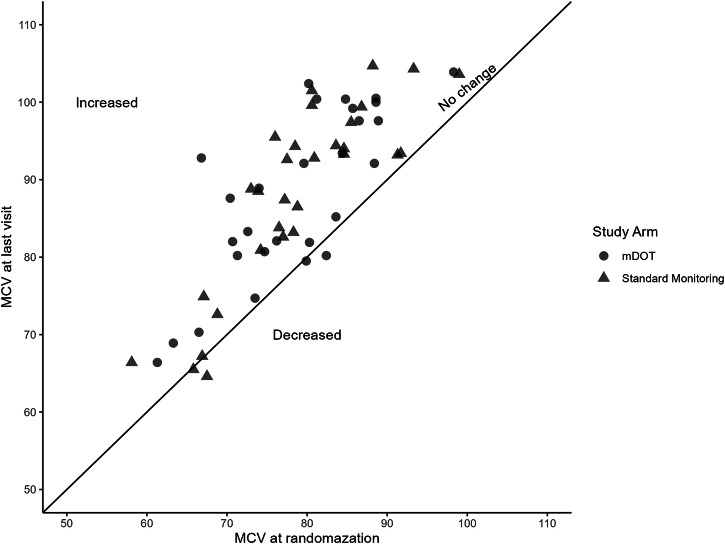 Figure 2
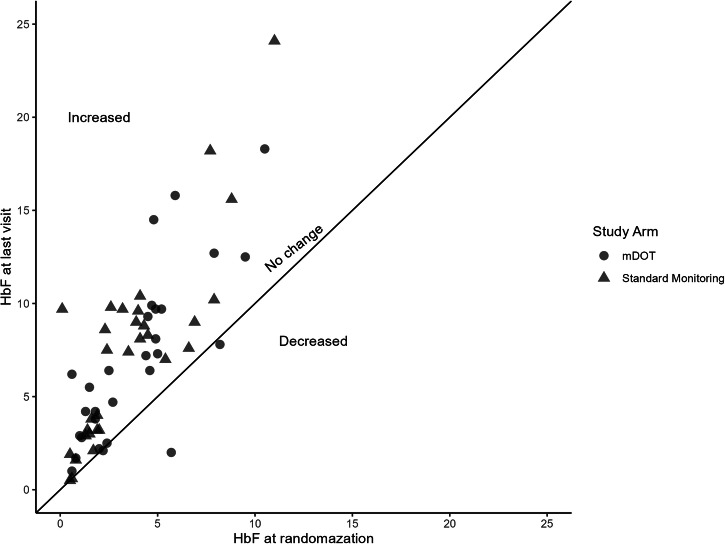 Figure 3
Peer Reviews
No public reviews on file for this paper yet. If you reviewed it on a platform where reviews are public (OpenReview, ICLR, NeurIPS, ICML), you can paste yours below so the community can read it here.
Videos
No videos yet. Explain this paper in a talk, walkthrough, or lecture? Add one.
Taxonomy
TopicsHemoglobinopathies and Related Disorders · Myeloproliferative Neoplasms: Diagnosis and Treatment · Iron Metabolism and Disorders