Alpha sensory stimulation modulates theta phase during speech-print associative learning
Zhijun Liao, Xiya Ao, Yulu Sun, Manli Zhang, Xiangzhi Meng

TL;DR
Using 10 Hz sensory stimulation before learning new speech-print pairs helps improve memory by adjusting theta brain waves.
Contribution
The study shows that α-rate stimulation resets theta phase to enhance associative learning.
Findings
10 Hz stimulation resets theta oscillation phase for better associative learning.
Alpha oscillations regulate attention while theta oscillations support memory storage.
Findings could help improve educational practices for children with reading difficulties.
Abstract
Applying 10 Hz (α-rate) sensory stimulation, not 5 Hz (θ-rate), prior to introducing novel speech-print pairs can reset the phase of θ oscillations and enhance associative learning. This rapid gain indicates coordinated mechanisms to regulate attentional/cognitive resources (α oscillations) and facilitate memory storage (θ oscillations) early in learning. The present findings may inform educational practices for children with reading difficulties.
Genes, proteins, chemicals, diseases, species, mutations and cell lines named across the full text — each resolved to its canonical identifier and authoritative record.
Click any figure to enlarge with its caption.
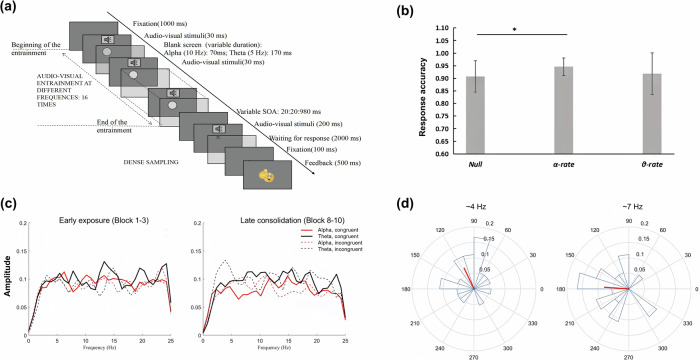 Figure 1
Peer Reviews
No public reviews on file for this paper yet. If you reviewed it on a platform where reviews are public (OpenReview, ICLR, NeurIPS, ICML), you can paste yours below so the community can read it here.
Videos
No videos yet. Explain this paper in a talk, walkthrough, or lecture? Add one.
Taxonomy
TopicsNeural dynamics and brain function · EEG and Brain-Computer Interfaces · Memory and Neural Mechanisms