DS-SIAUG: A Self-Training Approach Using a Disrupted Student Model for Enhanced Side-Scan Sonar Image Augmentation
Chengyang Peng, Shaohua Jin, Gang Bian, Yang Cui

TL;DR
This paper introduces DS-SIAUG, a new method for improving subsea target detection by enhancing sonar image datasets using a disrupted student model.
Contribution
The novel DS-SIAUG method uses a disrupted student model for image selection, achieving better recognition accuracy than traditional augmentation techniques.
Findings
Using the Disrupted Student model for selection achieves recognition accuracy comparable to manual selection.
DS-SIAUG improves intelligent target recognition accuracy by approximately 5% over direct adversarial network augmentation.
Abstract
Side-scan sonar is a principal technique for subsea target detection, where the quantity of sonar images of seabed targets significantly influences the accuracy of intelligent target recognition. To expand the number of representative side-scan sonar target image samples, a novel augmentation method employing self-training with a Disrupted Student model is designed (DS-SIAUG). The process begins by inputting a dataset of side-scan sonar target images, followed by augmenting the samples through an adversarial network consisting of the DDPM (Denoising Diffusion Probabilistic Model) and the YOLO (You Only Look Once) detection model. Subsequently, the Disrupted Student model is used to filter out representative target images. These selected images are then reused as a new dataset to repeat the adversarial filtering process. Experimental results indicate that using the Disrupted Student…
Genes, proteins, chemicals, diseases, species, mutations and cell lines named across the full text — each resolved to its canonical identifier and authoritative record.
Click any figure to enlarge with its caption.
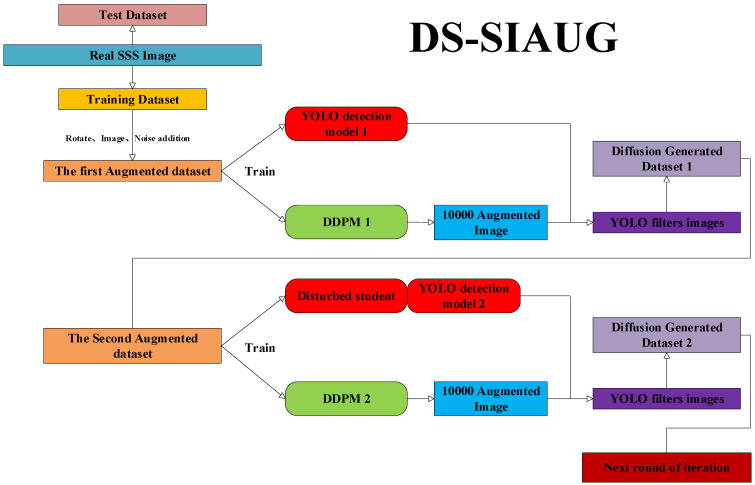 Figure 1
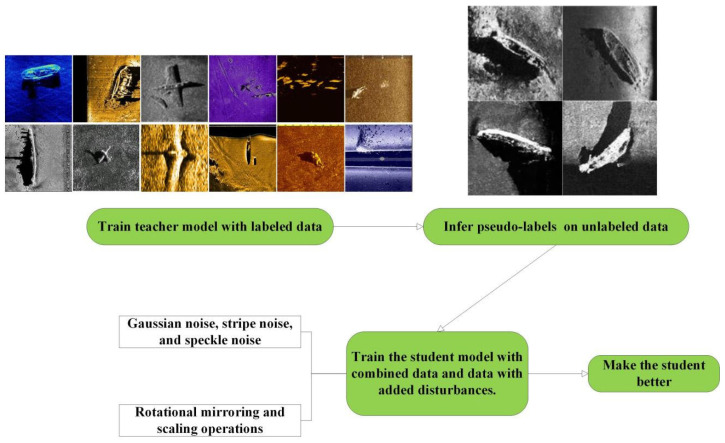 Figure 2
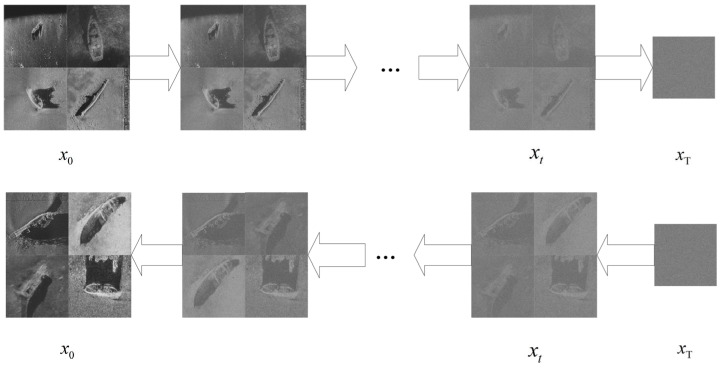 Figure 3
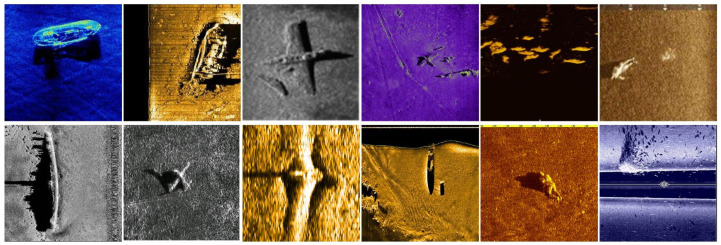 Figure 4
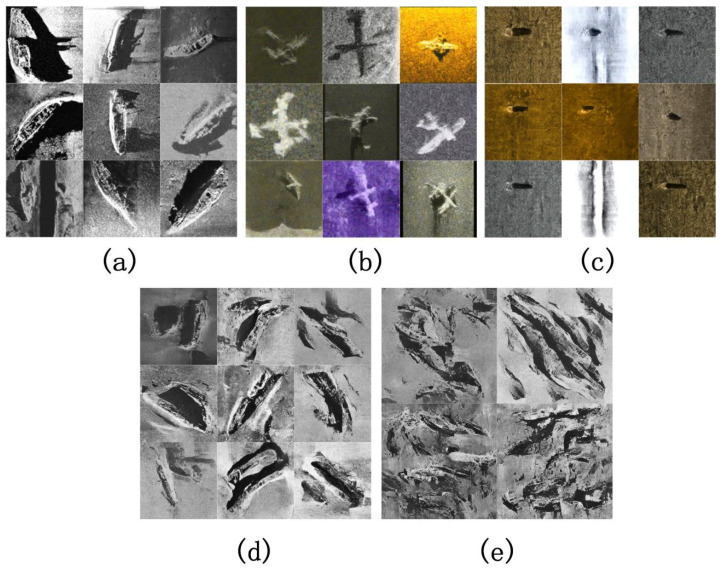 Figure 5
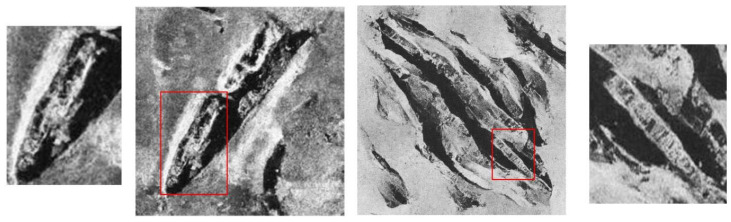 Figure 6
Peer Reviews
No public reviews on file for this paper yet. If you reviewed it on a platform where reviews are public (OpenReview, ICLR, NeurIPS, ICML), you can paste yours below so the community can read it here.
Videos
No videos yet. Explain this paper in a talk, walkthrough, or lecture? Add one.
Taxonomy
TopicsUnderwater Acoustics Research · Seismic Imaging and Inversion Techniques · Generative Adversarial Networks and Image Synthesis