Reduction of hydrocarbon pollutants by hyacinth plants ( Eichhornia crassipes)
Syahril Nedi, Irwan Effendi, Afrizal Tanjung, Elizal Elizal, Hemen Deka, Anithadevi Kenday Sivaram

TL;DR
Hyacinth plants can significantly reduce oil pollution in water and improve water quality by lowering hydrocarbon levels and increasing oxygen.
Contribution
This study demonstrates the effectiveness of hyacinth plants in reducing petroleum hydrocarbons and improving water quality parameters.
Findings
Hyacinth plants reduced total petroleum hydrocarbon (TPH) by 79% compared to natural reduction of 17–27%.
TPH reduction correlated with decreased chlorophyll in hyacinth leaves and increased dissolved oxygen in water.
Hyacinth plants improved water quality by reducing pollutants and enhancing dissolved oxygen levels.
Abstract
Background: The application of phytoremediation by utilizing plants has been used to control oil pollution in waters. One of the plants that can act as a phytoremediator is the hyacinth because this plant can reduce various pollutants including petroleum hydrocarbons. This study aims to study the reduction ability of petroleum hydrocarbons at different concentrations including improving water quality. Methods: This study consisted of one treatment (petroleum hydrocarbon) consisting of five factors with three replicates. The treatments consisted of 10 ppm (E1), 30 ppm (E2), 50 ppm (E3), 70 ppm (E4), 90 ppm (E5), and (E0) without aquatic plants as controls. The treatments were observed daily and measured from the first day (D-1), the seventh day (D-7), and the 14 th day (D-14). The water quality in each treatment was also measured, such as water temperature, pH, and dissolved oxygen.…
Genes, proteins, chemicals, diseases, species, mutations and cell lines named across the full text — each resolved to its canonical identifier and authoritative record.
Click any figure to enlarge with its caption.
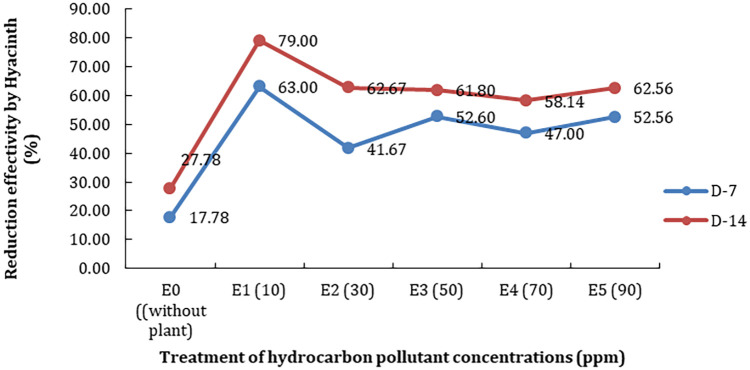 Figure 1
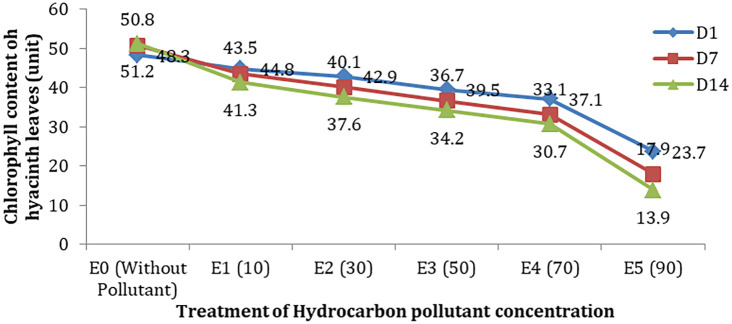 Figure 2
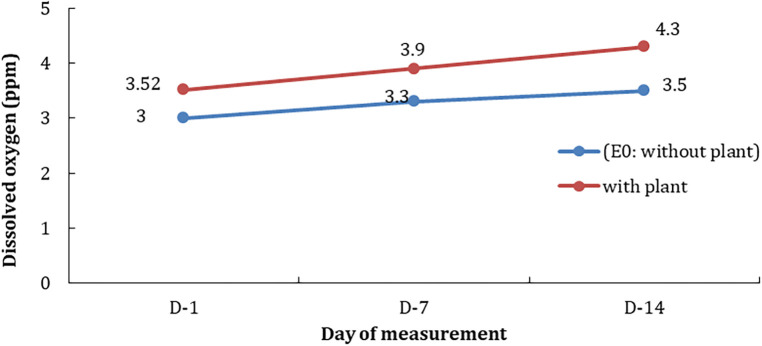 Figure 3
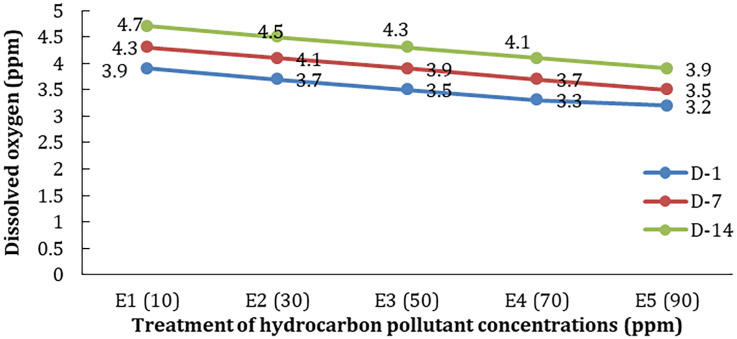 Figure 4
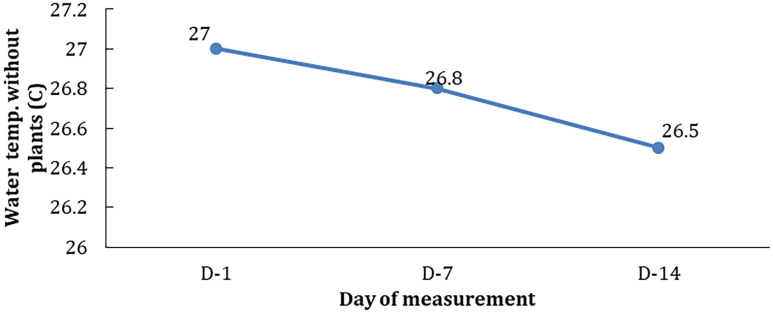 Figure 5
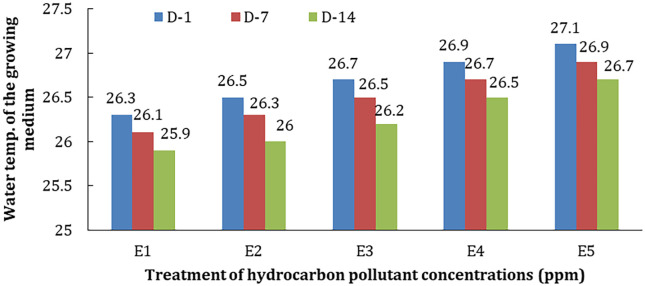 Figure 6
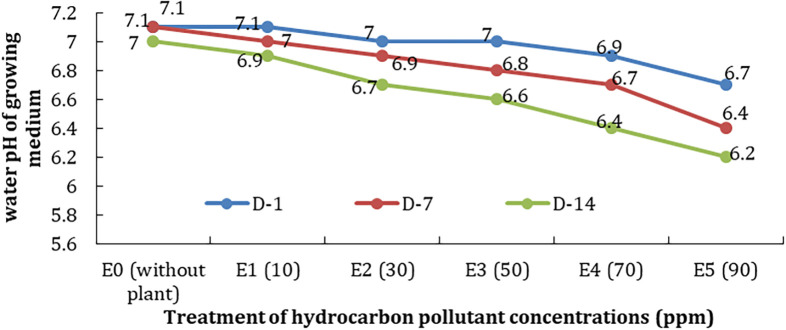 Figure 7
| Treatments | Notation and concentration of petroleum hydrocarbon (ppm) |
|---|---|
| With phytoremediator (200 g of hyacinth) | E1=10, E2=30, E3=50, E4=70, E5=90 |
| Without phytoremediator | E0=control |
| Treatments | TPH concentrations (ppm) | Total reduction after 14 days of observations | ||||
|---|---|---|---|---|---|---|
| D-1 | D-7 | D-14 | ||||
| con. | con. | red. | con. | red. | ||
| E1 | 10 | 3.700±0.20 a | 6.3 | 2.10±0.10 a | 1.6 | 7.9 |
| E2 | 30 | 17.33±0.76 b | 12.7 | 11.23±0.25 b | 6.1 | 18.8 |
| E3 | 50 | 23.73±1.25 c | 26.3 | 19.07±0.95 c | 4.7 | 31 |
| E4 | 70 | 37.07±1.05 d | 33 | 29.27±1.25 d | 7.8 | 40.8 |
| E5 | 90 | 42.73±1.95 e | 47.3 | 33.73±0.25 e | 9 | 56.3 |
| E0 | 90 | 74.00±1.00 f | 16 | 65.00±2.00 f | 9 | 25 |
- —Lembaga Penelitian dan Pengabdian kepada Masyarakat, Universitas Riau
Peer Reviews
No public reviews on file for this paper yet. If you reviewed it on a platform where reviews are public (OpenReview, ICLR, NeurIPS, ICML), you can paste yours below so the community can read it here.
Videos
No videos yet. Explain this paper in a talk, walkthrough, or lecture? Add one.
Taxonomy
TopicsPlant responses to water stress · Constructed Wetlands for Wastewater Treatment
Introduction
Oil pollution is a common problem in coastal waters; such as oil slicks or spills. Most of the oil contains toxic hydrocarbon compounds that are vulnerable to habitats and biota. Common ways to encounter this pollution are through the oil boom, skimmer, dispersant, and bioremediation. ^ 1 ^ ^–^ ^ 3 ^ Bioremediation is a way to clean up contaminants in an environment by living organisms; for example, the use of bacteria and water plants. Research on hyacinth as a phytoremediator has been conducted by several researchers before; for example, for radioactive waste ^ 4 ^ ^–^ ^ 6 ^ and using biogas hyacinth as a phytoremediator of industrial waste. ^ 7 ^ ^,^ ^ 8 ^ Besides, the use of water plants for phytoremediators is cost-effective and eco-friendly and well-documented. ^ 9 ^ ^,^ ^ 10 ^ Based on this circumstance, the author is interested in testing the ability of the hyacinth plant to reduce hydrocarbon pollutants in saline water.
Method
Time and place
This research was conducted in June 2022 at the Lagio Laboratory, Pekanbaru. The test plant, hyacinth, was taken from the reservoir of Binawidya Campus, Faculty of Fisheries and Marine, Universitas Riau. Meanwhile, the hydrocarbon pollutants used come from Pertamina DEX Solar from Pekanbaru gas stations. The seawater was taken from the coastal waters of Dumai and composted fertilizer was also used for the test plants. The plants were grown in 20 L plastic washbasins.
Research methods
In this experiment, petroleum hydrocarbon was added to the water of growing plants as a pollutant with different concentrations ( Table 1). Each treatment consisted of three replicates. The reductions of the petroleum hydrocarbon in the treatments were measured in terms of total petroleum hydrocarbon (TPH); they were measured once a week, starting from the 1 ^st^ day (D-1), the 7 ^th^ day (D-7), and the 14 ^th^ day (D-14).
Procedure
Acclimatization to salinity
The container used was a black tub with a volume of 10 L of 15 units. The research was started by acclimatizing hyacinth plants to different salinities, namely 1, 3, 5, 7, and 9 ppt. In each container, 200 g of hyacinth was added and its growth was observed for seven days. Plant growth was seen based on changes in leaf color, root condition, and number of leaves. The acclimatization results showed that the test medium with a salinity of 3 ppt was suitable for plants to grow in coastal areas, some plants at salinity 5,7, and 9 died after being given salinity treatment.
Petroleum hydrocarbon observations
After determining the suitable salinity for the test plants, they were then planted in petroleum hydrocarbon pollutant solutions with different concentrations, namely 10, 30, 50, 70, and 90 ppm, and without plants (control). The first step was a black tub with a volume of 20 L of 15 units filled with 10 L of water with a salinity of 3 ppt. Then 50 g of fertilizer was added to each container and 200 g of test plants were added. After that, petroleum hydrocarbons were added according to the concentration determined and observed for 14 days. ^ 11 ^ ^,^ ^ 12 ^ The parameters observed were total petroleum hydrocarbons, water quality (temperature, pH, DO, and salinity), and plant conditions (leaf color, root condition, and stem shape). To maintain the salinity in the test container, fresh water was added according to a predetermined volume limit, i.e. 10 L. Each container was marked, to determine the level of water whose volume is 10 L.
Leaf chlorophyll measurement
The chlorophyll value of water hyacinth leaves was read using a chlorophyll meter (Konica Minolta Spad 502 Plus). Observation of chlorophyll content in the leaves was carried out randomly by placing the leaves in the sensor area and waiting for the value to be displayed on the screen. Leaf chlorophyll measurements were carried out in situ between 10.00 AM–03.00 PM.
Data analysis
Data on TPH concentration and chlorophyll were tabulated and analyzed using SPSS version 23. Data were analyzed using a One Way ANOVA and continued by a Student Newman Keuls (SNK) test if necessary.
Result
Total petroleum hydrocarbon concentration
The phytoremediators (hyacinths) could grow well in the tested media; with 3 ppt of saline water at 10–20 cm in height after acclimation. The content of hydrocarbon pollutants can naturally decrease, this also occurs in the treatment without the addition of plants; this is thought to be due to evaporation (E0). The concentrations of TPH in all treatments at the time of observations can be seen in Table 2.
Table 2 showed that the TPH in all treatments reduced after the seventh day (D-7) and the 14 ^th^ day (D-14) of observations. The reductions were higher on the seventh day in comparison to the 14 ^th^ day of observation. These reductions ranged from 6.3–47.3 ppm and from 1.6–9 ppm consecutively. However, the total reductions ranged from 7.9–56.3 after the 14 ^th^ day of observations. This means that the longer the observation time the higher the TPH reductions. The affectivity of the plant to reduce TPH showed the same pattern due to the time constraint of observations ( Figure 1).
The effectivity of the plant in decreasing total petroleum hydrocarbon (TPH) on each treatment of observation time.
The treatment without a phytoremediator (E0) can only reduce the TPH by as much as 17.78% after the 7 ^th^ day (D-7) and 27.78% after the 14 ^th^ day (D-14). In contrast, it ranged between 41.67% and 63% reduction using a phytoremediator. The highest effectivity of reductions was found at the treatment E10 (79%) with 10 ppm of petroleum hydrocarbon because the reduction process will be optimum at lower concentrations of pollutants. In addition, there was a significant effect of hydrocarbon concentrations on the plant’s ability to reduce TPH, based on ANOVA analysis that p<0.05.
Chlorophyll content and water quality
Chlorophyll is also an indication of the productivity of green plants and is one of the important elements in the process of photosynthesis. The results showed that the amount of chlorophyll in the leaves of the test plant (hyacinth) decreased in line with the increase in hydrocarbon pollutants and the length of observation time ( Figure 2). In the treatment without hydrocarbons (E0), the amount of chlorophyll on the leaves of hyacinths was 48.3 units on the first day (D-1), then increased to 50.8 and 51.2 units on the 7 ^th^ day and the 14 ^th^ day (D-7 and D-14). In treating hydrocarbon pollutants (e.g. E5), the amount of chlorophyll encountered was 17.9 units on the seventh day and 13.9 on the 14 ^th^ day.
Chlorophyll content (mg/L) in hyacinth leaves based on observation time.
Differences in pollutant concentration treatment influence the chlorophyll content in hyacinth leaves (p<0.05). Another parameter of water quality is dissolved oxygen (DO). In control media (without plants), the average DO on the first day (D-1) was 3.0 ppm; it increased to 3.3 ppm and 3.5 ppm after seven and 14 days consecutively. It indicated that the DO naturally increased with the pollutant hydrocarbon. However, the increases of DO were higher in the treatments with hyacinth phytoremediators; it was up to 20% compared to the treatments without the phytoremediator plants ( Figure 3).
Comparison of dissolved oxygen on treatment using hyacinths and without hyacinths as phytoremediators at observation time.
Variations in the concentration of hydrocarbon pollutants affect the dissolved oxygen of the test medium. The higher the concentration of hydrocarbon pollutants given, the higher the decrease in DO content in the test media water ( Figure 4).
The decrease in dissolved oxygen (DO) in each treatment at the time of observation.
However, the DO figures were slightly higher based on the days of observations and concentrations; D-14>D-7>D1. Temperature plays an important role in plant life and growth. A good temperature for the plant to grow is known as the optimum limit of temperature. At this limit, plants can grow well both in terms of morphology and physiology. Temperature conditions at the treatment with 10 ppm hydrocarbon without phytoremediator’s plant (E0) were seen to decrease in line with the observation time ((D-1, D-2, and D-3); see Figure 4).
Figure 5 shows that the presence of hydrocarbon pollutants affected the temperature of the water test medium. On the seventh and 14 ^th^ days, the same concentration of hydrocarbon pollutants occurs with a decrease in temperature by 0.2–0.3°C.
The temperature of the control medium (E0) on each day of observations.
The temperature in the treatment medium with different concentrations of hydrocarbon pollutants and phytoremediators (E1–E5) can be seen in Figure 6.
The temperature of treatment media at various concentrations during observation.
Based on this figure, it can be seen that the temperature of the media increases in line with the increase in pollutant concentration and the length of time of observation. The increase in temperature may be closely related to the hydrocarbon reduction process that releases heat by phytoremediators when carrying out water purification.
The degree of acidity (pH) is the concentration of hydrogen ions in the water. The pH of the growing water of treatments tended to decrease along with the higher concentration of pollutants; it might be due to the phytoremediator process and pollutant degradation. The decrease was 0.4–0.7 between D-1 and D-14 ( Figure 7).
Decrease in water pH on the treatment of differences in concentration and observation time.
Discussion
Water hyacinth is a native freshwater plant from South America. ^ 13 ^ ^–^ ^ 15 ^ The results showed that this plant grows well at a salinity of 3 ppt; Ting et al., 2018 ^ 16 ^ also reported that this plant can adapt and grow at a salinity of <5 ppt. In addition, this plant can act as a phytoremediator against toxic pollutants derived from petroleum hydrocarbons. The effectiveness of TPH reduction depends on the concentration and length of time of observation ( Table 2 and Figure 1). Meanwhile, optimum reduction efficiency is found in treatments with low concentrations (10 ppm); i.e. 63% on D-7 and 79% on D-14. The process of reducing TPH by this plant is inseparable from its root system which acts as an absorbent and then spreads to all parts of the plant. ^ 17 ^ ^–^ ^ 19 ^ Some of the organic content contained in hydrocarbon pollutants is used as nutrients for plants; Oke et al., 2020 ^ 20 ^ reported that the highest absorption of hydrocarbons by 100 g of hyacinth is 72%. The presence of biodegradable bacteria in the water hyacinth root system may also play a role in the process of reducing TPH in the test media, according to Xia & Ma (2006) ^ 21 ^ the presence of bacteria in roots can degrade pollutants by 12%. Thus, these plants can purify water contaminated by hydrocarbon pollutants.
Although water hyacinths can reduce TPH and purify water, it has an impact on the growth of the test plants. This condition was indicated by a decrease in the amount of chlorophyll in each treatment along with an increase in concentration and length of observation time ( Figure 2).
The decrease in the amount of chlorophyll on the leaves is inseparable from the disruption of metabolic processes in plants so that their productivity is disturbed. Plants exposed to pollutants for a certain time will experience chlorosis due to inhibition of the chlorophyll synthesis. ^ 22 ^ Of course, a decrease in the amount of chlorophyll affects the process of photosynthesis and enrichment of DO in waters.
In the control treatment without hyacinths (E0), it was seen that DO increased in line with the observation time ( Figure 5). The amount of DO in the treatment with hyacinths was higher than without plants or controls. The increase in DO may come from the diffusion of oxygen from the air as well as the photosynthetic activity of phytoplankton and test plants. Nevertheless, DO conditions decreased with increasing concentrations of hydrocarbons and the length of time of observation ( Figure 6). The same condition is also shown by the temperature and pH of the water test plant ( Figure 7). The decrease could be due to the reduction of chemical processes and the decomposition of TPH. Where in these processes, in addition to requiring oxygen, there is also absorption and release of heat, including the use of hydrogen ions which affect the pH of water.
Conclusion
Hyacinth plants can reduce hydrocarbon pollutants. The effectiveness of the reduction of hydrocarbon pollutants by hyacinths can reach 79% at a hydrocarbon pollutant concentration of 10 mg/L. The presence of hydrocarbon pollutants has led to a decrease in chlorophyll in the leaves of hyacinths. Hyacinths can absorb organic matter without using oxygen for the decomposition process. Differences in pollutant concentration treatment influence the chlorophyll content in hyacinth leaves (p<0.05). Watered hydrocarbon pollutants are tolerated by hyacinth plants and can prevent water quality degradation.
The reference list from the paper itself. Each links out to its DOI / PubMed record.
- 1Nedi S Pramudya B Riani E : Karakteristik Lingkungan Perairan Selat Rupat. J. Environ. Sci. 2010;4(1):25–35.
- 2Sayed K Baloo L Sharma NK : Bioremediation of total petroleum hydrocarbons (TPH) by bioaugmentation and biostimulation in water with floating oil spill containment booms as bioreactor basin. Int. J. Environ. Res. Public Health. 2021;18(5):2226). 10.3390/ijerph 18052226 33668225 PMC 7956214 · doi ↗ · pubmed ↗
- 3Silva IA Almeida FCG Souza TC : Oil spills: impacts and perspectives of treatment technologies with focus on the use of green surfactants. Environ. Monit. Assess. 2022;194(143):143. 10.1007/s 10661-022-09813-z 35119559 · doi ↗ · pubmed ↗
- 4Nag S Biswas S : Bioremediation — the natural solution. Development in Wastewater Treatment Research and Processes. 2022. 10.1016/b 978-0-323-85583-9.00007-7 · doi ↗
- 5Saleh HM : Water hyacinth for phytoremediation of radioactive waste simulate contaminated with cesium and cobalt radionuclides. Nucl. Eng. Des. 2012;242:425–432. 10.1016/j.nucengdes.2011.10.023 · doi ↗
- 6Saleh HM : Biological Remediation of Hazardous Pollutants Using Water Hyacinth- A Review. J. Biotechnol. Res. 2016;2(11).
- 7Chaithra KS Lokeshappa B Gabriel KP : Water Hyacinth-A potential Phytoremediator and Biofertilizer. Int. Res. J. Eng. Technol. 2016;3(8).
- 8Saha P Shinde O Sarkar S : Phytoremediation of industrial mines wastewater using water hyacinth. Int. J. Phytoremediation. 2017;19(1). 10.1080/15226514.2016.1216078 PMC 515255527551860 · doi ↗ · pubmed ↗