Sexual gender-based violence among adolescent girls and young women during COVID-19 pandemic, Mid-Eastern Uganda
Patience Mwine, Richard Migisha, Benon Kwesiga, Juliet Cheptoris, Daniel Kadobera, Lilian Bulage, Edirisa Juniour Nsubuga, Peter Mudiope, Alex Riolexus Ario

TL;DR
This study examines factors linked to increased sexual gender-based violence among adolescent girls and young women in Uganda during the COVID-19 pandemic.
Contribution
The study identifies specific risk and protective factors for SGBV during the pandemic in a region with limited data.
Findings
Previous SGBV experiences significantly increased the odds of SGBV during the pandemic.
Having older siblings was associated with higher SGBV risk.
Living in a family that met basic needs reduced the odds of SGBV.
Abstract
global studies indicate that sexual gender-based violence (SGBV) may increase during pandemics including COVID-19. The Mid-Eastern region in Uganda was of concern due to the high prevalence of intimate partner sexual violence among adolescent girls and young women (AGYW). Due to limited data, we investigated factors associated with SGBV among AGYW during the COVID-19 pandemic in Eastern Uganda, in April 2022. we listed all AGYW 10-24 years who obtained SGBV services at 10 high-volume health facilities from March 2020 to December 2021, the main COVID-19 period in Uganda. We conducted a case-control study among these AGYW. A case was ≥1 SGBV episode experienced by an AGYW aged 10-24 years residing in the Tororo and Busia districts. For every randomly selected case from the health facility line list, we identified two neighbourhood-matched AGYW controls who reported no SGBV. We…
Genes, proteins, chemicals, diseases, species, mutations and cell lines named across the full text — each resolved to its canonical identifier and authoritative record.
Click any figure to enlarge with its caption.
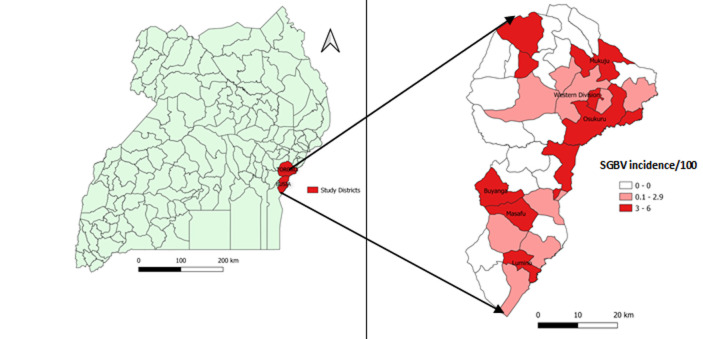 Figure 1
| Variable | n=389 | (%) |
|---|---|---|
|
| ||
| 10-14 | 25 | (6.4) |
| 15-19 | 350 | (90) |
| 20-24 | 14 | (3.6) |
|
| ||
| Married | 198 | (51) |
| Not married | 191 | (49) |
|
| ||
| Yes | 321 | (83) |
| No | 65 | (17) |
|
| ||
| Yes | 16 | (4.1) |
| No | 373 | (96) |
|
| ||
| Yes | 0 | (0) |
| No | 389 | (100) |
|
| ||
| Yes | 214 | (67) |
| No | 107 | (33) |
|
| ||
| <24 hours | 97 | (25) |
| 24-72 hours | 112 | (29) |
| >72 hours | 180 | (46) |
|
| ||
| Yes | 8 | (3.8) |
| No | 201 | (96) |
| Variable | N=108 | (%) | |
|---|---|---|---|
|
| |||
| Physically forced sex | 79 | (73) | |
| Pressured into sex through harassment and threats | 29 | (27) | |
| First time experience of SGBV during COVID-19 | 88 | (82) | |
|
| |||
| Day | 23 | (21) | |
| Evening | 21 | (19) | |
| Night | 44 | (40) | |
| Declined to answer | 20 | (19) | |
|
| |||
| Friend | 29 | (40) | |
| Neighbor | 17 | (23) | |
| Relative | 9 | (12) | |
| Others | 18 | (25) | |
|
| |||
| On the way somewhere | 25 | (21) | |
| Friends place | 25 | (23) | |
| Home | 26 | (24) | |
| Relative home | 11 | (10) | |
| Workplace | 2 | (1.9) | |
| Not comfortable to mention the place | 20 | (19) | |
|
| |||
| Unwanted pregnancy | 38 | (35) | |
| Depression | 20 | (19) | |
| Anxiety | 12 | (11) | |
| STI | 7 | (6.5) | |
| Others | 14 | (13) | |
| Reported they received emergency contraception | 35 | (32) | |
|
| |||
| Immediately | 18 | (27) | |
| 1-3 days | 18 | (27) | |
| >3 days | 72 | (67) | |
|
| 35 | (34) | |
|
| 20 | (56) | |
|
| |||
| Social stigma | 42 | (58) | |
| Fear of retaliation | 13 | (18) | |
| Lack of awareness | 13 | (18) | |
| Others | 4 | (5.6) | |
| Characteristic | Cases (n=108) | Controls (n=216) | Bivariate analysis | Multivariate analysis | ||||
|---|---|---|---|---|---|---|---|---|
| n | (%) | n | (%) | cOR | 95% CI | aOR | 95% CI | |
|
| ||||||||
| 10-14 | 16 | (15) | 47 | (22) | Ref | |||
| 15-19 | 67 | (62) | 107 | (50) | 1.8 | (0.97-3.5) | 0.94 | (0.44-2.03) |
| 20-24 | 26 | (24) | 61 | (28) | 1.3 | (0.60-2.6) | 0.52 | (0.20-1.3) |
|
| 77 | (71) | 126 | (58) | 1.7 | (1.04-2.8) | 1.9 | (1.1-3.4) |
|
| 63 | (58) | 76 | (35) | 2.5 | (1.6-4.0) | 1.7 | (0.86-3.2) |
|
| 40 | (37) | 8 | (3.7) | 8.1 | (4.1-16) | 5.8 | (2.8-12) |
|
| 54 | (50) | 47 | (22) | 3.4 | (2.1-5.6) | 1.7 | (0.9-3.2) |
|
| 63 | (58) | 172 | (80) | 0.33 | (0.20-0.56) | 0.42 | (0.23-0.78) |
|
| 58 | (54) | 110 | (51) | 1.06 | (0.67-1.7) | - | - |
|
| 29 | (27) | 51 | (24) | 1.1 | (0.66-1.9) | - | - |
|
| 44 | (41) | 56 | (26) | 0.83 | (0.39-1.7) | - | - |
|
| ||||||||
| Parent | 69 | (64) | 151 | (70) | Ref | - | - | - |
| Friends/relatives | 40 | (37) | 64 | (30) | 1.3 | (1.04-1.6) | - | - |
|
| ||||||||
| None | 3 | (2.8) | 2 | (0.9) | Ref | - | - | - |
| Primary | 73 | (68) | 130 | (60) | 0.37 | (0.06-2.2) | - | - |
| Secondary | 32 | (30) | 69 | (32) | 0.31 | (0.05-1.9) | - | - |
| Tertiary | 0 | (0.0) | 6 | (2.8) | 1 | - | - | - |
|
| 86 | (80) | 182 | (84) | 0.64 | (0.35-1.2) | - | - |
|
| 87 | (80) | 154 | (77) | 1.2 | (0.68-2.1) | - | - |
Peer Reviews
No public reviews on file for this paper yet. If you reviewed it on a platform where reviews are public (OpenReview, ICLR, NeurIPS, ICML), you can paste yours below so the community can read it here.
Videos
No videos yet. Explain this paper in a talk, walkthrough, or lecture? Add one.
Taxonomy
TopicsEducation, Innovation and Language Studies · Educational Methods and Teacher Development · Education and Social Development in Ukraine
Introduction
Sexual gender-based violence (SGBV) is defined as “any sexual act, attempt to obtain a sexual act, or other act directed against a person's sexuality using coercion, by any person regardless of their relationship to the survivor, in any setting” [1]. SGBV is a significant public health concern with multifaceted consequences for adolescent girls and young women (AGYW), including increased risks of HIV transmission, mother-to-child HIV transmission, unwanted pregnancies, school dropouts, mental health disorders and socio-economic difficulties [2].
In Uganda, approximately 22% of women aged 15-49 experience SGBV at some point in their lives [3]. However, AGYW is disproportionately affected by sexual violence. The 2018 Violence Against Children Survey (VAC) revealed that one in three girls aged 18-24 years experienced sexual violence during their childhood, while one in four girls aged 13-17 years reported recent sexual violence (past 12 months) [4]. Women reporting SGBV receive essential services, including timely post-exposure prophylaxis (PEP) and emergency contraception within 72 hours, as well as the necessary medical attention for any injuries or wounds sustained [5]. However, the implementation of COVID-19 restrictions aimed at controlling the pandemic resulted in disruptions in access to post-violence essential services [6].
From March 2020 to January 2022 in Uganda, schools were closed as part of the COVID-19 pandemic response. Anecdotal reports from Uganda Police and an analysis of national SGBV program data suggested that SGBV cases had increased during the COVID-19 pandemic, especially during the two lockdown periods in 2020 and 2021 [6,7]. Both the prolonged period spent out of school and the implementation of multiple lockdowns, leading to girls' exposure to perpetrators within homes and neighborhoods during times they would otherwise have been elsewhere, were suggested as possible causes [7]. A notable 33% increase in teenage pregnancies during 2020 and 2021 compared to 2019 indicated a potential rise in sexual gender-based violence (SGBV) during the COVID-19 pandemic period; analysis of Health Information Management System HMIS data (P.M., unpublished data). The Mid-Eastern Region, known for the highest prevalence of sexual violence among AGYW 15-24 years (13.3%) according to Uganda Population-based HIV Impact Assessment (UPHIA) 2016 [8], was of particular concern. Nevertheless, SGBV dynamics were insufficiently documented in the Mid-Eastern Region during the pandemic. To enrich the broader understanding of these issues and better inform the formulation of effective evidence-based prevention and control strategies to safeguard the well-being of vulnerable populations, particularly AGYW, our study assessed SGBV services and identified the factors associated with SGBV among AGYW in the Mid-Eastern Region of Uganda during the COVID-19 pandemic.
Methods
Study design and setting: we employed a mixed-methods approach, including a qualitative, and case-control study among AGYW aged 10-24 years in Tororo and Busia districts, Mid-Eastern Region. These two districts are in Eastern Uganda, bordering Kenya. Both have active trading activities and border points with many transit truck drivers. These districts were selected because they reported the highest number of teenage pregnancies during the COVID-19 period in the Mid-Eastern Region [9].
Case definition and finding: we selected 10 high-volume health facilities providing SGBV care, including one district hospital, one Health Center IV, and three high-volume Health Center IIIs from each of the two districts. We abstracted health facility data for AGYW (aged 10-24 years) recorded in the SGBV register from March 2020 to December 2021 from 20^th^ March to 2^nd^ April 2022. Healthcare workers document information for survivors of SGBV, identified through self-reporting or routine screening. This screening is conducted as part of various healthcare settings, including HIV care and treatment clinics, as well as antenatal care clinics.
Quantitative study variables: we obtained information on the visit date, socio-demographic characteristics (age, religion, level of education, socioeconomic status, level of family support concerning providing basic needs), and patient management, including HIV post-exposure prevention (PEP), family planning, outcome (whether they became pregnant or contracted sexually transmitted infections), and follow-up. Additional information on PEP provision was obtained from the PEP registers.
Case-control study: the SGBV incidence rates (IR) among sub-counties ranged from 0.1% to 6%. Among the 11 sub-counties with IR ≥3%, we randomly selected six (three from each district) to serve as sites for the case-control study. These included Mukuju, Western Division, and Usukuru sub-counties from Tororo District and Masafu, Lumino, and Buyanga sub-counties from Busia District (Figure 1).
sexual gender-based violence incidence rate among adolescent girls and young women in Busia and Tororo Districts, March 2020-December 2021
We conducted a neighbourhood-matched case-control study to determine factors associated with SGBV among AGYW from March 2020 to December 2021, covering the highest-burden phases of the COVID-19 pandemic in Uganda. We defined a case as an AGYW aged 10-24 years who reported at least one episode of SGBV to any of the 10 high-volume health facilities in Tororo and Busia Districts during this time. For every case, we identified two randomly selected neighbourhood-matched AGYW controls who reported no SGBV during the same period.
We assumed a self-reported reduction in family income during the pandemic was a significant risk factor for SGBV with an odds ratio of 2 and 40% of controls exposed. At a ratio of 1: 2 cases to controls and 80% power, we obtained a sample size of 324 (108 cases and 216 controls). Using a line list of SGBV cases from the ten health facilities, we randomly selected 108 SGBV cases for interviews. We visited the cases in the community for interviews with the help of social workers and community health workers. For every case, we identified two neighbourhood-matched control AGYW. We interviewed one control in each household. If more than one control was available in a given household, we used a random number to select one for interviews.
We adopted the recent Uganda Violence Against Children (VAC) Survey (2018) questionnaire [4] and tailored it to our study. We interviewed cases and controls to obtain information on socio-demographics, risk factors for SGBV, care and services received, economic activities undertaken during the COVID-19 period by the participant and their immediate family, place of residence before and during the COVID-19 period, school attendance before and during the COVID-19 period, household size, household members living in the house, household members' occupations, day and night-time activities of the case, parental supervision, and others.
Qualitative study
Key informant interviews: we interviewed the six GBV focal persons who manage SGBV cases as key informants at the six facilities in which the focal person was present during data collection. Using a predesigned key informant guide that had open-ended questions, we asked about possible root causes of increased SGBV cases in the region and explored challenges related to high rates of teenage pregnancies, management of SGBV during the pandemic, and availability of drugs such as emergency contraceptives and PEP.
Data management and analysis: quantitative data were entered in the Open Data Toolkit (ODK) and we used STATA version 14 (StataCorp, Texas, USA) for analysis of quantitative data. We described the SGBV cases by place and person and the quality of SGBV services received by the survivors. Using district sub-county population estimates (district records-un-published data) as the denominator, we computed SGBV incidence rates per 100 persons in each sub-county using health facility data. The numerator included recorded SGBV cases among AGYW aged 10-24 years from March 2020 to December 2021. To determine factors associated with SGBV, we conducted a logistic regression analysis, at bivariate and multivariate levels. Adjusted odds ratios, along with their corresponding 95% confidence intervals, were reported as our measures of association. Variables demonstrating a significance level of p<0.2 in the bivariate analysis were incorporated into the final multivariate model to identify independent factors associated with SGBV. For qualitative data, the interviews were audio-recorded and transcribed, followed by a thematic content analysis approach. The transcriptions were coded to identify recurring themes, which were then organized into broader thematic categories. Qualitative data were analyzed manually. The results were summarized by extracting relevant information and including verbatim quotes to support the quantitative findings.
Availability of data and materials: the datasets upon which our findings are based belong to the Uganda Public Health Fellowship Program, Ministry of Health, Uganda. For confidentiality reasons, the datasets are not publicly available. However, the data sets can be made available upon reasonable request from the corresponding author and with permission from the Uganda Public Health Fellowship Program.
Ethical approval and consent to participate: the Ministry of Health Uganda gave the directive and approval to evaluate the factors associated with the increased numbers of Sexual and Gender-based Violence during COVID-19 in the country. In agreement with the International Guidelines for Ethical Review of Epidemiological Studies by the Council for International Organizations of Medical Sciences (1991) and the Office of the Associate Director for Science, CDC/Uganda, it was determined that this activity was not human subject research and that its primary intent was public health practice or disease control activity (specifically, epidemic or endemic disease control activity). This activity was reviewed by the CDC and was conducted consistent with applicable federal law and CDC policy. All experimental protocols were approved by the US CDC Human Subjects Review Board and the Uganda Ministry of Health and have been performed according to the Declaration of Helsinki. Written informed consent was obtained from the participants before the start of each interview including the health care workers and the interviewed AGYW. We obtained written informed consent from the parents and guardians of the AGYW who were below the age of 18 years before interviews and assent from these girls. We also sought permission from the district health officials and heads of the health facilities. During data collection, respondents were assigned unique identifiers instead of names to protect their confidentiality.
Results
Description of SGBV cases, Mid-Eastern Region, Uganda, March 2020-December 2021: we identified 389 SGBV cases among AGYW at the 10 selected health facilities in Tororo and Busia Districts from March 2020 to December 2021. Their mean age was 16.4 years (SD± 1.61: range, 10-24 years) and most (90%) were 15-19 years of age. Two-thirds (67%) were pregnant at the time their SGBV event was recorded in the facility register. Nearly half (46%) presented to the facility >72 hours after the event. Among the 209 who presented within 72 hours, only 8 (4%) received PEP (Table 1).
Description of sexual gender-based violence cases considered for the case-control study: of the 108 cases interviewed, 79 (73%) reported being physically forced into sex while 29 (27%) reported that they were pressured into sex through harassment and threats. Most (88; 82%) reported that the episode was their first SGBV experience during the COVID-19 period. Among 73 (68%) who agreed to share information about the perpetrator, 29 (40%) reported it was a friend and 17 (23%) said it was the neighbour. The majority (71; 67%) reported to the health facility after >72 hours; of these, 42 (58%) said that they delayed reporting due to feelings of social stigma about their SGBV experience. The most reported adverse outcome from the episode was unwanted pregnancy (38; 35%) (Table 2).
Factors associated with sexual gender-based violence among adolescent girls and young women during COVID-19, Tororo and Busia districts, Mid-Eastern Uganda: in bivariate analysis, having older siblings [cOR=1.7, 95% CI: 1.04-2.8], ever being pregnant before the COVID-19 period [cOR=2.5, 95% CI: 1.6-4.0], ever being sexually violated before the COVID-19 period [cOR=8.1, 95% CI: 4.1-16], and ever being involved in sex work [cOR=3.4, 95% CI: 2.1-5.6] were associated with SGBV. In contrast, having a family that was able to provide all basic needs was protective [cOR=0.33, 95% CI: 0.20-0.56] (Table 3). Age, being in school before COVID-19 period, level of education, ever having had children, knowledge and use of family planning, and family change in economic status during the COVID-19 period were not significantly associated with SGBV.
In multivariable analysis, experiencing sexual violence before COVID-19 [aOR=5.8, 95% CI: 2.8-12] and having older siblings [aOR=1.9, 95% CI: 1.1-3.4] remained significantly associated with SGBV during COVID-19 period. The family's ability to provide all basic needs [aOR=0.42, 95%: CI 0.23-0.78] was protective. While the odds of SGBV decreased with increasing age, the association was not significant (Table 3).
Qualitative results: results from the key informant interviews supported these findings. Most GBV focal persons reported that AGYW who experienced SGBV often presented to the health facility beyond the recommended 72 hours. In many cases, these survivors were only identified during their antenatal care visits, often due to pregnancies resulting from the SGBV incidents. Consequently, they were unable to receive PEP and emergency oral contraceptives, despite the availability of such medicines. The management of SGBV cases posed a significant challenge during the COVID-19 period, as expressed by one key informant: "The management of the SGBV cases was a big challenge during the COVID-19 period. Most girls presented here very late, some already pregnant, and whenever you asked them why they never came early, they reported they feared the perpetrators. You had nothing to do for them apart from counseling" (Key Informant II).
The key informant respondents highlighted significant parenting issues during the COVID-19 period, noting that many young people had unrestricted movement due to school closures and were frequently seen walking at night. This lack of parental supervision and control was a concern, as it potentially exposed girls to high-risk situations that could contribute to sexual gender-based violence. One key informant stated, "I think parents did not play a good role during the COVID-19 lockdown. You know children were very idle and had nothing to do. You could find a group of girls and boys walking and laughing in the evenings as if they had no chores at home. Also, in this community, it is common to find young people moving at night, and this is even worse when there is a party" (Key Informant IV).
Five out of six GBV focal persons highlighted that the families faced challenges in meeting their basic needs. The COVID-19 pandemic led to widespread poverty due to disrupted businesses. Consequently, many parents were unable to provide adequate support to their families. The resulting lack of necessities such as food may have compelled young people including the AGYW to seek necessities from other sources. Key informant IV stated, “During COVID-19, there was a lot of poverty due to disrupted businesses and closure of schools. As a result, most parents were unable to support their children. Such could have forced girls to look for necessities such as food and clothing from elsewhere”
Discussion
During the COVID-19 period, sexual gender-based violence (SGBV) became a pervasive and often overlooked challenge, perpetuating a disturbing silence that hindered effective intervention and support to the survivors. Many reported cases were pregnant at the time their SGBV experience was recognized and recorded. Close to half of the survivors delayed reporting their experiences, making them ineligible for timely access to Post Exposure Prophylaxis (PEP). Even among those who reported earlier, the utilization of PEP services remained alarmingly low. Previous experiences of sexual violence and having older siblings were found to increase the likelihood of SGBV, while having sufficient family resources was a protective factor. Key informant interviews highlighted delays in seeking post-violence services, parenting challenges, and the lack of basic necessities as contributing factors to SGBV among AGYW during the COVID-19 period. These findings underscore the pressing need for comprehensive interventions to address and prevent SGBV, particularly in times of crisis.
Our findings indicate that less than half (34%) of SGBV victims self-reported to have received PEP. The low uptake of PEP among the exposed persons raises concerns about their risk of HIV acquisition. PEP is a critical intervention that can significantly reduce the risk of HIV transmission after a potential exposure, such as sexual assault [10]. These findings were in line with a study done in Uganda where analysis of health information system (HMIS) data revealed 18% reduction on PEP uptake despite the increased sexual violence reports during COVID-19 period [6]. PEP is available in public and private healthcare facilities in Uganda and must be given within 72 hours of the event to be effective [11]. Low PEP uptake raises significant concerns about the provision of appropriate healthcare services to survivors of SGBV during the COVID-19 pandemic. We identified many missed opportunities for preventing HIV infection among AGYW who experienced SGBV in the Mid-Eastern Region. Several pandemic-related factors such as movement restrictions, limitations in resources and personnel, shifting priorities, and changes in service delivery models [12] may have impacted the availability and accessibility of healthcare services, including PEP [13].
Even among the AGYW who presented early, few received PEP. However, even among those who received PEP, it was often inappropriately given, highlighting a knowledge gap on PEP use among healthcare workers and users. Due to data gaps in the SGBV health facility registers, we could not verify the appropriateness of PEP use for all reported incidents. Similar findings were noted in a study done in Uganda to compare post-rape care before and during COVID-19 using national Health Management Information System (HMIS) and Uganda Child Help Line (UCHL) data; in this study, 50% of cases received PEP beyond the recommended 72 hours [6]. This highlights the need for flexible methods of service delivery to increase timely access and utilisation of PEP among SGBV survivors. These might include community-based approaches such as “off-facility PEP medication delivery” and “PEP hotlines” [14]. These community-based approaches were piloted in rural populations in Kenya and Uganda; results showed increased uptake and completion of PEP in the population [14]. Emphasizing PEP guidelines on use within 72 hours among healthcare workers may be necessary to facilitate more appropriate use, since PEP's effectiveness is time bound.
Interviews with the GBV focal persons, as well as the high rate of pregnancy among AGYW identified as SGBV survivors from the clinic registers, suggested that many AGYW presented because of their pregnancy rather than the SGBV event itself. AGYW cited fears of the perpetrator and stigma as reasons they did not present immediately. Given that many SGBV events will not result in pregnancy, the high frequency of pregnancy among SGBV survivors who do report suggests that the reports described in this paper are the tip of the iceberg. Many women who do not become pregnant because of the SGBV likely simply do not report it. Fear of public stigma is a well-documented factor that hinders patients from accessing health care services [3,9]. Similarly, social stigma related to SGBV is known to worsen physical and psychological health impacts [15] and may increase the risk of additional violence [16]. Efforts are needed to support AGYW to report SGBV and enable adequate and timely care to prevent HIV and unwanted pregnancies. The UCHL 116, which allows reporting by phone, was found to be a more acceptable channel to report sexual violence than reporting at health facilities [17]. UCHL was implemented by the Ministry of Gender Labour and Social Development (MGLSD) to improve the reporting of child abuse and sexual violence. However, there is still low awareness of the UCHL and a need for more advocacy [17]. Active case-finding for SGBV survivors may be necessary to ensure appropriate care and support to the affected persons.
Having experienced SGBV before the COVID-19 period was associated with SGBV during COVID-19. Repeated sexual violence during COVID-19 suggests that affected girls may be continually exposed to the same perpetrator(s). Other studies have also indicated a heightened risk of re-victimization among individuals who have experienced sexual victimization [6,14,18]. Both psychosocial support and ways to protect the once-identified survivors such as establishing peer support groups to create safe spaces for victims, economic empowerment initiatives, and community mobilization may be necessary to prevent repeated SGBV experiences [19]. In addition, there is a need to strengthen the parents'/guardians' daughter relationship to enable the girls to open up to parents in case of SGBV through evidence-based interventions such as community parenting programs and whole family support programming [20,21].
The association between having older siblings and an increased risk of sexual gender-based violence (SGBV) observed in our study warrants careful consideration. There is a possibility that this association may be attributed to the younger age of SGBV victims as compared to non-SGBV survivors; age was found to be negatively associated with SGBV in our study, with the odds of association decreasing as age increased. Other factors could be related to power dynamics [22] or older siblings having experienced or witnessed SGBV, perpetuating a cycle of violence within the family [23]. Exposure to violence can impact their attitudes toward relationships and sexual behavior, potentially leading to higher incidences of SGBV among younger siblings [24]. Interventions that promote healthy sibling relationships and fostering positive role modeling may be necessary to address SGBV. Nevertheless, further research is needed to gain a deeper understanding of the underlying mechanisms involved and provide a potential explanation for this association.
We found that having a family providing all the basic needs to AGYW was protective against SGBV during COVID-19. As a result of COVID-19 measures like the closure of shops, saloons, and markets and movement restrictions, many families were unable to provide basic needs for their children [19,25-27]. Efforts to support vulnerable AGYW with basic needs like food, clothing, and shelter among others may be necessary during future pandemics or similar situations to prevent SGBV.
Limitations: our study was subject to several limitations. Health facility data were incomplete, limiting what we could analyse. We found irregularities with documentation in health facility registers, especially information on dates of incidence and follow-up services, and data on repeated episodes of SGBV. We could not tell from the data if the persons who were offered PEP accepted or completed the dosage. In addition, information on the first point of care was missing, and thus we could not establish if the cases who were recorded as pregnant were identified only during their antenatal clinic visits. We used the health facility data to identify the cases, and thus our data certainly represent an underestimate of the problem as well as reflecting possible bias if the survivors who did not present to the facility differ from those who did. Additionally, given the sensitivity of the subject and self-reporting of the data, some cases did not respond to questions related to the perpetrator resulting into potential bias.
Conclusion
Sexual gender-based violence negatively affected the lives of many adolescent girls and women during the COVID-19 pandemic. Most survivors did not present in time for HIV exposure prophylaxis and therefore efforts to improve access to services through community education and engagement with AGYW is key for PEP uptake when needed. Public health programs in the future may need to focus on identifying or supporting known survivors of SGBV and those who are socioeconomically vulnerable and identify approaches to protect them, especially during school closures or events that confine AGWY to their homes, where the risk of victimization may be heightened Furthermore, establishing family-based support programs, community engagement, and capacity building for frontline healthcare workers could facilitate the effective and comprehensive response to SGBV during future epidemics.
What is known about this topic
- Studies from various regions around the world, including Africa, Asia, and the Americas, have indicated an alarming rise in cases of SGBV during pandemics, including the COVID-19 crisis;
- The stressors and disruptions caused by such public health emergencies can exacerbate existing vulnerabilities, leading to an increased risk of violence against women and girls.
What this study adds
- Insights into specific risk factors during COVID-19: this study provides valuable insights into the factors associated with SGBV among AGYW during the COVID-19 pandemic in Uganda, offering a deeper understanding of the unique circumstances and vulnerabilities that may contribute to increased incidents of violence during such crises;
- Identification of protective factors and intervention opportunities: by uncovering the protective role of a supportive family environment and shedding light on the influence of factors like prior SGBV experiences and family dynamics, this research offers actionable information for designing targeted interventions;
- These insights can guide efforts to both support existing SGBV victims and implement preventive measures to reduce the burden of SGBV in similar future events.
The reference list from the paper itself. Each links out to its DOI / PubMed record.
- 1World Health Organization (WHO)Violence against women Accessed 4th November 2023
- 2Health Cluster Gender-based violence in health emergencies Accessed 4th November 2023
- 3U Bo S I Uganda demographic and health survey 2016 Kampala, Uganda and Rockville, Maryland, USA 2018
- 4Ministry of Gender Lasd Uganda Violence Against Children Survey: Findings from a National Survey, 20152018 Kampala UNICEF
- 5Committee I-AS Guidelines for integrating gender-based violence interventions in humanitarian action: reducing risk, promoting resilience and aiding recovery Accessed 4th November 2023
- 6Apondi R Awor A Nelson L Cheptoris J Ngabirano F Egbulem Cet al Gender-based violence shadows COVID-19: Increased sexual violence, HIV exposure and teen pregnancy among girls and women in Uganda Journal of the International AIDS Society 202124 S 4535
- 7Mukasa N Hasaba S Makori D Vulnerability, Poverty, and Covid-19 in Uganda: Risk Factors and Correlates The Palgrave Handbook of Global Social Change, Palgrave Macmillan, Cham 2023
- 8Ministry of Health Uganda population -Based HIV Impact Assessment UPHIA 2016-2017 Accessed 4th November 2023