Unusual Cause of Recurrent Episodes of Dysphagia
Yasutoshi Shiratori, Ryosuke Yokosuka, Katsuyuki Fukuda

Abstract
Genes, proteins, chemicals, diseases, species, mutations and cell lines named across the full text — each resolved to its canonical identifier and authoritative record.
Click any figure to enlarge with its caption.
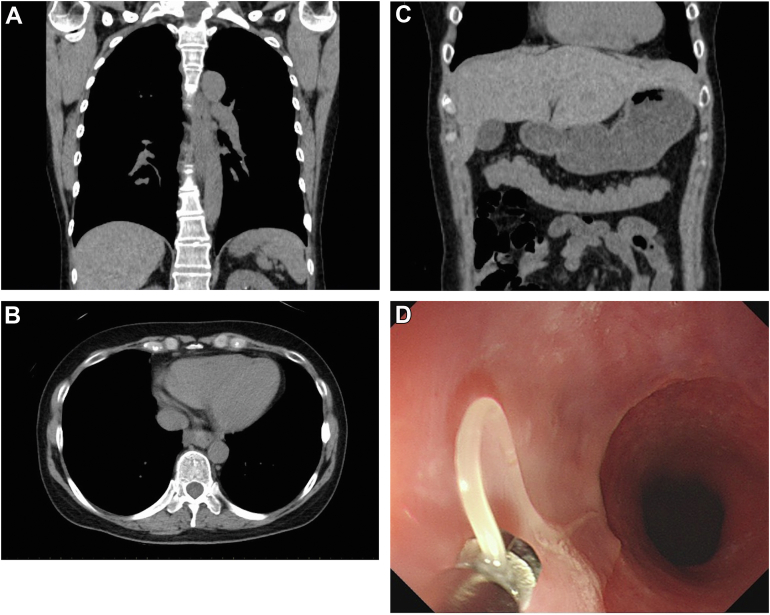 Figure 1
Peer Reviews
No public reviews on file for this paper yet. If you reviewed it on a platform where reviews are public (OpenReview, ICLR, NeurIPS, ICML), you can paste yours below so the community can read it here.
Videos
No videos yet. Explain this paper in a talk, walkthrough, or lecture? Add one.
Taxonomy
TopicsTracheal and airway disorders · Gastrointestinal disorders and treatments · Esophageal and GI Pathology
A 59-year-old woman came to our emergency department with dysphagia. The patient ate a steak course dinner. She had the same history one year ago, and a follow-up endoscopy one month later at that time showed no apparent abnormalities. She was afebrile, and her vital signs were stable. Blood exam revealed mild elevation of C-reactive protein (0.50 mg/dL). Plain chest computed tomographic scan presented broad thickening of the esophageal wall (Figure A) and fluid correction next to the esophagus (Figure B). Gastric wall was unremarkable (Figure C). Urgent esophagogastroduodenoscopy did not reveal residual food or stricture in the esophagus. Instead, anisakis larvae were detected invading the lower esophagus (Figure D). After removing it using forceps, symptoms were rapidly resoluted. The anisakis was presumed to be in the raw fish of the steak dinner appetizer, and the previous event also occurred after the Japanese sushi dinner. The stomach is the most common site of infection, with infections in the esophagus being very rare (1.4%). Although gastric anisakiasis is mainly characterized by epigastric pain and vomiting, esophageal anisakiasis presents with dysphagia. The esophageal wall is relatively thin, with a risk of mediastinitis in esophageal anisakiasis; therefore, urgent esophagogastroduodenoscopy should be performed.