Choroid Metastasis From Human Epidermal Growth Factor Receptor Type 2-Positive Gastric Cancer
Tomonobu Koizumi, Noriko Yoshida, Kai Mizuhata

Abstract
Genes, proteins, chemicals, diseases, species, mutations and cell lines named across the full text — each resolved to its canonical identifier and authoritative record.
Click any figure to enlarge with its caption.
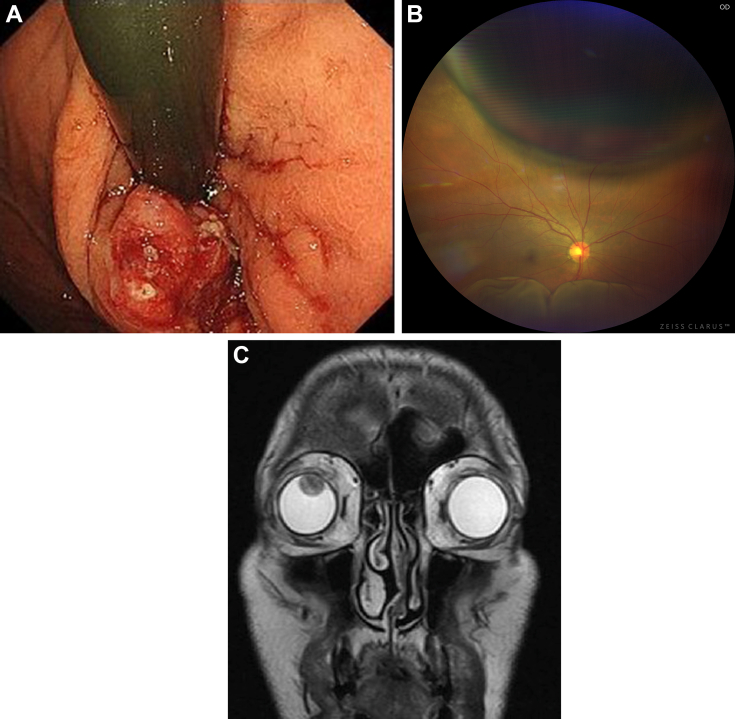 Figure 1
Peer Reviews
No public reviews on file for this paper yet. If you reviewed it on a platform where reviews are public (OpenReview, ICLR, NeurIPS, ICML), you can paste yours below so the community can read it here.
Videos
No videos yet. Explain this paper in a talk, walkthrough, or lecture? Add one.
Taxonomy
TopicsMelanoma and MAPK Pathways · Cancer Mechanisms and Therapy · Cancer-related Molecular Pathways
A 39-year-old man with human epidermal growth factor receptor type 2-positive gastric cancer with hepatic metastasis had been treated with first-line chemotherapy consisting of trastuzumab + S-1 + oxaliplatin followed by trastuzumab deruxtecan for 18 months. Endoscopic examination showed a mass in the esophagogastric junction (Figure A), but disease remained stable during chemotherapy. He was referred to the ophthalmology department of our hospital due to visual impairment in the right eye. The right eye showed a mass on the superior subretinal space at 1- to 3-o’clock position with secondary serous retinal detachment in the inferior eye (Figure B) suggesting a metastatic tumor. Coronal magnetic resonance imaging showed a smooth and sharply marginated tumor in the right eye with low-intensity signals on Dixon T2-weighted imaging (Figure C). Based on the clinical course, a diagnosis of choroid metastasis of gastric cancer was made. The tumor size in the right eye was reduced after radiotherapy (3 Gy × 10 fractions), but this failed to improve the visual impairment. Choroid metastasis in patients with gastric cancer is extremely rare. In addition, there have been no previous case reports regarding the development of choroid and/or eye metastasis in cases of human epidermal growth factor receptor type 2-positive gastric cancer.