Internal Medicine and Internal Medicine-Pediatrics Residency Program Website Traffic Patterns Across Two Institutions and Five Electronic Residency Application Service (ERAS) Cycles
Tzeidel Brown Eichenberg, Paul Fallaha, Daniel Matassa, Brent Parris, Stefanie Brown, Jonathan L Tolentino, Kristin Wong

TL;DR
This study examines website traffic patterns for Internal Medicine residency programs to understand what content attracts applicants during the application cycle.
Contribution
The study provides data-driven insights into residency program website traffic and content preferences during ERAS cycles.
Findings
Highest website traffic occurs before application deadlines and around Match Day.
Popular pages align with applicant priorities like location, work/life balance, and program reputation.
Unique content like pipeline programs for underrepresented groups and new clinical sites also attract significant traffic.
Abstract
Background Since the start of the COVID-19 pandemic in Spring 2020, medical residency program recruitment has become increasingly web-based due to the transition to virtual interviews. Although social media use by residency programs has soared during this time, applicant surveys show that official program websites remain the most used online resource. According to survey-based studies, the content that applicants favor on program websites tends to mirror their priorities in choosing programs. However, it is unclear whether applicant-reported priorities in program choice and website content truly drive program website traffic. In this analysis, we will elucidate website traffic patterns from two Internal Medicine residency programs and two Internal Medicine-Pediatrics programs, both in terms of the thematic content of high-traffic pages and changes in traffic patterns throughout the…
Genes, proteins, chemicals, diseases, species, mutations and cell lines named across the full text — each resolved to its canonical identifier and authoritative record.
Click any figure to enlarge with its caption.
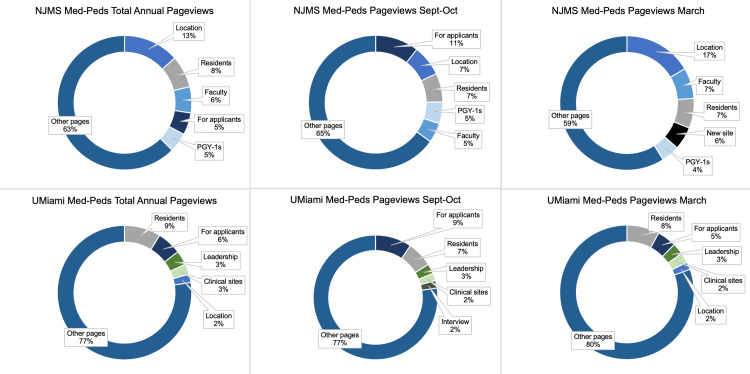 Figure 1
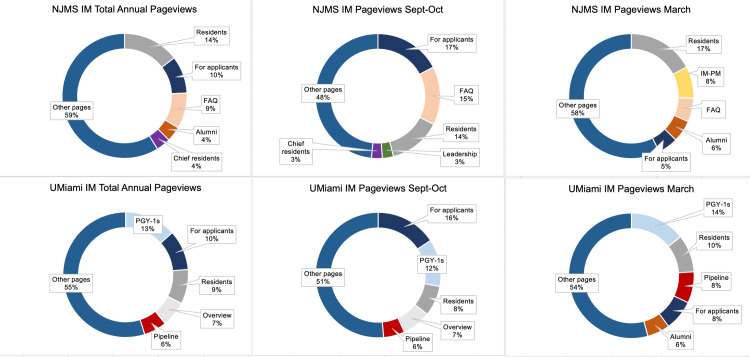 Figure 2
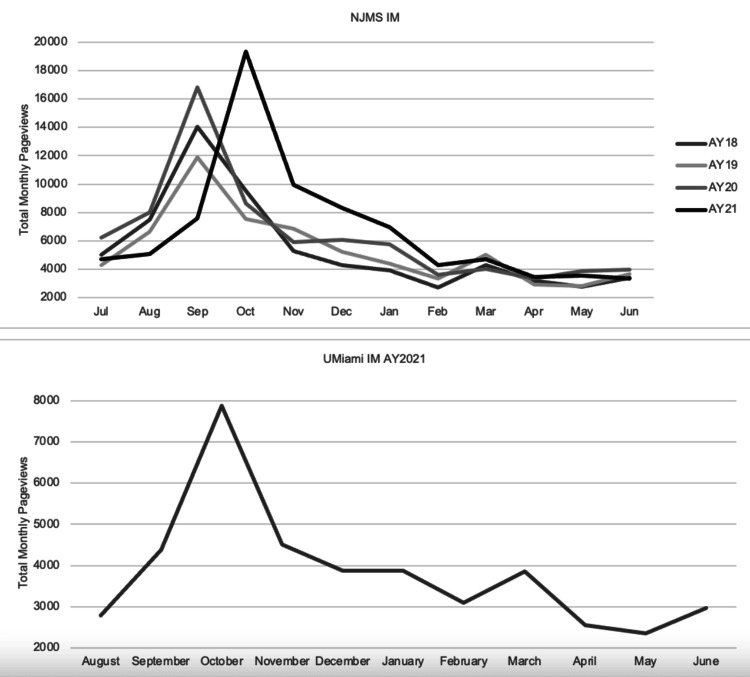 Figure 3
| Program | US MD | US DO | IMG | Total |
| NJMS Med-Peds | 132 | 29 | 77 | 238 |
| NJMS IM | 965 | 545 | 3200 | 4,710 |
| UMiami Med-Peds | 199 | 51 | 77 | 327 |
| UMiami IM | 2,545 | 728 | 3,158 | 6,431 |
| Mean annual pageviews (95% CI) | Mean annual pageviews (95% CI) | Mean annual pageviews (95% CI) | Mean annual pageviews (95% CI) | |
| Page type | NJMS IM | NJMS MP | MIA IM | MIA MP |
| Homepage | 15,752 (13,928-17,576) | 2,480 (1,757-3,203) | 23,811 (18,848-28,774) | 4,084 (3,341-4,827) |
| Residentså | 10,809 (9,698-11,920) | 1,427 (1,207-1,646) | 1,739 (1,153-2,353) | |
| PGY-1 | 866 (641-1,091) | 13,604 (11,464-15,744) | ||
| PGY-2 | 755 (560-949) | 6,909 (5,730-8,088) | ||
| PGY-3 | 651 (524-779) | 6,811 (5,542-8,081) | ||
| PGY-4 | 732 (478-985) | |||
| For applicants | 7,159 (6,433-7,886) | 986 (862-1,110) | 10,574 (9,389-11,759) | 1,159 (659-1,660) |
| Faculty | 1,385 (1,173-1,597) | 1,162 (913-1,412) | 394 (247-541) | |
| Alumni | 2,905 (2,633-3,177) | 732 (532-932) | 4,793 (3,483-6,103) | 264 (225-303) |
| Archived match lists* | 1,320 (458-2,182) | |||
| Chief residents | 2,751 (2185-3,317) | 381 (222-541)c | ||
| Leadership | 2,485 (2,133-2,837) | 370 (363-376)a | 3,452 (2,485-4,419) | 683 (907-1411) |
| Program coordinators | 1,332 (882-1782) | |||
| Dept Chair | 1,200 (928-1,472) | |||
| Overview | 1,375 (1,134-1,615)a | 557 (366-748) | 6,769 (5,784-7,754) | 380 (341-419) |
| Location | 948 (819-1,078) | 2,185 (2,117-2,253) | 1,214 (983-1,446) | 400 (352-448) |
| FAQ | 6,880 (6,079-7,681) | 500 (0-1,027) | ||
| Program contact info | 307 (148-466) | 1,564 (1,177-1,951) | 246 (148- 345)c | |
| Clinical sites | 1,310 (1,085-1,535) | 211 (78-343) | 1,197 (983-1,446) | 500 (168-626) |
| University Hospitala | 261 (153-369) | |||
| Children’s Hospitala | 314 (220-408) | |||
| Veteran’s Affairs Hospitala | 161 (100-222) | |||
| New Community Affiliateb | 568 (n = 1) | |||
| Continuity clinic | 313 (255-371) | 215 (117-173) | ||
| Sample schedule | 2,280 (2,485-4,419) | 235 (210-260) | ||
| Pipeline program | 6,000 (2,947-9,053) | |||
| Tracks/Subspecialty | 2,264 (1,797-2,731) | |||
| Preventative Medicineb | 973 (n = 1) | |||
| Medical education track | 745 (435-1,054) | |||
| Urban health track | 741 (528-953) | 250 (206-294)c | ||
| Global health track | 309 (244-374) | |||
| Available fellowships | 1,982 (1,679- 2,284) | |||
| Benefits** | 1,541 (1,289 - 1,793) | 384 (337- 432) | ||
| Diversity, equity, and inclusion | 353 (336-369)a | 1,124 (1,024-1,224) | 264 (204.41, 323.59)c | |
| Scholarly activity | 725 (498-953) | 239 (224-254)c | ||
| Wellness | 708 (644-771) | 357 (264-450)c | ||
| Resident awards | 1,036 (840-1,232) | |||
| Language training | 288 (248-328) | |||
| Notable features*** | 806 (715-898) | 173 (144-201) | 260 (208-230) | |
| Applicant webinars | 2,165 (1,863-2,467) |
Peer Reviews
No public reviews on file for this paper yet. If you reviewed it on a platform where reviews are public (OpenReview, ICLR, NeurIPS, ICML), you can paste yours below so the community can read it here.
Videos
No videos yet. Explain this paper in a talk, walkthrough, or lecture? Add one.
Taxonomy
TopicsSocial Media in Health Education · Diversity and Career in Medicine · COVID-19 and healthcare impacts
Introduction
In the United States, medical students apply to postgraduate residency programs to complete training in their medical specialty of interest via the Electronic Residency Application Service (ERAS) and the National Resident Matching Program’s (NRMP) algorithmic match. In 2022, the average US medical school graduate applying to Internal Medicine (IM) submitted 49 applications, and to combined Internal Medicine-Pediatrics (Med-Peds), 30 applications [1]. While residency programs have communicated program details to applicants through official websites since the early 2000s, residency program websites have taken on new importance since the transition to virtual applicant interviews due to the COVID-19 pandemic. This change was first implemented for the 2020-2021 application cycle and has likely left applicants with a need for program information in the absence of an in-person interview, which traditionally included a site visit.
While the use of social media platforms for specific program information and communication has soared, official program websites remain the most commonly utilized digital platform by applicants [2-20]. According to digital media experts and seasoned residency program directors, this persistent emphasis on web browser-based content is likely because applicants can rely on institutional websites as a source of more consistent information about the details of the program, as opposed to the more fleeting, interactive nature of social media posts [12,13].
According to the NRMP’s annual applicant survey, the five most important factors to residency applicants completing their final year at US allopathic medical schools were geographic location, goodness of fit, program reputation, work/life balance, and current program residents as they selected the programs to which they would apply [14]. Similarly, applicants report that the most vital content areas on a program’s website include information regarding program faculty, current residents, alumni careers, resident wellness initiatives, program curriculum, program facilities, and research activities [15,16].
While there appear to be thematic elements in common between applicant-reported program preferences and applicant-reported areas of focus on program websites, it was previously unclear whether web pages catering to these topics are the most trafficked pages within program websites. In this analysis, we will demonstrate trends in residency program website traffic across four residency programs at two institutions in New Jersey (NJ) and Florida (FL) from July 2017 through March 2022. By comparing site traffic patterns with the NRMP’s 2022 applicant survey results, this study intends to analyze whether topics that applicants self-report as most important to them coincide with the most trafficked pages within program websites.
We posit that website traffic will demonstrate applicants’ interest in web pages pertaining to geographic location, current residents, resident clinical experience, resident life outside of work, and program academics. This analysis will aid programs in identifying which website components should take priority in website development as they continue to develop a digital marketing strategy in an increasingly online residency application process.
Materials and methods
All available web analytics data from the current websites for the Rutgers University New Jersey Medical School’s (NJMS) Med-Peds and IM residency programs, and the University of Miami Miller School of Medicine’s (UMiami) Med-Peds and IM residency programs were included in this analysis. The NJMS sites used an internal web analytics platform, and the UMiami sites used Squarespace sites for web design and analytics. Of note, the number of applicants to each program during the years studied is shown in Table 1.
As all four programs had unique websites with varying page names and content, consistent labels (i.e., “Residents,” “Location,” “Leadership”) were applied to each page across all four websites based upon broad page content. This enabled content-based comparison of analytics data across all websites.
Web analytics data included all daily pageviews, or instances that a page was loaded, for each individual page within each website. Both NJMS programs and the UMiami Med-Peds program had available data from July 1, 2017, to March 31, 2022. UMiami IM’s current website was created in 2020; therefore, only data from July 1, 2020, to March 31, 2002, was included. Daily pageviews were summed to obtain monthly pageview data for each page. Mean monthly pageviews, as well as a 95% confidence interval, for each page was calculated across all academic years (AYs) within each of the four programs’ sites. Descriptive statistics, including mean and standard deviation, and 95% confidence intervals were calculated using Microsoft Excel’s Analysis ToolPak and the Social Sciences Statistics website’s Z-score-based single-sample confidence interval calculator, respectively. The latter tool calculated a 95% population mean interval using the equation population mean = sample mean ± Z statistic × (standard error).
Total monthly pageviews to all pages within each website were summed throughout each individual annual application cycle. Additionally, total daily pageviews to all pages within each website were summed during the most highly trafficked months of each annual application cycle, i.e., September-October and March of each year.
Results
The most popular pages across four programs included “Residents,” “For applicants,” “Location,” “Faculty,” “Alumni,” “Leadership,” and pages featuring the program’s current first-year residents, or “postgraduate year 1’s” (PGY-1) (Table 2, Figures 1, 2). For all programs, the five most trafficked pages differed between the Fall and Spring (Figures 1, 2).
Table 2: Mean annual pageviews by page topic and residency program. All data for study period 6/30/17 to 3/31/22 unless otherwise denoted. Pages accounting for 1% or less of annual pageviews are excluded. Topics that drew <1% of annual pageviews included pages displaying categorical IM and Pediatrics program leadership (for Med-Peds programs), program coordinator(s) biography, community service, photo gallery, interview day information, FAQ (for some programs), morning lecture highlights, resident publications and presentations, directions, and internal quality improvement.*: Alumni fellowship match lists >3 years old.: The UMiami programs listed benefits information on their “For Applicants” page.***: No
Med-Peds programs: mean pageviews by page topic. Mean pageviews by topic are shown for total annual pageviews, pageviews during September and October, and pageviews during March across all years studied. The top five most popular pages for each period are shown.PGY-1’s denotes current first-year residents.
IM programs: mean pageviews by page topic. Mean pageviews by topic are shown for total annual pageviews, pageviews during September and October, and pageviews during March across all years studied. The top five most popular pages for each period are highlighted.FAQ is frequently asked questions; PGY-1’s denotes current first-year residents; IM-PM is the combined Internal Medicine-Preventative Medicine program.
For the Rutgers programs, analysis of the most popular pages during the month of March showed that two newly added pages during AY’s 2021 and 2022, a page regarding a new integrated IM-Preventative Medicine (IM-PM) for the IM program, and a page regarding a new major clinical site for the Med-Peds program were some the of sites’ most popular pages (Figures 1, 2). Additionally, UMiami Med-Peds’ site showed higher traffic toward its “Interview day” page in the Fall, while its “Location” page outcompeted interview day information during March (Figure 1). UMiami IM’s site showed consistently high traffic to a page regarding a pipeline program throughout the two years of studies, as well as higher traffic to its “Alumni” page in March (Figure 2).
Peak traffic for all programs in all years occurred during the Fall months of September-October (Figure 3). There was a second, smaller surge in traffic in March of each year for all programs (Figure 3).
Internal Medicine programs: total monthly pageviews by year. Total monthly pageviews are shown for both Internal Medicine programs studied by academic year for full academic years with available data.
Discussion
While many of the most trafficked sites did reflect the priorities reported by applicants in prior survey-based analyses, such as topics related to current residents, program location, and life outside of work, three unexpected topics received heavy traffic with informative seasonal variation. First, for both IM program websites, pages with information on the career trajectory of alumni were among the most heavily trafficked sites, especially during the month of March. This finding underscores the fact that, while the bulk of traffic is likely current applicants, an important audience for program leadership to consider is recently matched, new interns engaging in career planning. This is supported by the seasonal variation in website traffic. The days leading up to the application deadline in mid-September showed by far the highest traffic of any period across all four programs. In AY21 the application deadline was postponed, and its associated surge in traffic was similarly delayed that year. All four websites across all years analyzed showed a second, smaller surge in mid-March, around Match Day.
Second, both NJMS program websites added new web pages mid-cycle in AY22 that went on to surge in popularity the following March, both becoming top pages in the month of March. For Rutgers Med-Peds, the new page detailed a new community site that had recently merged resident clinical and academic activities with NJMS-affiliated training programs in both the Pediatrics and Internal Medicine departments. For IM, the popular new page detailed its new integrated IM/Preventative Medicine subspecialty program.
Third, a “Pipeline” page, unique to only UMiami IM, proved to be a major draw of traffic. This page detailed a program through which citizens of Latin American or Caribbean nations can apply to positions within the residency program reserved only for such applicants. Such programs are usually termed “pipeline” programs and serve to foster the careers of physicians who belong to ethnic or racial groups that are underrepresented in medicine (UIM), namely, Black and Latinx people [20,21].
The major limitations of our analysis pertain to the generalization of conclusions nationally, data harmonization, and lack of available traffic source data. Our analysis included data from residency program websites originating only from urban centers on the East Coast. We included no data from surgical specialty programs or subspecialty fellowship programs. In general, prior similar studies have included all programs or applicants nationally within a particular specialty or subspecialty without interspecialty analysis. With regards to data harmonization, individual researchers assigned consistent labels to pages across websites via personal review of site content with very little set methodology, as opposed to a more objective coding scheme. The most recent descriptive studies of residency website content have used such software. Lastly, traffic source data was not included due to inconsistent availability across the programs. As mentioned above, the major strength of our analysis is that it is the first published analysis of applicant interaction with residency program websites that uses website traffic data, as opposed to survey-based data.
Conclusions
This analysis supports the following major takeaways for residency program leadership. Programs should expect large surges of traffic each fall and each Match Day and might consider twice annual website updates in advance of these periods, catering to both prospective residents and newly matched residents. In formulating website updates, leadership should consider that applicants remain interested in program updates throughout the ERAS cycle and will flock to pages detailing current program happenings or recent changes. Lastly, there is robust interest in pipeline programs for physicians from UIM groups, and easily accessible information about such programs may even draw applicants to a residency program that they may not have considered otherwise.
Future analysis of residency program website traffic should seek to improve upon the limitations of our analysis. Further study of web analytics from websites of programs with a greater geographic spread and diversity, as well as surgical specialty programs and subspecialty fellowship programs is needed to provide guidance on web design across all of graduate medical education. Given that there is inevitable heterogeneity among program websites, a scoping study of website content should use thematic content analysis software, or a similarly systematic approach, to review page content to harmonize web analytics data across programs more precisely. Additionally, traffic to residency program websites may originate from a variety of sources, including social media, search engines, and elsewhere on the institution’s website. Analysis of website traffic sources in the future will help program leadership optimize website viewership by increasing our understanding of how applicants seek out program websites, and how websites could be made more accessible to applicants.
The reference list from the paper itself. Each links out to its DOI / PubMed record.
- 1ERAS Statistics Data. Association of American Medical Colleges 12 2023 2023 https://www.aamc.org/data-reports/data/eras-statistics-data
- 2An evaluation of social media utilization by general surgery programs in the COVID-19 era Am J Surg Fang HA Boudreau HBS Khan S 93794322220213390672810.1016/j.amjsurg.2021.04.014PMC 8629310 · doi ↗ · pubmed ↗
- 3Social media utilization trends in orthopaedic surgery residency programs during the COVID-19 pandemic Iowa Orthop J Le Duc R Lyons MM Riopelle D Wu K Schiff A 1317412021 https://pubmed.ncbi.nlm.nih.gov/34552398/34552398 PMC 8259205 · pubmed ↗
- 4Analysis of social media perceptions among orthopaedic surgery residency applicants and social media use by residency programs during the 2020 to 2021 cycle JB JS Open Access Checketts JX Hunt T Checketts BR 06202110.2106/JBJS.OA.21.00083 PMC 869149034957367 · doi ↗ · pubmed ↗
- 5Neurosurgical residency adaptations for the residency application cycle amid the COVID-19 pandemic: acute on chronic sequelae Interdiscip Neurosurg Chisolm P Singh N Zaniewski R Rais-Bahrami S Rozzelle CJ 1011772520213461151710.1016/j.inat.2021.101177 PMC 8484515 · doi ↗ · pubmed ↗
- 6The #Path 2Path virtual landscape during the COVID-19 pandemic: preparing for the 2020 pathology residency recruitment season Acad Pathol Cutshall H Hattaway R Singh NP Rais-Bahrami S Mc Cleskey B 23742895211002783820213419213310.1177/23742895211002783 PMC 7994921 · doi ↗ · pubmed ↗
- 7Impact of COVID-19 on radiology residency selection process: a survey of radiology residency programs in the US Acad Radiol Jones HM Ankem A Seroogy EA Kalantar A Goldsmith DC Rizenbergs KC Van Meter TL 7797852920223512527710.1016/j.acra.2021.12.033PMC 8743012 · doi ↗ · pubmed ↗
- 8Evaluation of emergency medicine residency programs' use of social media in the setting of the COVID-19 pandemic J Am Coll Emerg Physicians Open Baldwin CS De Marinis AR Singh NP Khoury CA 03202210.1002/emp 2.12637 PMC 873871835028641 · doi ↗ · pubmed ↗