Ascites With Honeycombed Appearance
Kento Shionoya, Haruki Uojima

Abstract
Genes, proteins, chemicals, diseases, species, mutations and cell lines named across the full text — each resolved to its canonical identifier and authoritative record.
Click any figure to enlarge with its caption.
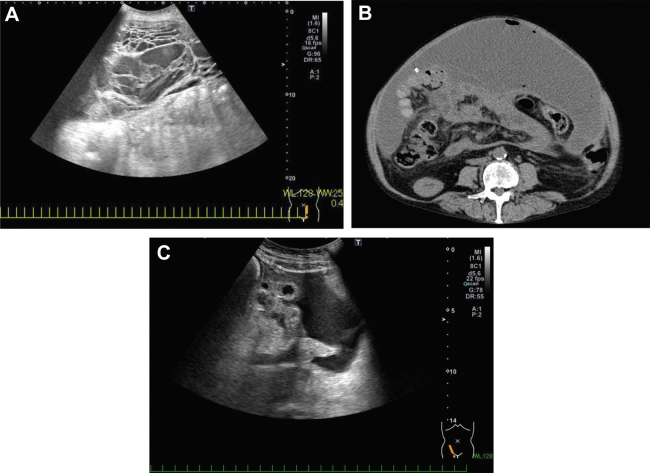 Figure 1
Peer Reviews
No public reviews on file for this paper yet. If you reviewed it on a platform where reviews are public (OpenReview, ICLR, NeurIPS, ICML), you can paste yours below so the community can read it here.
Videos
No videos yet. Explain this paper in a talk, walkthrough, or lecture? Add one.
Taxonomy
TopicsLiver Disease and Transplantation · Liver Disease Diagnosis and Treatment · Amoebic Infections and Treatments
A 56-year-old woman presented with alcoholic cirrhosis with complications of ascites unless treated otherwise using diuretics (on furosemide, spironolactone, and tolvaptan) and ascites puncture. She had a history of alcoholic cirrhosis, obesity, and depression. A peritoneovenous shunt temporarily improved the ascites. Shunt obstruction worsened her abdominal distention a few weeks later. During the follow-up period, she had abdominal pain with a low-grade fever. Abdominal ultrasonography revealed significant ascites with a honeycombed appearance (Figure A); however, abdominal computed tomography did not indicate the same result (Figure B). The cell count analysis of the ascitic fluid revealed bacterial peritonitis. The infected shunt was removed, assuming that it caused the honeycombed appearance. Subsequently, ascites and abdominal distension improved. Four months after the shunt removal and continuous administration of antibiotics, abdominal ultrasonography results revealed decreased ascites without a honeycombed appearance (Figure C). Peritoneovenous shunt automatically injects ascites into the jugular vein. It can help effectively reduce the number of ascites. Although it is often effective in cases where liver function is relatively well maintained, and there is no hepatic encephalopathy, it is prone to complications such as peritonitis and heart failure, and shunt obstruction can easily occur.