Evaluation of comparative efficacy of Celastrus paniculatus (Jyotishmati) capsule versus sertraline capsule in the management of Chittodvega (generalized anxiety disorder): protocol for a randomized controlled trial
Reeya Gamne, Sadhana Misar, Mayank Rai, Punam Khobarkar, Reeya Gamne, Dr Savitha H P, Reeya Gamne

TL;DR
This study will compare the effectiveness of a herbal supplement and a common antidepressant in treating anxiety disorder.
Contribution
A randomized controlled trial protocol to compare Jyotishmati and sertraline for generalized anxiety disorder.
Findings
70 patients will be randomly assigned to receive either Jyotishmati or sertraline for 60 days.
Efficacy will be measured using the HAM-A scale, serum cortisol, and WHO Quality of Life assessments.
Results will be analyzed to determine the comparative effectiveness of the two treatments.
Abstract
Generalized anxiety disorder (GAD) (Chittodvega) is one among many types of mental disorders explained in Ayurveda. It can be defined as a Chitta (mind) + Udvega (anxiety)= Chittodvega- Anxious status of a mind. Celastrus paniculatus is one of the most important medicinal plants of the Celatraceae family commonly known as Jyotishmati. It stimulates and improves the digestive fire and metabolism at a cellular level ( Jatharagni and Majja dhatwagni). It can be correlated to GAD. GAD is characterized by feelings of threat, restlessness, irritability, sleep disturbance, and tension, and symptoms such as palpitations, dry mouth, and sweating. It affects women more frequently than men and prevalence rates are high in midlife (prevalence in females over age 35: 10%) and older subjects. In modern medicine the first-line psychological and pharmaceutical treatments are selective serotonin…
Genes, proteins, chemicals, diseases, species, mutations and cell lines named across the full text — each resolved to its canonical identifier and authoritative record.
Click any figure to enlarge with its caption.
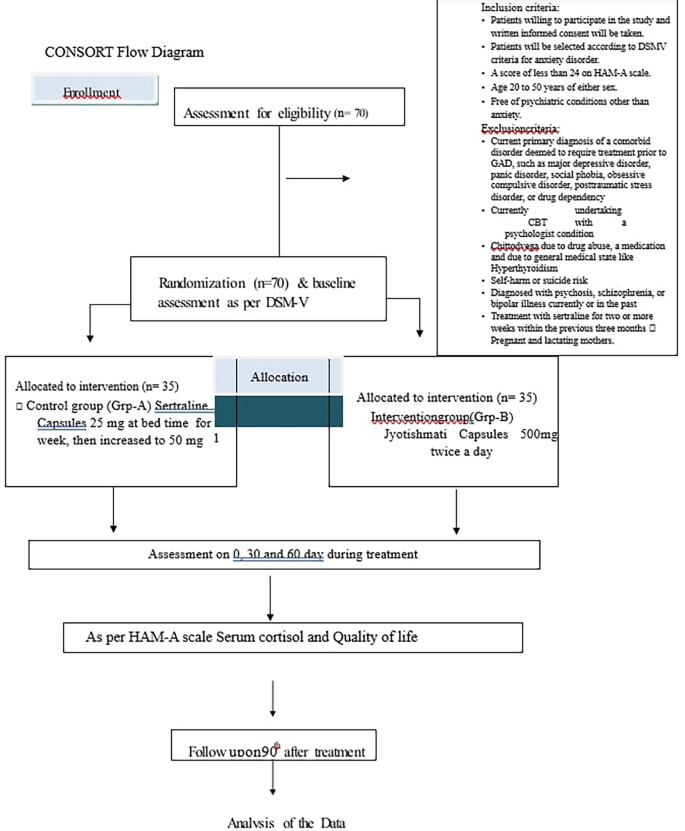 Figure 1
| Group | Sample size | Intervention | Dose and frequency | Anupana | Duration | Follow up |
|---|---|---|---|---|---|---|
| A | 35 | Sertraline Capsule | 25 mg at bed time for 1 week, then increased to 50 mg | With water | 60 days | Day 0 th, 30 th, 60 th, 90 th |
| B | 35 |
| 500 mg twice a day after food | With water | 60 days | Day 0 th, 30 th, 60 th, 90 th |
Peer Reviews
No public reviews on file for this paper yet. If you reviewed it on a platform where reviews are public (OpenReview, ICLR, NeurIPS, ICML), you can paste yours below so the community can read it here.
Videos
No videos yet. Explain this paper in a talk, walkthrough, or lecture? Add one.
Taxonomy
TopicsNatural Compounds in Disease Treatment · Complementary and Alternative Medicine Studies · Ethnobotanical and Medicinal Plants Studies
Introduction
Ayurveda, due to its psychosomatic approach considers the mind as an integral part of life. It advocates the integration between the mind, body and soul with holistic approach. In our bodies, there are two different types of mind qualities ( Manas doshas like Satva, Rajas, and Tamas) and bodily humours like ( Vata, Pitta, and Kapha). Because bodily humours and mind qualities frequently interact with one another, ^ 1 ^ Ayurveda accepts the idea of psychosomatic disorder. Of the three humours, Vata (Particularly Prana, Vyana, and Udana Vata) is primarily in charge of controlling and stimulating mental activity as well as generating enthusiasm. Sadhaka, a subtype of Pitta, has a direct connection to how the mind works. It is in charge of intelligence, memory, and cognition, as well as self-worth and enthusiasm. ^ 2 ^ The qualities of Kapha ( Tarpaka and Bodhaka, types of Kapha) include endurance, strength, knowledge, learning, wisdom, thinking, understanding, comprehensiveness, comprehension ability, equilibrium, enthusiasm etc. ^ 3 ^ Generalized anxiety disorder (GAD) ( Chittodvega) is referred to as the “anxious status of a mind” and is described as a Chitta (mind) + Udvega (anxiety). ^ 4 ^ It is referred to as Raja-tama vikara in Charaka vimana 6 ( Rogaanik vimaana adhyaya). ^ 5 ^
The vitiation of mind qualities like Raja and Tama leads to the development of Chittodvega. Raja is aggravated by indulgence in causative factors, which also aggravates another mind quality, i.e., Tama as well as Vata, and Pitta. In Ayurveda Chittodvega (anxiety disorders) is described as one of the causes of psychosis ( Unmada) rather than as a separate disease. ^ 6 ^ One of the minor psychiatric diseases is chittodvega; there is no disorientation and the patient can carry out everyday activities without much trouble (i.e neurosis), ^ 7 ^ whereas psychosis ( Unmada) is a major psychological disorder (impairment of orientation, i.e. psychosis), and neurosis may leads to psychosis, so can be considered as prodromal of psychosis ( Unmada). ^ 8 ^
The symptoms of Chittodvega are similar to those of GAD, which are muscle tension, poor concentration, autonomic arousal, feeling “on edge” or restless, and insomnia. GAD manifests as persistent, excessive, and/or exaggerated worry. The Diagnostic and Statistical Manual of Mental Disorders, Fifth Edition (DSM-5) includes the following diagnostic criteria: anxiety and worry that has lasted at least six months. ^ 9 ^ Controlling the worry is difficult. For at least 6 months, the anxiety is connected with three or more of the following symptoms: 1. Restlessness, tenseness, or apprehension. 2. Being easily exhausted. 3. Difficulty concentrating or going blank, as well as impatience. 4. Muscle tenseness. 5. Sleep deprivation. Irritability: anxiety causes severe distress or impairment in social and work settings. ^ 10 ^ There is no physiologic reason for the worry. ^ 11 ^
Many disorders are more common today, and one of them is mental illness, which stands as India’s third largest health burden according to a World Health Organization (WHO) report. ^ 12 ^ WHO estimates that 264 million people globally, or 3.6%, suffer from an anxiety illness. Additionally, anxiety affects 4.6% of females and 2.6% of males worldwide. ^ 13 ^ The following primary categories of anxiety disorders are included in the DSM-5, according to the American Psychiatric Association: acute stress disorder, post-traumatic stress disorder, obsessive compulsive disorder (OCD), GAD, agoraphobia without panic, social phobia (social anxiety disorder), specific phobia, and anxiety disorder not otherwise mentioned. ^ 14 ^
In modern medicine, GAD management consists of psychotherapy, like cognitive behavioral therapy (CBT) and pharmacological approaches such as cannabis, citalopram, escitalopram, sertraline, duloxetine, and venlafaxine. ^ 15 ^ The first-line psychological and pharmaceutical treatments are CBT and selective serotonin reuptake inhibitors (SSRIs) like sertraline; alternative possibilities include selective norepinephrine reuptake inhibitors (SNRIs). Compared to other anxiolytics, SSRIs deal with depression, which is frequently co-occurring with anxiety and has less adverse effects. ^ 16 ^ The World Federation of Societies of Biological Psychiatry recommends SSRIs, and SNRIs as first-line therapies for GAD. However the medicine should treat the condition without any adverse effects on the body. So, there is a need to search for better treatment with less complications.
One of the most significant medicinal plants in the Celatraceae family is Celastrus paniculatus, also known as Jyotishmati. It is a deciduous, woody forest climber that grows primarily in mountainous terrain. Jyotishmati is a combination of the words “enlightens” (Jyoti) and “brain functions” ( mati), which means “enlightens the psychomotor function.” The seed oil ( Jyotishmati taila) is well renowned for its intellect-promoting ( medhya) properties. As a brain tonic, it is used to boost intelligence and improve memory. ^ 17 ^ With its pungent and bitter taste and hot potency, Celastrus paniculatus ( Jyotishmati) has an effect on three bodily humours of the body. It strengthens the ability of grasping and remembering (i.e Grahana and Smarana) and supports Sadhak Pitta (a subtype of pitta). Both digestion and cellular metabolism ( Jatharagni and Majja dhatwagni) are stimulated and improved by its attributes. ^ 18 ^ By clearing and opening the micro channel, it enhances circulation and offers appropriate nutrition. ^ 19 ^ ^,^ ^ 20 ^
In Bhavaprakash Nighantu and Raj Nighantu it is mentioned as intellect promoting ( Medhya) drug. ^ 21 ^
Need for the study
One type of anxiety illness, known as generalized anxiety disorder (GAD), is marked by excessive worry and anxiety that the individual with it has trouble controlling. GAD leads to functional disability and a markedly reduced quality of life for the patient. ^ 22 ^ This constituted 25–30% of psychiatric outpatients. ^ 23 ^ International Statistical Classification of Diseases and Related Health Problems ICD 10 enlists anxiety as one of the symptoms. Anxiety has a significant financial impact on the healthcare system that cannot be overlooked. Its prevalence is about 2–4%, along with psychological arousal, muscle tension, sleep problems, and restlessness. ^ 24 ^ Many people live with GAD, which makes it difficult for them to engage in relationships, employment, and other parts of life. Due to the problems of living in a materialistic, competitive society as well as the modern way of life, these types of symptoms and diseases are becoming more and more prevalent day by day. ^ 25 ^
To reduce the impact of these ongoing health hazards, treatment regimens are always being sought for the management of anxiety and the reduction of stress. Substitutes to SSRIs, benzodiazepines, and other prescribed medication are highly sought after in an effort to reduce exposure to hazardous effects related to these drugs. ^ 26 ^
The intellect promoting ( Medhya) medicines described in the Ayurvedic texts have a powerful effect on the mind, have the ability to lower anxiety, and support mental wellness. It is also mentioned in the classics that the one who uses rejuvenating ( medhya rasayana) drugs would attain longevity, memory, intellect, youth, luster, skin tone and voice, excellent functioning of the body and sense organs.
Presently there is a need for safer and effective drugs for GAD ( Chittodvega) and less research have been done in this regard in recent years. Celastrus paniculatus is one such herb mentioned having intellect promoting (Medhya) property. ^ 27 ^
As a result, this study aims to assess the effectiveness of Celastrus paniculatus ( Jyotishmati) capsules in the treatment of Chittodvega.
Aim: Evaluation of comparative efficacy of Celastrus paniculatus ( Jyotishmati) capsules versus sertraline capsules in the management of Chittodvega (generalized anxiety disorder).
Objective
Primary
- •To evaluate the efficacy of Jyotishmati capsules on the Hamilton anxiety rating-scale (HAM-A) and serum cortisol level.
- •To evaluate the efficacy of sertraline capsules on the HAM-A Scale and serum cortisol level.
- •To compare the efficacy of both on the HAM-A Scale and serum cortisol level.
Secondary
- •To evaluate the efficacy of Jyotishmati capsules on quality of life.
- •To evaluate the efficacy of sertraline capsules on quality of life.
- •To compare the efficacy of both on quality of life.
Methods
Ethical considerations
The study will start after clearance from the institutional ethics committee of Mahatma Gandhi Ayurved College Hospital and Research Centre, Salod (H), Wardha. And after CTRI registration (Ref. No. REF/2023/07/069880) Date – 15/09/2023.
The committee will decide on the endpoint and oversee the trial as it progresses. The researcher will assess any adverse event and will report these to the ethics committee. The committee will decide on the endpoint and oversee the trial as it progresses.
Before conducting the trial, written informed consent will be taken from the patient in the local language while explaining every aspect of the study. The researcher will take consent from trial participants.
The personal information of the participants will be collected and kept confidential before, during, and after the trial. Physical data will be stored in a protected storage facility with only access to the researcher. Computerized data will be held in a password-protected hard drive with only access to the researcher.
Study setting
The patients will be selected from Kayachikitsa Out-patient department and In-patient department of the Mahatma Gandhi Ayurved College, Hospital & Research Centre, Salod (H) and peripheral camps, mainly the population of Wardha district including patients of all community, (Maharashtra) India.
A total of 70 patients will be recruited for the study. They will randomly be divided into two groups; Group A – sertraline capsules, and Group B – Jyotishmati capsules. All the baseline parameters will be recorded at the start of the study. The patients will undergo treatment for 60 days for both groups. All the parameters will be recorded at the 0 ^th^, 30 ^th^, 60 ^th^, 90 ^th^ day of the study duration.
Eligibility criteria
Inclusion criteria
- •Patients willing to take part in a research study and ready to give written informed consent.
- •Patients will be selected according to DSM-V, ^ 28 ^ ICD-10 ^ 29 ^ criteria for anxiety disorders.
- •A score of less than 24 on HAM-A scale.
- •Age group of 20 to 50 years of either sex.
- •Free of psychiatric conditions other than anxiety.
Exclusion criteria
- •Current primary diagnosis of a comorbid disorder deemed to require treatment prior to GAD, such as major depressive disorder, panic disorder, social phobia, obsessive compulsive disorder, post-traumatic stress disorder, or drug dependency.
- •Currently undertaking CBT with a psychologist.
- •GAD (Chittodvega) due to drug abuse, a medication or due to general medical state like hyperthyroidism.
- •Alcoholic, and self-harm or suicide risk.
- •Diagnosed with psychosis, schizophrenia, or bipolar illness currently or in the past.
- •Treatment with sertraline for two or more weeks within the previous three months.
- •Pregnant and lactating mothers.
Intervention description
- • Group A – sertraline capsules 25 mg at bedtime for 1 week, then increased to 50 mg with water for 60 days.
- • Group B – Jyotishmati capsules containing processed seed powder of Jyotishmati, 500 mg twice a day with water for 60 days.
Preparation
Jyotishmati (Celastrus paniculatus) seed will be pulverized into powdered form which then will be sieved and three bhavanas (trituration) of Jyotishmati phanta will be given to it according to Churnakriya method mentioned in Sharangadhara Samhita in Dattatreya Ayurved Rasashala, Salod (H), Wardha. ^ 30 ^ The processed powder will be filled into capsules.
Intervention modification
Any adverse effect during the treatment will be noted and will be informed to the ethical committee. The patients will be taken care of for the adverse effect. If participants want to drop out, this will be mentioned with the reason for discontinuing the treatment.
Outcomes
- • Primary – Reduction in Hamilton A score and serum cortisol levels,
- • Secondary – Improvement in quality of life.
Participant timeline
Patients will be treated for 60 days and assessment will be done up to 90 days as mentioned in Figure 1.
Showing study timeline.
Sample size formula using mean difference
Primary Variable = Hamilton anxiety rating scale (Anxiety Assesment)
Before the treatment (sertraline) Hamilton Anxiety Rating Scale (mean ± sd) = 19.38 ± 4.318, (As per reference article). ^ 31 ^
After the treatment (sertraline) Hamilton Anxiety Rating Scale at 28 day (mean ± sd) = 15.70 ± 4.550,
Mean difference (δ) = 3.68
Pooled Std. Deviation = (4.318+ 4.550)/2 = 4.434
Sample size N = 31
Considering 10 % drop out = 3
Total sample size required = 31+3 = 34 per group.
For protocol purposes and according to the calculated sample size for each group is = 34
Recruitment
As per sample size calculation, total 34 patients will be recruited which include 31 patients and 3 drop outs. Data collected will be analyzed by using appropriate statistical methods. The patients of Chittodvega will be selected from the Kayachikitsa Out-patient department and In-patient department of Mahatma Gandhi Ayurved College, Hospital & Research Centre, Salod (H), and from specialized peripheral camps.
A total of 70 patients will be recruited for the study.
Enrolment and interventions time schedule
The intervention period will be from 0 to 60 days and follow up on the 0 ^th^, 30 ^th^, 60 ^th^ and 90 ^th^ day.
Guidelines
This protocol follows the SPIRIT guidelines. ^ 23 ^
Case definition
Patients between 20–50 years of age of both gender having symptoms of Chittodvega and a HAM-A scale score of less than 24, i.e., mild to moderate cases, will be selected for the study.
Type of study
Interventional study.
Study design
Randomized active controlled double blind equivalence trial.
Investigation – Serum cortisol level.
Diagnostic criteria – DSM-V Diagnostic Criteria for Generalized Anxiety Disorder. ^ 32 ^
Assessment criteria
- 1.Hamilton Anxiety Scale – HAM-A assessment will be done on 0, 30, 60 and 90 days by asking the validated questionnaire attached in annexure. ^ 33 ^
- 2.Serum cortisol level – will be assessed before and after treatment in our lab.
- 3.WHO Quality of life – assessment will be done on 0, 30, 60 and 90 days by asking the validated questionnaire attached in annexure. ^ 34 ^
Assignment of interventions
Allocation sequence generation – Computer-generated random numbers.
Allocation implementation – The researcher or the first author will generate an allocation sequence, enrol participants, and assign participants to intervention.
Sampling procedure
Randomization will be done by computer-generated random allocation software by SPSS 7.0 to avoid bias in the study.
Concealment of allocation
A third person will do coding to allocate subjects in sequentially numbered, opaque, sealed envelopes in groups A or B (SNOSE Scheme) to avoid bias in the study.
Blinding – Randomized active controlled double blind equivalence trial, i.e., trial participants and care providers will be blinded in the study.
Data collection plan
Data will be assessed according to HAM-A Scale ** , ** WHO Quality of life, on 0 ^th^, 30 ^th^, 60 ^th^ & 90 ^th^ day and serum cortisol at baseline and after completion of treatment. See Table 1.
Drug collection/authentication
The raw material for the drug will be purchased from an authentic shop from Nagpur (Wagh brothers) and will be identified by the department of Dravyaguna and Rasashastra of M.G.A.C.H. and RC, Salod, Wardha.
Data analysis
After the study, the data will be analyzed according to a suitable statistical test.
The collected data will be entered in the software SPSS version 22. Man-Whitney and Wilcoxon tests will be used if the distribution of data was not normal. A chi squared test will be used to compare the qualitative variables. Independent t-test will be used to compare the mean of the two groups in the normal distribution of data, and for comparison before and after data, the paired t-test will be used.
Study status
Drug preparation is in process.
Discussion
Chitta (mind) + Udvega (anxiety) = Chittodvega, or anxious mental state. However, Chittodvega is a more appropriate expression for describing the entire anxious illness. ^ 35 ^ As a result, the term Chittodvega is compared to GAD in this study. GAD patients exhibit chronic, excessive, and/or unreasonable worry that is accompanied by muscle tension, reduced focus, autonomic arousal, a feeling of being on edge or restless, and insomnia for at least six months. This disease causes the patient to have unfocused worry and anxiety that is not related to recent traumatic experiences, but it may be worsened by specific circumstances. ^ 36 ^ GAD is a common mental condition in the general society as a whole with a prevalence of about 5%. Women are twice as likely as men to have this condition. ^ 37 ^ Medication such as selective serotonin reuptake or serotonin-norepinephrine reuptake inhibitors are the first-line treatments ^ 38 ^ but long-term use can have negative side effects such nausea, trouble sleeping, changes in appetite, dry mouth, headaches, and sexual dysfunction. ^ 39 ^ In contrast, Ayurveda states that mental disorders ( manas rogas) is where mind promoting ( Medhya) medicines are used. Jyotishmati ( Celastrus paniculatus) is a thorny climbing polygamodioecious shrub that may climb up to 10 m with the help of a nearby tree. It is found virtually across India, rising to an elevation of 1800 m in the subtropical Himalayas. ^ 40 ^ The seed oil and fruit are often used for their tranquillizing, sedative, wound-healing, and other properties. The Ayurvedic application is primarily for its Medhya (brain tonic) activity. It can be used as a brain tonic to enhance intelligence and memory. Its Deepana (stimulating digestion) property help in improving deranged digestive fire ( Agni) and thereby balancing bodily as well as mental humours ( Sharir and Manas dosha) ^ 41 ^ Jyotishmati is a renowned medicinal herb recognised for its brain-boosting properties that has been used for generations in Ayurvedic medicine to sharpen memory and improve concentration and cognitive function. ^ 42 ^
Data monitoring: formal committee.
Dissemination
This protocol will be further published as a thesis to disseminate the study for GAD ( Chittodvega). The study protocol provides a detailed overview of the study design, methodology, data collection procedures, data analysis plan, and ethical considerations. By disseminating this protocol, we hope to advance knowledge in the field and facilitate future research by posters, papers and publications.
The reference list from the paper itself. Each links out to its DOI / PubMed record.
- 1Shilpa S Murthy CV : Understanding personality from Ayurvedic perspective for psychological assessment: A case. Ayu. 2011;32(1):12–19. 10.4103/0974-8520.85716 22131752 PMC 3215408 · doi ↗ · pubmed ↗
- 2Stranger T : How to Overcome Stress Naturally: Take Control of Your Mental & Emotional Life. Global Publishing Group;2023.
- 3Patel VDV : MANASA, MANASABHAVA & MANASAVIKARA: AN AYURVEDIC CONCEPT. RED’SHINE Publication. Pvt. Ltd.;2020.
- 4Saroj UR Rao P Joshi RK : Clinical Evaluation of the Efficacy of Shankhapushpi Panak and Shirodhara with Mansyadi Kwatha in the Management of Chittodvega WSR to Generalized Anxiety Disorder. J. Ayurveda. 2015;9(1).
- 5Dadu V : The Vimana Sthana of the Charaka Samhita as a knowledge and measurement unit. Anchor Academic Publishing;2016.
- 6Gupta K Mamidi P : Vataja Unmada: Schizophrenia or Dementia or Mood Disorder with Psychosis? Int. J. Yoga - Philos. Psychol. Parapsychol. 2020;8(2):75.
- 7Dileep K Sarvesh K Narasimha MK . Reference Source
- 8Hiremath NB : A comparative study of brahmi taila and anutaila pratimarsha nasya in management of Generalized Anxiety Disorder (GAD) (Doctoral dissertation, Tilak Maharashtra Vidyapeeth, Pune). 2022.