Radiocarbon dataset for the TRB central-place at Kałdus, Poland
Kamil Adamczak, Magdalena Kozicka, Łukasz Kowalski, Dominika Kofel, Wojciech Chudziak, Piotr Błędowski, Jacek Bojarski, Ryszard Kaźmierczak, Marcin Weinkauf

TL;DR
This paper presents a dataset of radiocarbon dates from an archaeological site in Poland to study the chronology and organization of a Neolithic culture.
Contribution
The dataset includes new radiocarbon dates and provides insights into the TRB settlement pattern and cultural practices.
Findings
The dataset includes 10 new radiocarbon dates and 4 previously published ones.
The data helps establish the absolute chronology of the TRB central-place at Kałdus.
The dataset supports future research on cultural practices like cremation and metalwork movement.
Abstract
This dataset compiles radiocarbon dates received for botanical macroremains and animal bones from domestic and ritual pits and human graves unearthed during excavations at the archaeological site of Kałdus (Poland) that can be related to the Funnel Beaker culture (TRB). Prior to radiocarbon dating by accelerator mass spectrometry (AMS), plant macroremains were checked against diagnostic attributes of species identification by standard paleobotanical analysis. The dataset contains already published (n = 4) and new (n = 10) radiocarbon dates that were used to establish the absolute chronology of the TRB habitus at Kałdus and its diachronic spatial organization. This dataset serves as an archive for future studies focusing on the TRB settlement pattern and organization in the region of modern Poland. It also has a utility to be reused in archaeological and chronological research on the…
Genes, proteins, chemicals, diseases, species, mutations and cell lines named across the full text — each resolved to its canonical identifier and authoritative record.
Click any figure to enlarge with its caption.
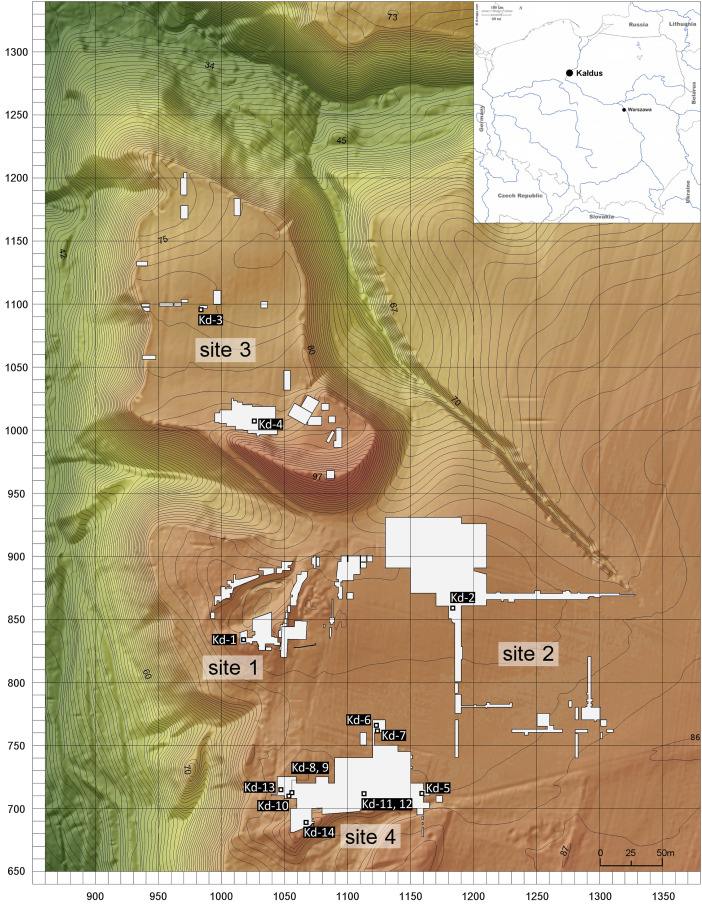 Figure 1
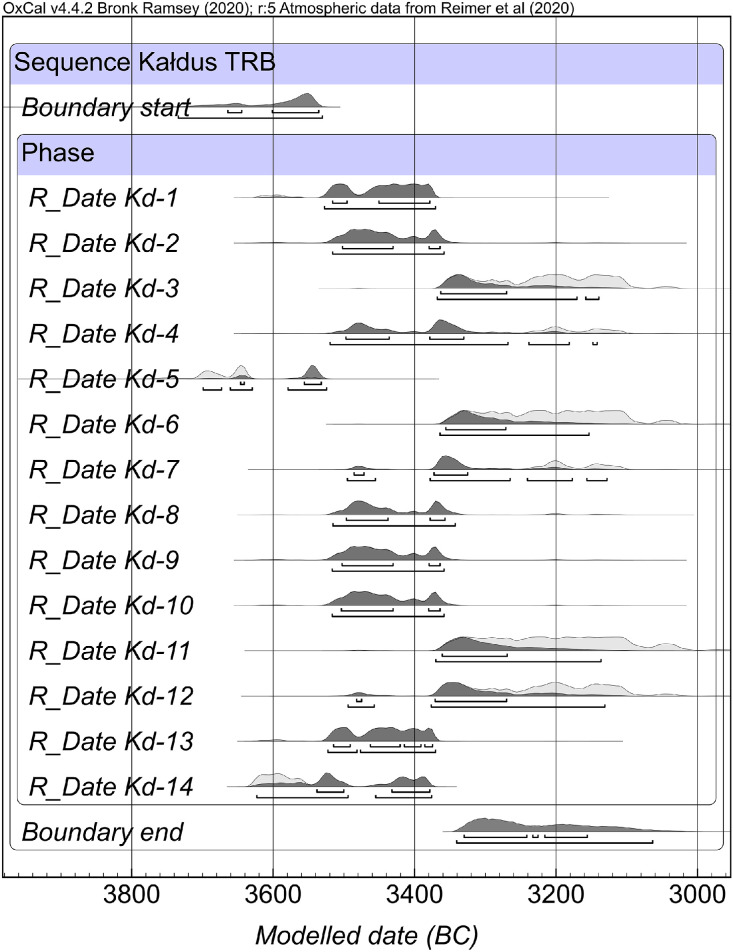 Figure 2
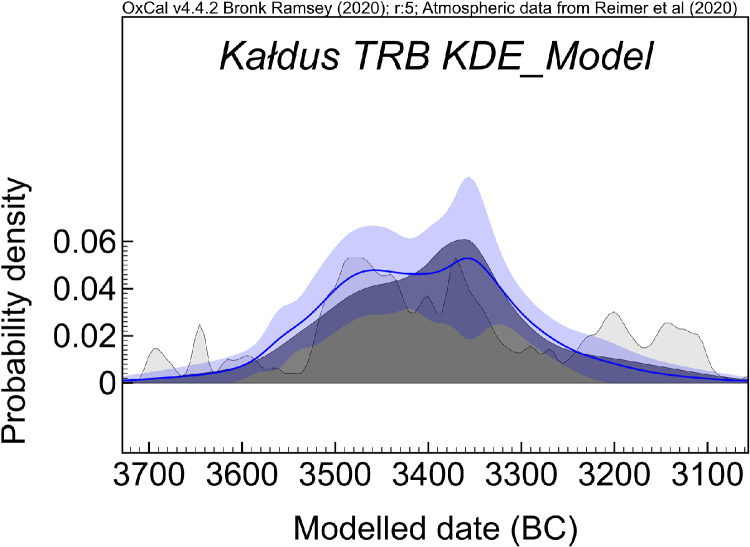 Figure 3
Peer Reviews
No public reviews on file for this paper yet. If you reviewed it on a platform where reviews are public (OpenReview, ICLR, NeurIPS, ICML), you can paste yours below so the community can read it here.
Videos
No videos yet. Explain this paper in a talk, walkthrough, or lecture? Add one.
Taxonomy
TopicsHistorical and Archaeological Studies · Archaeology and ancient environmental studies · Ancient and Medieval Archaeology Studies
Specifications TableSubjectArchaeologySpecific subject areaAMS radiocarbon dating, Bayesian modellingType of dataTable, FigureRaw, ProcessedData collectionRadiocarbon dating: an Accelerator Mass Spectrometer (AMS) National Electrostatics Corporation (NEC) 1.5 SDH Compact Carbon Pelletron at Poznań ^14^C dating unit (Poznań Park of Science and Technology, Poland).Archaeobotanical analysis: for soil samples a manual bucket flotation system was used. The macroscopically visible plant remains from flotation and those extracted from potsherds and daub lumps were identified from morphological characters using a Delta Optical SZ-430B low-power stereomicroscope (magnification ×6.5–40).Data source locationKałdus (53°19′41,178″N 18°22′52,010″E), Chełmno commune, PolandData accessibilityRepository name: Mendeley DataData identification number: 10.17632/tdxv8×7b7r.1Direct URL to data: https://data.mendeley.com/datasets/tdxv8×7b7rRelated research article
Value of the Data
1
- •This dataset brings together all radiocarbon dates for the Late Neolithic (TRB) habitus at the site of Kałdus, which is one of the northernmost archaeological testimonies of the Baden culture uptake in Central Europe.
- •The database includes two pits with one of the earliest copper metal depositions in Central Europe, which are rarely radiocarbon dated.
- •This dataset offers the first direct radiocarbon evidence of a one-phase, large TRB settlement in the region.
- •Archaeologists can use this dataset for the interregional research on the emergence and development of the Baden culture north of the Carpathians.
- •The data have utility for refining the absolute chronology of the TRB settlement in the region.
Background
2
The problem of large sites of the Funnel Beaker (TRB) culture has long been recognized in Polish archaeology [[1], [2], [3]]. Although in some cases the TRB settlements of considerable extent have been brought to light by excavation (e.g. Bronocice, Ćmielów, Gródek Nadbużny, Mozgawa), their exposure represents only a small portion of the total area of a real settlement coverage. The delineation of a settlement area is usually determined in relation to the distribution of features and structures recorded at the site and their stratigraphic relations. This fact, combined with the shortage of radiocarbon data for the extensive TRB sites in Poland, has fueled the ongoing debate as to whether such archaeological records offer evidence of large settlements, encompassing an area of up to 30–50 ha, or represent a multi-phase settlement with diachronic spatial organization.
The original motivation behind compiling this dataset was to fill the gap in radiocarbon dating of the TRB settlement at Kałdus, north-central Poland, and provide an absolute chronology framework for investigating the spatial and temporal organization of the site. This dataset offers a starting point for creating an open access radiocarbon database for the site, which will be gradually updated as new radiocarbon dates become available. Presented information can be further explored and placed within the wider settlement context of the Late Neolithic in the region of modern Poland and beyond.
Data Description
3
This dataset consists of 14 AMS radiocarbon dates of charged material and bulk collagen extracted from one soil sample (No. Kd-13), two fragments of daub, three potsherds, three pieces of unidentified charred material and five animal bones from the Late Neolithic habitus at the site of Kałdus, north-central Poland (Fig. 1). Two pits were radiocarbon dated twice (sample Nos. Kd-8 and 9, and Kd-11 and 12). Archived archaeological materials and documentation for the site were revisited in 2018. The sampled archaeological material was collected by the authors during excavations at the site between 1996 and 2016 [4], and analyzed in the Poznań Radiocarbon Laboratory (Poland).Fig. 1. Plan of the archaeological site in Kałdus showing the location of features and layers covered by this dataset (plan site by M. Skrzatek; edited by Ł. Kowalski; map background: https://d-maps.com; see Table 1 for further details).Fig 1
All faunal and botanical remains were collected from domestic and ritual pits and human graves. These features can be linked to the TRB habitus at the site and dated by ceramic typology to as early as the mid-4th millennium BC [[5], [6], [7]].
Table 1 summarizes all AMS radiocarbon dates with their archaeological context, which includes site location, context of dated material and accompanying finds. For animal bones and botanical macroremains taxonomic identification is provided. The bibliographical references of the primary radiocarbon data are referenced in brackets on the column “^14^C Lab ID” in Table 1 and in extensive form in the References. The location of features and layers covered by this dataset is shown in Fig. 1.Table 1. Summary of radiocarbon dates for the TRB habitus at Kałdus covered by this dataset, with their archaeological context and references of the primary data (in brackets). Sample ID corresponds to number shown on the map in Fig. 1. Two pits have two radiocarbon dates (sample Nos. Kd-8 and 9, and Kd-11 and 12).Table 1. Sample IDDated materialSpeciesSite-no.ContextAccompanying finds^14^C Lab IDAge BPAge BC68.2 %95.4 %Kd-1botanical macroremainsTricitum1storage pit (?)potsherds, daub, animal bonesPoz-1017944690±303519–33773627–3371Kd-2animal boneunspecified2ritual pitCopper objects (ornament, hammer-axe, dagger), bone awl, amber disc, clay spindle whorl, flint retouched blade, two flint arrowheads, potsherdsPoz-95657 [6]4640±403502–33633620–3350Kd-3botanical macroremainsTricitum3storage pitceramic vessel, potsherdsPoz-1281774520±353353–31063361–3099Kd-4botanical macroremainsTricitum3house (?)ceramic vessels, daubPoz-1020804590±503499–31283516–3103Kd-5charcoalunspecified4gravepotsherds, daub, flint artefacts, animal bonesPoz-1017964880±353695–36423759–3541Kd-6animal boneunspecified4graveceramic vessels, potsherds, flint artefact, human bones (cremated), animal bonesPoz-1279824500±353338–31043357–3041Kd-7botanical macroremainsTricitum4graveceramic vessels, potsherds, flint artefact, grinding stone, animal bonesPoz-1281784565±353371–31203492–3102Kd-8animal boneSus scrofa f. domestica4ritual pitcopper ornament, ceramic vessels, polishing stone, animal bones, potsherdsPoz-97720 [6]4620±403498–33563520–3138Kd-9animal boneSus scrofa f. domestica4ritual pitsee “Kd-8”Poz-97721 [6]4640±403502–33633620–3350Kd-10animal boneOvis aries/Capra hircus4ritual pit (?)flint axe, bone perforator, animal bones, potsherdsPoz-101200 [7]4640±403502–33633620–3350Kd-11charcoalunspecified4storage pitceramic vessel, potsherds, millstonePoz-1020794500±503338–31033362–3027Kd-12botanical macroremainsTricitum4storage pitsee “Kd-11”Poz-1281804540±503366–31053489–3036Kd-13botanical macroremainsHordeum vulgare4trash pitpotsherds, animal bonesPoz-874124680±303516–33763623–3370Kd-14charcoalunspecified4trash pitceramic vessel, potsherds, daub, flint artefacts, stone artefact, animal bonesPoz-1017954735±303631–33843635–3378
Summary of a single-phase model for the TRB habitus at the site is given in Table 2 and Fig. 2. The Kernel density model (KDE) distribution of radiocarbon dates is shown in Fig. 3.Table 2. Summary of a single-phase model for the TRB habitus at Kałdus covered by this dataset (A_overall_=85.1; A_model_=84) (OxCal v4.4.2).Table 2. CommandSample IDUnmodelled age BCModelled age BCAgreement index68.2 %95.4 %68.2 %95.4 %Boundary start………3663–35363726–3531…Kd-13517–33793605–33703517–33793528–3371102.9Kd-23504–33653521–33563504–33653517–3360101Kd-33353–31063361–30993364–32823369–314196.3Kd-43497–31263516–31023497–33323520–3183113.8Kd-53704–36363765–35363647–35323697–352541.2Kd-63338–31043357–30413357–32763365–315898Kd-73371–31203492–31023486–33263496–3130119.9Kd-83498–33573522–31933497–33583516–3344102.9Kd-93504–33653521–33653504–33653517–3360101.1Kd-103504–33653521–33653503–33653517–3360101.2Kd-113339–31033364–30263362–32753371–3139101.4Kd-123366–31053498–30363484–32753495–313299.9Kd-133516–33753526–33693515–33763523–3371101.4Kd-143626–33833632–33773539–33793622–337791.9Boundary end………3334–31703340–3071…Fig. 2. One-phase model for the TRB habitus at Kałdus covered by this dataset (OxCal v4.4.2; see Table 2 for further details).Fig 2. Fig. 3The KDE model for the TRB habitus at Kałdus covered by this dataset (OxCal v4.4.2; A_overall_=88.9; A_model_=88.2). The dark grey is the KDE estimated distribution of the events at the site. The light grey is the sum of the calibrated date distribution. The blue line and band provide a ± 1σ estimate of the KDE model uncertainty.Fig 3
Experimental Design, Materials and Methods
4
Study area
4.1
The multi-period archaeological site at Kałdus is located in north-central Poland, on the border of the Lower Vistula Valley and the Chełmno-Dobrzyń Lakeland, ca. 3 km south of Chełmno (53°19′41,178″N 18°22′52,010″E). The Kałdus site covers a total area of ca. 15 ha and stretches over four conventional sites (Fig. 1). The site was first excavated by Lissauer in 1877 and fieldworks were continued by Polish and German archaeologists in the late 19th c. and at the beginning of the 20th c. Much more archaeological record was gained from the site after World War II. In 1996, an extensive research program was run in Kałdus by the Institute of Archaeology, NCU in Toruń, encompassing the entire site complex and focusing on the relics of the Early Middle Ages [4].
To date, approximately 15 % of the total site area (over 2 ha) has been excavated, exposing archaeological structures and objects that signify domestic and ritual activities at the site during an extended timescale spanning the Late Neolithic to the Early Middle Ages. The bottom layers recorded in Kałdus can be dated by ceramic typology to as early as the mid-4th millennium BC and linked to the TRB culture. The TRB's activity has been exposed over the entire area of the site and can be attested to by cremation graves, metal hoards and numerous storage and ritual pits, which yielded a substantial portion of ceramics and other archaeological material. The Neolithic habitus in Kałdus was succeeded by the Early Bronze Age newcomers of the Iwno culture (ca. 2100–1700 BC), and later by the Lusatian culture of the Early Iron Age (ca. 750–450 BC). The uppermost stratum of the site was formed between the 11th and 13th c. AD, when Kałdus became the political center (sedes regni principalis) for the first rulers of Piast Poland [[4], [5], [6], [7]].
Archaeobotanical analysis
4.2
The soil samples, potsherds and daub fragments were analyzed to extract material for radiocarbon dating. Soil sampling followed a combination of a systematic and judgement sampling strategies [8] and used a manual bucket flotation system. Each soil sample was dispersed in water and then gently stirred to release the botanical remains. Thereafter, the watery solution from the upper part of the bucket was poured through two sieves (0.5 mm and 0.25 mm mesh size). The next step was to pour fresh water onto the soil remains at the bottom of the bucket and the operation was repeated until no more soil was left. Sieves retained both the heavy and the light residues after silts and other particles smaller than 0.25 mm were rinsed through. Residues were dried and the heavy elements were separated from the lighter ones. After that, the residues were sorted under a Delta Optical SZ-430B low-power stereomicroscope (magnification ×6.5–40). The macroscopically visible plant remains were picked from the different sieved residues and identified from morphological characters. The macrofossil identifications were checked against the botanical literature [9,10] and compared with the modern reference collection, following standard nomenclature [[9], [10], [11]]. The potsherds and daub fragments were initially measured and then hand cleaned using soft brush and rubber dust blower. Observations of imprints were made with the use of a low-power stereomicroscope at low magnifications (max ×20), after which the ceramic objects were crushed for more negatives and charred plant fragments. Taxonomical identifications followed the botanical literature and were compared with the modern reference collection.
Radiocarbon dating
4.3
Selected botanical macroremains, charcoal and animal bones were analyzed in the Poznań Radiocarbon Laboratory (Poland). Preparation of the samples and dating by Acceleration Mass Spectrometry (AMS) was performed according to procedures described by Goslar [12]. All dates were calibrated in OxCal v4.4.2 [13] against the IntCal20 calibration curve [14]. The resulting endpoints were not rounded and the radiocarbon ages are reported as 68.2 % and 95.4 % confidence intervals. The data on the quality of the bone collagen can be found in the .xlsx file shared in the repository.
Bayesian modelling
4.4
KDE and one-phase Bayesian start/end date modelling [[15], [16], [17]] were performed in OxCal v4.4.2 [13] using the IntCal20 calibration curve [14] to summarize the radiocarbon dates and obtain a refinement of the TRB habitus at Kałdus.
Preliminary data analysis
4.5
The Bayesian modelling refined the radiocarbon dataset for Kałdus by providing a potential start date for the TRB habitus at 3663–3536 cal BC and suggests that the end boundary was 3334–3170 cal BC, both at 68.3 % (Table 2 and Fig. 2). According to the KDE model (Fig. 3), the events recorded at the site that are covered by this dataset (Table 1) are tightly clustered in a relatively short time period of approximately 200 years ranging between 3520 cal BC and 3320 cal BC. The Bayesian modelling suggests a continuous occupation of Kałdus by the TRB people, which extended over ca. 15 ha of the site (Fig. 1) and 8–10 generations.
Limitations
At the moment, only the site 4 has representative coverage of radiocarbon dates. As the Kałdus site complex has been excavated with a particular focus on the Early Middle Ages activity, no systematic programme of archaeobotanical sampling was carried out for features and structures that have been assigned to the Late Neolithic. The radiocarbon dating of TRB pottery from the site revealed that the ceramic paste used for their production contains different carbon sources, of different radiocarbon ages. Furthermore, the obtained date ranges overlap and enter the plateau region of the calibration curve beginning around 3350 cal BC. Radiocarbon database for the TRB habitus at Kałdus will be gradually updated as new radiocarbon dates become available.
Ethics Statement
This work does not involve any modern human subjects, animal experiments, or any data collected from social media platform.
CRediT authorship contribution statement
Kamil Adamczak: Writing – original draft, Funding acquisition. Magdalena Kozicka: Data curation, Methodology, Software, Writing – original draft, Visualization, Funding acquisition. Łukasz Kowalski: Conceptualization, Writing – original draft, Writing – review & editing, Visualization, Supervision. Dominika Kofel: Writing – original draft, Investigation. Wojciech Chudziak: Resources, Funding acquisition. Piotr Błędowski: Resources. Jacek Bojarski: Resources. Ryszard Kaźmierczak: Resources. Marcin Weinkauf: Resources.
The reference list from the paper itself. Each links out to its DOI / PubMed record.
- 1Nowak M.Drugi Etap Neolityzacji Ziem Polskich 2009 Księgarnia Akademicka, Kraków
- 2Kruk J.Milisauskas S.Bronocice: the Chronology and Development of a Neolithic settlement of the Fourth Millennium BC 2018 Institute of Archaeology and Ethnology of the Polish Academy of Sciences
- 3Korczyńska M.Cappenberg K.Nowak M.Multi-methodological approaches to investigate large archaeological sites: the case study of the Eneolithic settlement in Mozgawa, western Lesser Poland J. Archaeol. Sci.: Rep.272019 e 10194110.1016/j.jasrep.2019.101941 · doi ↗
- 4Chudziak W.Wczesnośredniowieczna przestrzeń sakralna in Culmine na Pomorzu Nadwiślańskim Mons Sancti Laurentii 12003 Wyd. Naukowe UMK, Toruń
- 5Adamczak K.KowalskiŁ.Bojarski J.Eneolithic metal objects hoard from Kałdus, Chełmno commune, kujawsko-pomorskie voivodeship Spraw. Archeol.672015199219 https://rcin.org.pl/Content/57807/PDF/WA 308_78190_PIII 368_Eneolithic-metal-obj_I.pdf
- 6KowalskiŁ.Adamczak K.Garbacz-Klempka A.Back to the Eneolithic: exploring the Rudki-type ornaments from Poland Archaeol. Anthropol. Sci.11820194355437710.1007/s 12520-019-00825-4 · doi ↗
- 7KowalskiŁ.Weckwerth P.Chabowski M.Towards ritualisation: insights into bone-tempered pottery from the TRB settlement in Kałdus (Poland, 3500–3350 BC)Ceram. Int.46320203099311210.1016/j.ceramint.2019.10.012 · doi ↗
- 8Orton C.Sampling in Archaeology, Cambridge Manuals in Archaeology 2000 Cambridge University Press 10.1017/CBO 9781139163996 · doi ↗