Author Correction: Early-pregnancy N-terminal pro-brain natriuretic peptide level is inversely associated with hypertensive disorders of pregnancy diagnosed after 35 weeks of gestation
Masaya Takahashi, Luka Suzuki, Nanase Takahashi, Mayu Hanaue, Masahiro Soda, Tamito Miki, Naoko Tateyama, Shiro Ishihara, Taro Koshiishi

Abstract
Genes, proteins, chemicals, diseases, species, mutations and cell lines named across the full text — each resolved to its canonical identifier and authoritative record.
Click any figure to enlarge with its caption.
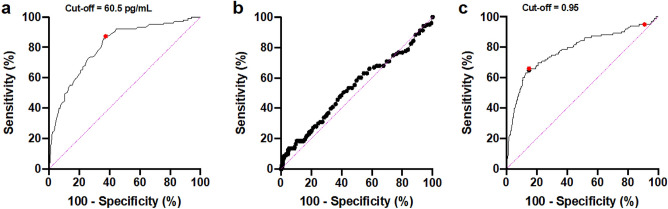 Figure 3
Peer Reviews
No public reviews on file for this paper yet. If you reviewed it on a platform where reviews are public (OpenReview, ICLR, NeurIPS, ICML), you can paste yours below so the community can read it here.
Videos
No videos yet. Explain this paper in a talk, walkthrough, or lecture? Add one.
Taxonomy
TopicsCardiovascular Issues in Pregnancy · Pregnancy and preeclampsia studies
Correction to: Scientific Reports 10.1038/s41598-024-63206-5, published online 28 May 2024
In the original version of this Article Figure 3c contained an incorrect marking. The original Figure 3 and accompanying legend appear below.Figure 3ROC curve for the accuracy analysis of NT-proBNP levels and the ratio of third-to-first-trimester NT-proBNP levels for predicting HDP. (a) NT-proBNP levels during the first trimester (7–13 weeks of gestation). (b) NT-proBNP levels during the third trimester (35–37 weeks of gestation). (c) Ratio of third-to-first-trimester NT-proBNP levels. ROC, receiver operating characteristic; NT-proBNP, N-terminal pro-brain natriuretic peptide; HDP, hypertensive disorders of pregnancy.
The original Article has been corrected.