The complete chloroplast genome of Blechnopsis orientalis (Linnaeus) C. Presl 1753 (Blechnaceae)
Yu-tong Huang, Wen-xiao Men, Yan-ping Xing, Wen-juan Hou, Yan-chang Huang, Yan-yun Yang, Liang Xu

TL;DR
This paper reports the complete chloroplast genome of Blechnopsis orientalis, a fern used in food and medicine, providing insights into its genetic structure and phylogenetic relationships.
Contribution
The study presents the first complete chloroplast genome sequence of Blechnopsis orientalis and its phylogenetic analysis.
Findings
The chloroplast genome is 155,211 bp long with specific regions and a GC content of 41.3%.
A total of 131 genes were annotated, including 88 protein-coding genes.
Phylogenetic analysis shows B. orientalis is closely related to Oceaniopteris gibba.
Abstract
Blechnopsis orientalis (Linnaeus) C. Presl (1753) is a fern used both as food and medicine. It is found primarily in southern China and Southeast Asia, thriving in warm, humid shrublands or sparse forest. The total length of the chloroplast genome is 155,211 bp, including a large single-copy region (LSC, 81,877 bp), a small single-copy region (SSC, 21,500 bp), and two inverted repeat regions (IRs, 25,917 bp). The GC content is 41.3%. A total of 131 genes were annotated, including 88 protein-coding genes, eight rRNA genes, and 35 tRNA genes. The phylogenetic analysis using the maximum-likelihood method showed that B. orientalis and Oceaniopteris gibba were closely related. This study provides genomic resources for phylogenetic genetics and resource exploitation of B. orientalis.
Genes, proteins, chemicals, diseases, species, mutations and cell lines named across the full text — each resolved to its canonical identifier and authoritative record.
Click any figure to enlarge with its caption.
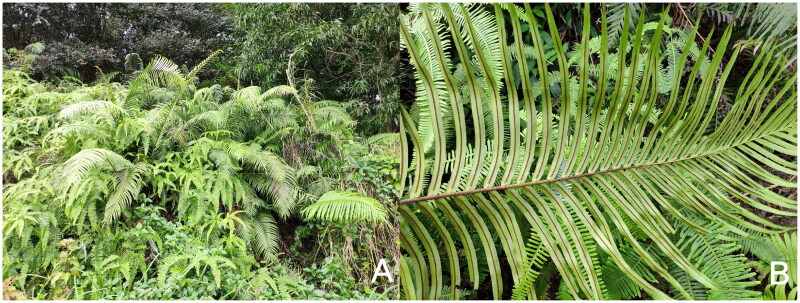 Figure 1
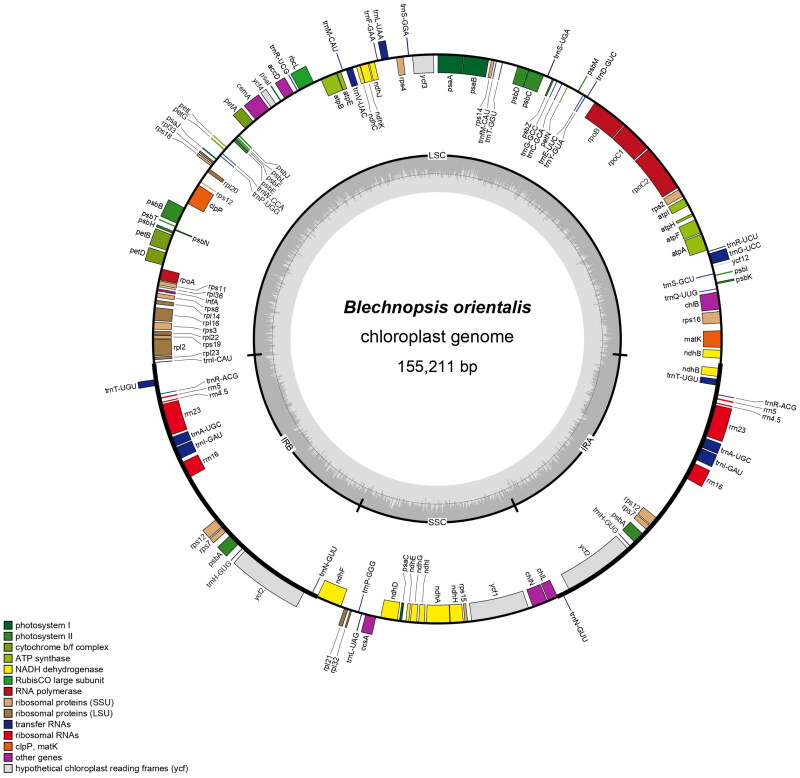 Figure 2
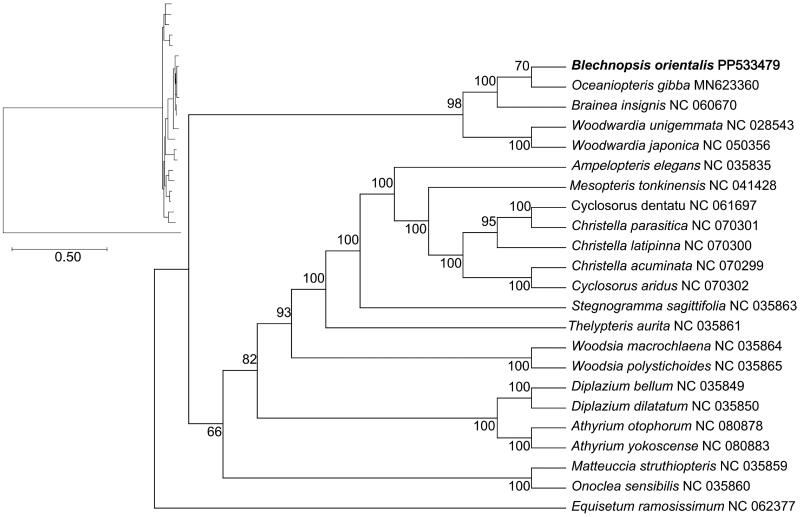 Figure 3
- —Liaoning BaiQianWan Talents Program
- —Key Project at Central Government Level: The Ability Establishment of Sustainable Use for Valuable Chinese Medicine Resources
- —Liaoning Provincial Department of Education
- —National Natural Science Foundation of China10.13039/501100001809
- —Liaoning Province Joint Fund
Peer Reviews
No public reviews on file for this paper yet. If you reviewed it on a platform where reviews are public (OpenReview, ICLR, NeurIPS, ICML), you can paste yours below so the community can read it here.
Videos
No videos yet. Explain this paper in a talk, walkthrough, or lecture? Add one.
Taxonomy
TopicsPlant and Fungal Species Descriptions · Fern and Epiphyte Biology · Plant and animal studies
Introduction
Blechnopsis orientalis (Linnaeus) C. Presl (1753) is a fern species of the genus Blechnopsis in the Blechnaceae family. It is mainly distributed in China and parts of southeast Asia (Wang et al. 2013). In some provinces of southern China, the dry rhizomes and petiole residues of this plant are used as traditional Chinese medicine to treat diseases such as wind-heat cold, hematemesis, taeniasis, ascariasis, and so on. In some countries of Southeast Asia, it is often used to treat wounds, blisters, abscesses, and ulcers (Ahmad and Holdsworth 2003), as well as stomachache and bladder discomfort (Maridass and Ghantikumar 2008). As one of the most popular edible ferns in Asia, the main edible part is the young leaves (Piggott 1996; Huang et al. 2019). It has strong vitality and can still grow even in places with serious environmental pollution (Zhu et al. 2013). Modern pharmacological studies have found that B. orientalis has antioxidant, anti-cancer, and antibacterial effects. Its ethyl acetate, n-butanol, and water extracts have strong free radical scavenging activity and significant bactericidal activity against Gram-positive bacteria (Tao et al. 2009). It can be used as antioxidant with antibacterial and antitumor properties of natural materials (Lai et al. 2017).
The chloroplast genome is independent of the nuclear genome and is a circular DNA consisting of four fragments: IRA, IRB, LSC, and SSC. These fragments can be used to characterize the functions and transcription processes of chloroplasts, providing information that helps influence the functionality of chloroplasts (Liu et al. 2018). Chloroplast genes have high stability and can be inherited independently, making them a reliable basis for species identification, phylogeny, origin, and evolution (Lilly et al. 2001; Liu, Ni, et al. 2023; Liu, Zeng, et al. 2023). At present, most of the studies on B. orientalis focus on resource distribution and pharmacological effects, lacking systematic research and analysis of its chloroplast genome and genetic background information. Therefore, in this study, the whole genome information of B. orientalis chloroplast was measured by Next-generation sequencing. Using bioinformatics software, we analyzed the sequence characteristics, gene composition, and phylogenetic relationship of this species. This study laid a research and theoretical foundation for the study of genetic structure and genetic diversity of B. orientalis, and also provided support for the phylogenetic analysis and genetic diversity research of Blechnopsis in the future (Figure 1).
Photographs of (A) habitat and (B) linear sporangia group of B. orientalis taken by Ling-ling Lin in Guangzhou, Guangdong Province, China (113°21′29.40″ E, 23°9′20.11″ N). Sporangium group linear, born along both sides of the main vein, sporangium lid round, open to the main vein.
Materials and methods
Plant material
Fresh leaf samples were collected from Guangzhou, Guangdong Province, China (113°21′29.40″ E, 23°9′20.11″ N) and identified by Professor Liang Xu from the Liaoning University of Traditional Chinese Medicine. A specimen was deposited at the herbarium of Liaoning University of Traditional Chinese Medicine (Liang Xu [email protected], B. orientalis number: 10162231017007LY) (Supplementary Figure S1).
DNA extraction and sequencing
Total genomic DNA was isolated from 150 mg of fresh leaves utilizing the cetyltrimethylammonium bromide technique (Doyle and Doyle 1987). Monitoring of DNA degradation and contamination was conducted using 1% agarose gels. DNA concentration was determined using the Qubit^®^ DNA Assay Kit in Qubit^®^ 3.0 Fluorometer (Invitrogen, Waltham, MA). An aliquot of the purified DNA (1 μg) underwent sonication to fragment it into pieces of 350 bp in size, which were subsequently used to build a short-insert (350 bp) library with the Nextera XT DNA library preparation kit (Illumina, San Diego, CA). The sequencing of the library was performed on the Illumina NovaSeq 6000 platform, with coverage assessment carried out through the samtools depth utility.
Genome assembly and annotation
The raw data underwent quality filtering with the NGS QC Tool Kit v2.3.3. (https://nipgr.ac.in/ngsqctoolkit.html) (Patel and Jain 2012). And then select the high quality of the sequence data (9.47 G) and the use of assemblers SPAdes v.3.14.1 (http://cab.spbu.ru/software/spades/) from the beginning to assemble a complete chloroplast genome (Bankevich et al. 2012). Finally, the complete chloroplast genome was annotated by utilizing PGA (Qu et al. 2019) with reference to the complete chloroplast genome of Woodwardia unigemmata (NC028543).
Phylogenetic analysis
To determine the position of B. orientalis in the phylogeny, we constructed phylogenetic trees. The complete chloroplast genomes of 23 fern species were randomly obtained from NCBI, with Equisetum ramosissimum as an outgroup. Common protein-coding genes of 57 chloroplast genomes were identified using MAFFT version 7.037 (Katoh and Standley 2013) and compared with B. orientalis. Twenty-two complete chloroplast genomes were obtained by FFT-NS-2 strategy. Finally, the phylogenetic tree of 23 chloroplast genomes was constructed based on the maximum-likelihood method with 1000 bootstrap replicates and the GTR + F + I + G4 model line selected by ModelFinder (Kalyaanamoorthy et al. 2017).
Results
Genome structure analysis
The total length of the chloroplast genome was 155,211 bp, including 81,877 bp of the large single-copy region, 21,500 bp of the small single-copy region, 25,917 bp of the two inverted repeat regions, and the GC content was 41.3%. A total of 131 genes were annotated, including 88 protein-coding genes, eight rRNA genes, and 35 tRNA genes. ndhB, rps16, trnG-UCC, atpF, rpoC1, trnL-UAA, trnV-UAC, petB, petD, rpl16, rpl2, trnI-GAU, trnA-UGC, ndhA, and trnT-UGU each contained one intron. The clpP and ycf3 genes contain two introns, and the rps12 gene is trans-spliced. The chloroplast genome of B. orientalis was correctly assembled according to coverage depth (Supplementary Figure S2). The maximum sequencing depth was 3532×, the minimum sequencing depth was 9×, and the average sequencing depth was 1507.77×. The annotated chloroplast genome map, cis-splicing gene map, and trans-splicing gene map (Figure 2, Supplementary Figures S3 and S4, respectively) of B. orientalis were processed using PAG (Qu et al. 2019) and CPGview (Liu, Ni, et al. 2023; Liu, Zeng, et al. 2023).
The circular map of B. orientalis chloroplast genome was mapped using PGA software. Genes within the ring representing transcription in a counterclockwise direction and genes outside the ring in the opposite direction. Genes with different functions were marked with different colors. The built-in gray histogram shows the genomic GC content, and the middle gray line is the 50% threshold line. Genes were colored according to their functional classification and were shown in the bottom left corner.
Maximum-likelihood (ML) phylogenetic tree of B. orientalis and 22 other complete chloroplast genome sequences. The numbers above the branches indicate the bootstrap values from ML analyses. The best evolutionary model was chosen as GTR + F + I + G4, which was selected using ModelFinder. The scale bar in the lower left corner of the figure represents the evolutionary distance, with a unit length of 0.50. The following sequences were used: Oceaniopteris gibba MN623360 (Liu et al. 2020), Brainea insignis NC060670 (Yu et al. 2020), Woodwardia unigemmata NC028543 (Lu et al. 2015), Woodwardia japonica NC050356 (Ramekar et al. 2019), Ampelopteris elegans NC035835 (Wei et al. 2017), Mesopteris tonkinensis NC041428 (Ding et al. 2018), Cyclosorus dentatus NC061697 (unpublished), Christella parasitica NC070301 (unpublished), Christella latipinna NC070300 (unpublished), Christella acuminata NC070299 (unpublished), Cyclosorus aridus NC070302 (unpublished), Stegnogramma sagittifolia NC035863 (Wei et al. 2017), Thelypteris aurita NC035861 (Wei et al. 2017), Woodsia macrochlaena NC035864 (Wei et al. 2017), Woodsia polystichoides NC035865 (Wei et al. 2017), Diplazium bellum NC035849 (Wei et al. 2017), Diplazium dilatatum NC035850 (Wei et al. 2017), Athyrium otophorum NC080878 (unpublished), Athyrium yokoscense NC080883 (unpublished), Matteuccia struthiopteris NC035859 (Wei et al. 2017), Onoclea sensibilis NC035860 (Wei et al. 2017), and Equisetum ramosissimum NC062377 (unpublished).
Phylogenetic analysis
Phylogenetic tree analysis confirmed that B. orientalis and Oceaniopteris gibba form a monophyly branch with close genetic relationship. The establishment of phylogenetic tree will be helpful for the future research of genus Blechnopsis (Figure 3).
Conclusions and discussion
In this study, we first reported the complete chloroplast genome of B. orientalis, which was 155,211 bp in total length and had a typical quadripartite structure. The phylogenetic tree showed that B. orientalis and O. gibba were the closest species. The Blechnaceae clustering results were consistent with previous studies (Liu et al. 2020), which provided new genetic information for analyzing the taxonomic position of B. orientalis in the family Blechnaceae. In addition, the complete chloroplast genome of Blechnopsis is rarely reported, indicating the need for further studies. The results could be used as a basis for the morphological classification of B. orientalis, and provide data support for the study of evolutionary relationships, species identification, and resource development of Blechnaceae. In the future, the chloroplast information of B. orientalis can be further applied in phylogenetic studies, identification studies, and even more drug effects can be developed through the application of the B. orientalis chloroplast genes in genetic engineering.
Supplementary Material
Supplementary materials.docx
The reference list from the paper itself. Each links out to its DOI / PubMed record.
- 1Ahmad F, Holdsworth DK. 2003. Medicinal plants of Sabah, East Malaysia—Part I. Pharm Biol. 41(5):340–346. doi:10.1076/phbi.41.5.340.15940. · doi ↗
- 2Bankevich A, Nurk S, Antipov D, Gurevich AA, Dvorkin M, Kulikov AS, Lesin VM, Nikolenko SI, Pham S, Prjibelski AD, et al. 2012. SP Ades: a new genome assembly algorithm and its applications to single-cell sequencing. J Comput Biol. 19(5):455–477. doi:10.1089/cmb.2012.0021.22506599 PMC 3342519 · doi ↗ · pubmed ↗
- 3Ding Z, Chen T, Liu S, Li S, Wang Z, Wang T, Su Y. 2018. The complete chloroplast genome of monotypic fern, Mesopteris tonkinensis (Thelypteridaceae). Mitochondrial DNA B Resour. 3(2):868–869. doi:10.1080/23802359.2018.1502632.33474348 PMC 7799979 · doi ↗ · pubmed ↗
- 4Doyle JJ, Doyle JL. 1987. A rapid DNA isolation procedure for small quantities of fresh leaf tissue. Phytochem Bull. 19:11–15.
- 5Huang YM, Chang YH, Chiou WL. 2019. Edible ferns and lycophytes in Asia. Fern Gazette. 21(2):45.
- 6Kalyaanamoorthy S, Minh BQ, Wong TKF, von Haeseler A, Jermiin LS. 2017. Model Finder: fast model selection for accurate phylogenetic estimates. Nat Methods. 14(6):587–589. doi:10.1038/nmeth.4285.28481363 PMC 5453245 · doi ↗ · pubmed ↗
- 7Katoh K, Standley DM. 2013. MAFFT multiple sequence alignment software version 7: improvements in performance and usability. Mol Biol Evol. 30(4):772–780. doi:10.1093/molbev/mst 010.23329690 PMC 3603318 · doi ↗ · pubmed ↗
- 8Lai HY, Lim YY, Kim KH. 2017. Isolation and characterisation of a proanthocyanidin with antioxidative, antibacterial and anti-cancer properties from fern Blechnum orientale. Pharmacogn Mag. 13(49):31–37. doi:10.4103/0973-1296.197659.28216880 PMC 5307911 · doi ↗ · pubmed ↗