Evaluation of Surface Roughness of Translucent Zirconia After Applying Nd:YAG and CO2 Lasers: An In Vitro Study
Ahmad Shalabi, Chaza Kanout, Omar Hamadah

TL;DR
This study compares how two types of lasers affect the surface roughness of translucent zirconia, finding that the Nd:YAG laser creates a rougher surface than the CO2 laser.
Contribution
The novel contribution is a direct in vitro comparison of Nd:YAG and CO2 lasers for modifying the surface roughness of translucent zirconia.
Findings
Nd:YAG laser produced a higher mean surface roughness (1.208±0.22) compared to CO2 laser (0.809±0.21).
The difference in surface roughness between the two laser groups was statistically significant.
Abstract
Background and objectives: Surface roughness is one of the most important factors that play an important role in increasing the connection between the surface of the tooth and the applied restoration. Due to the increased interest in zirconia and the improvement of its mechanical and aesthetic properties, studies have increased that work to improve and increase its surface roughness so that it can be used as a veneer in the future. This study aims to compare the effect of two types of lasers on the surface of highly transparent zirconia to evaluate the surface roughness resulting from the two techniques. Methodology: The study sample consisted of 20 ceramic cubes made of translucent zirconia (DD cubeX2, Dental Direct, Germany). It was made using a CAD-CAM Zircodenta device (Imes-Icore, Germany) and a zirconia sintering furnace (Imes-Icore, Germany). The study sample was divided into…
Genes, proteins, chemicals, diseases, species, mutations and cell lines named across the full text — each resolved to its canonical identifier and authoritative record.
Click any figure to enlarge with its caption.
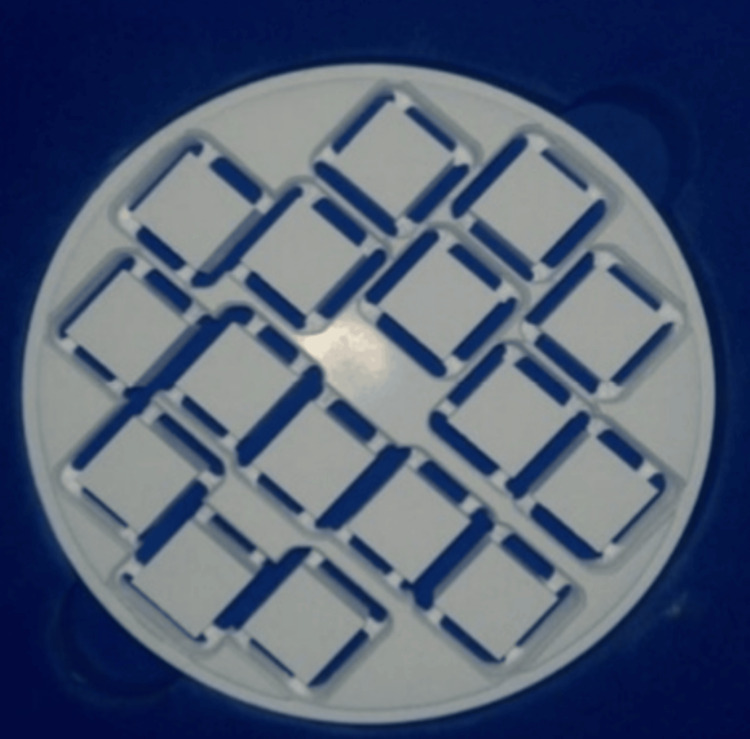 Figure 1
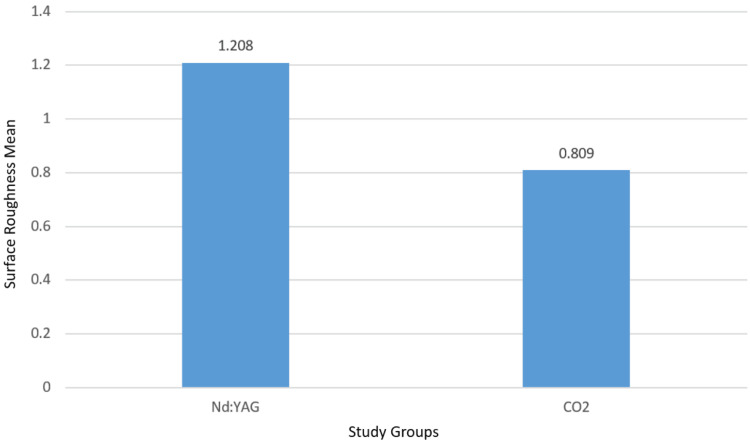 Figure 2
| Group | Number | Mean±SD | Min value | Max value |
| Nd:YAG laser | 10 | 1.208±0.22 | 0.682 | 1.425 |
| CO2 laser | 10 | 0.809±0.21 | 0.452 | 1.081 |
| Measurement | Test value | Degrees of freedom | P-value |
| Surface roughness | 0.185 | 20 | 0.200 |
| Group | Number | Independent sample T-test | P-value |
| Nd:YAG laser | 10 | 12.903 | 0.001 |
| CO2 laser | 10 | 7.449 |
Peer Reviews
No public reviews on file for this paper yet. If you reviewed it on a platform where reviews are public (OpenReview, ICLR, NeurIPS, ICML), you can paste yours below so the community can read it here.
Videos
No videos yet. Explain this paper in a talk, walkthrough, or lecture? Add one.
Taxonomy
TopicsDental materials and restorations · Bone Tissue Engineering Materials · Dental Implant Techniques and Outcomes
Introduction
The development of zirconia, its structure, and manufacturing methods have directed attention toward the use of highly transparent zirconia in the manufacture of veneers [1]. The current trend is to develop methods to ensure the bond of translucent zirconia to dental tissues by finding techniques to treat the inner surface of crowns and veneers made of translucent zirconia and increase the surface roughness, thus ensuring a clinically acceptable bond strength [2].
Zirconia is one of the types of polycrystalline dental ceramics. It has been widely used in dentistry due to the increasing demand of patients for metal-free restorations, as its optical properties are similar to those of natural teeth. Zirconia also has bio-receptivity and high mechanical properties, which is what made us use it in the manufacture of single crowns and fixed prosthodontics [3].
Translucency is one of the most important factors that affect the color match between natural teeth and restorations [1]. Translucency is the amount of light that passes through the restorative materials. The passage of light through the zirconia structure is affected by several factors (grain size, material density, and crystal structure) and to improve the aesthetic properties of zirconia restorations, the composition of traditional zirconia was modified by changing the percentage of impurities and the stabilizer. Those changes affected the structure of the crystals and thus the mechanical and aesthetic properties of the material, and translucent zirconia was produced, which was an alternative to E.max [4].
The main problem with translucent zirconia is its weak bond with dental tissues and its surface not being affected by the hydrofluoric acid used in treating E.max [5]. Therefore, research has turned to strengthening its adhesion to the enamel and dentin in various ways, including treating the surfaces of translucent zirconia before affixing them with various methods such as sandblasting and laser [6,7].
The laser is one of the recent methods used in dentistry, which has been used in treating soft and hard tissues [8]. Therefore, it has also been used in treating and roughening the surfaces of materials used in dental prosthetics [9].
Therefore, it was necessary to conduct a study to evaluate the surface roughness of highly transparent zirconia after laser treatment. This study aims to compare the effect of two types of lasers on the surface of highly transparent zirconia to evaluate the surface roughness resulting from the two techniques.
Materials and methods
Study design
An experimental in vitro study was conducted to evaluate several lasers in surface roughness of highly translucent zirconia to study surface roughness.
Sample size estimating
The size of the studied sample was estimated using the Gpower software, based on preliminary data from the current study, where the results of this study were entered into the program, and using the Student's T test for independent samples, at a confidence of 0.95, and the effect size was 1.762. The level of significance is 0.05, and it turns out that the minimum sample size required is 8 in each group and raised to 10 to increase statistical safety.
Study sample
The study sample consisted of 20 ceramic cubes made of translucent zirconia (DD cubeX2, Dental Direct, Germany). It was made using a CAD-CAM Zircodenta device (Imes-Icore, Germany) and a zirconia sintering furnace (Imes-Icore, Germany). The study sample was divided into two groups; the first group consisted of 10 cubes exposed to Nd:YAG laser (1064 nm، 2.5 w، 20 Hz، 125 mj) at a distance of 1 mm from the surface of the cube for 45 seconds. The second group consists of 10 discs exposed to continuous wave CO_2_ laser (10600 nm، 4 w، 1000 Hz، 150 mj), at a distance of 1 mm from the cube surface for 1 minute.
The translucent zirconia blocks (DD cubeX2, Dental Direct, Germany) were cut into 20 cubes, each with dimensions of 10x10x10 (Figure 1) and then the samples were cleaned by placing them in an ultrasonic device with distilled water for 10 minutes.
Translucent zirconia cubes after turning process.
The roughness of cubic zirconia was measured after turning and before the application of lasers using a surface roughness tester (TR200, TIME, USA). This is in order to determine whether turning cubic zirconia leads to an increase in its roughness. None of the study samples needed to be polished or smoothed before being treated with the laser because the turning did not affect the roughness of the zirconia cube.
The first group of cubes was treated using Nd:YAG laser (1064 nm، 2.5 w، 20 Hz، 125 mj) at a distance of 1 mm from the surface of the cube for 45 seconds, whereas the second group was treated using continuous wave CO_2_ laser (10600 nm، 4 w، 1000 Hz، 150 mj) at a distance of 1 mm from the cube surface for 1 minute.
Surface roughness measurement
The surface roughness test was conducted for the study samples in each of the groups using a surface roughness tester (TR200, TIME, USA). The sample was fixed on the base designated for measurement so that the measuring head was perpendicular to the surface of the cube, and then the measurement was carried out for each surface through mechanical contact between the sensor with the sample surface of 5 mm long for each measurement and at a speed of 0.5 mm per minute. To give Ra on its screen (roughness average), which represents the average roughness of each surface, the device electronically measures the mean of all the peaks and pits present over the entire measured distance of the surface.
Statistical analysis
Data were collected and entered into Excel and statistically analyzed using SPSS version 26 (IBM, SPSS Inc, USA), and an independent sample T-test was used to determine if there were statistically significant differences.
Results
The sample of the current study was distributed into two groups (10 cubes in each group, 50%). Descriptive statistical analyses were conducted for surface roughness measurements of zircon cubes. The mean in the Nd:YAG laser group was 1.208, with a standard deviation of ±0.22, a minimum value of 0.682, and a maximum value of 1.425 (Table 1).
The mean surface roughness in the CO_2_ laser group was 0.809, with a standard deviation of ±0.21, a minimum value of 0.452, and a maximum value of 1.081 (Table 1).
Figure 2 shows a comparison between the mean surface roughness of the Nd:YAG laser group and the CO_2_ laser group.
The mean values of surface roughness in both groups.
We find from the previous values that the average surface roughness value was higher in the Nd:YAG laser group. To find out if this difference is statistically significant, we test the data distribution with Kolmogorov-Smirnov test.
After conducting a test to determine the distribution of the data, it appeared that the P-value of the Kolmogorov-Smirnov test was greater than 0.005, and therefore the distribution of the data was normal (Table 2). Then the independent sample T-test was conducted to determine whether there are significant differences between the two study groups.
Table 2: Kolmogorov-Smirnov test to determine the distribution of the study sample.P-value <0.005 is a significant difference.
The presence of differences between the two study groups was studied using the independent sample T-test, and the P-value was 0.001, and therefore, there is a significant difference between the two study groups.
Since the value of the independent sample T-test was higher in the Nd:YAG laser group, it outperforms the CO_2_ group according to Table 3.
Table 3: Independent sample T-test results for surface roughness.P-value <0.005 is a significant difference.
From Table 1 and Table 3, we found that the surface roughness was greater in the Nd:YAG laser group than the CO_2_ laser group, with a statistically significant difference.
Discussion
The use of zirconia has increased in various fields of dentistry in general, especially fixed prosthetics, as a result of the mechanical properties that allow it to withstand the pressures applied to the prostheses in the posterior areas, high resistance to wear, good color stability, and low thermal conductivity [10].
Improving the stability of zirconia is important to avoid loosening of the prosthesis, which is considered the third reason for replacing the prosthesis within a period of three years and the second reason for the failure of zirconia restorations after the fracture of the covering porcelain [11].
In 1981, research in the field of lasers was directed toward developing modern technologies that replace rotary drilling tools, and this led to the creation of the first Er:YAG laser, mediated by Keller and Hibst, that enables the cutting of hard dental tissues [12].
The results of this research may be applied in dental clinic daily practice by improving the bonding between the third-generation zirconia prosthesis and the dental tissues to ensure longer durability of the prosthesis.
The current study showed that the surface roughness values in the first group using the Nd:YAG laser were greater than in the continuous wave CO_2_ laser roughening group, with a statistically significant difference.
The current study agreed with Arami et al. that the roughening with the Nd:YAG laser was stronger than the CO_2_ laser and would provide superior bond strength, as the two Nd:YAG laser groups (2.5W-2W) recorded higher surface roughness compared to other groups that used lasers [13]. The study concluded that the greater the laser power, the greater the surface roughness. This may be due to the fact that the use of the Nd:YAG laser has a stronger effect on hard tissues than the effect of the CO_2_ laser, which is used to treat soft tissues [14].
The current study differed from Hemdan et al., which evaluated the effect of different surface parameters of cubic zirconia on surface roughness and bond strength after treating the surface with sandblasting or a CO_2_ laser [15]. The results showed that roughening using a CO_2_ laser had the highest shear strength of resin cement with zirconia ceramics, followed by Sandblasting with aluminum oxide and this differs from the results of the current study. This difference may be attributed to the difference in the laser power used. In the current study, a CO_2_ laser power of 4 watts was used, while in his study, the power used was 10 watts and 20 watts [15].
The current study agreed with the study of Hadi Ran, which studied the effect of roughness of the surface of zirconia with CO_2_ and Nd:YAG lasers and evaluated the surface roughness and bond strength. The results showed that the surface roughness was higher in the Nd:YAG laser group compared to the CO_2_ laser, and this is consistent with the results of the current study [16].
This article has several limitations including not conducting scanning electron microscope sections of the laser-treated surfaces of cubic zirconia to ensure that there are no cracks or fissures within them.
Conclusions
Surface roughness is one of the most important factors that play an important role in increasing the connection between the surface of the tooth and the applied restoration. Due to the increased interest in zirconia and the improvement of its mechanical and aesthetic properties, studies have increased that work to improve and increase its surface roughness so that it can be used as a veneer in the future. Within the limitations of this study, we conclude that the Nd:YAG laser roughens the surface of zirconia to a greater extent than the continuous wave CO_2_ laser, with a substantially significant difference.
The reference list from the paper itself. Each links out to its DOI / PubMed record.
- 1Optical properties of translucent zirconia: a review of the literature Eurobiotech J Manziuc M-M Gasparik C Negucioiu M 455132019
- 2Comparison of the mechanical properties of translucent zirconia and lithium disilicate J Prosthet Dent Kwon SJ Lawson NC Mc Laren EE Nejat AH Burgess JO 13213712020182931087510.1016/j.prosdent.2017.08.004 · doi ↗ · pubmed ↗
- 3Three generations of zirconia: from veneered to monolithic Quintessence Int Stawarczyk B Keul C Eichberger M Figge D Edelhoff D Lümkemann N 3693804820172839688610.3290/j.qi.a 38057 · doi ↗ · pubmed ↗
- 4Translucent zirconia in the ceramic scenario for monolithic restorations: a flexural strength and translucency comparison test J Dent Carrabba M Keeling AJ Aziz A Vichi A Fabian Fonzar R Wood D Ferrari M 70766020172827465110.1016/j.jdent.2017.03.002 · doi ↗ · pubmed ↗
- 5Surface roughness of monolithic and layered zirconia restorations at different stages of finishing and polishing: an in vitro study J Prosthodont Al Hamad KQ Abu Al-Addous AM Al-Wahadni AM Baba NZ Goodacre BJ 8188252820193106648310.1111/jopr.13071 · doi ↗ · pubmed ↗
- 6Surface roughness and morphologic changes of zirconia: effect of different surface treatment Niger J Clin Pract Kirmali O Kustarci A Kapdan A 124129182015 https://www.ajol.info/index.php/njcp/article/view/1116272551135710.4103/1119-3077.146994 · doi ↗ · pubmed ↗
- 7Surface roughness of zirconia for full-contour crowns after clinically simulated grinding and polishing Int J Oral Sci Hmaidouch R Müller WD Lauer HC Weigl P 241246620142505924910.1038/ijos.2014.34PMC 5153586 · doi ↗ · pubmed ↗
- 8Laser treatment of zirconia surface for improved surface hydrophobicity J Alloys Compd Yilbas B 2082156252015