Melioidosis Masquerading as a Mediastinal Abscess
Chee Yik Chang

Abstract
Genes, proteins, chemicals, diseases, species, mutations and cell lines named across the full text — each resolved to its canonical identifier and authoritative record.
Click any figure to enlarge with its caption.
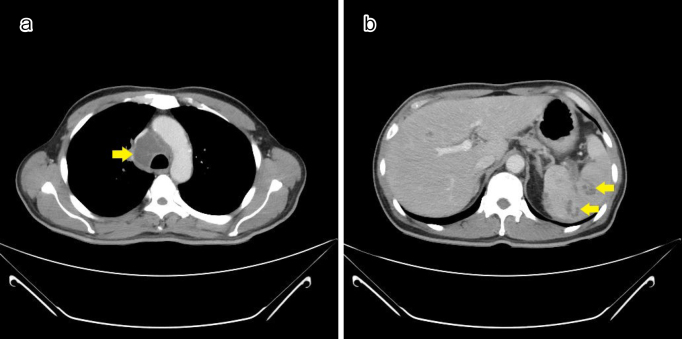 Figure 1
Peer Reviews
No public reviews on file for this paper yet. If you reviewed it on a platform where reviews are public (OpenReview, ICLR, NeurIPS, ICML), you can paste yours below so the community can read it here.
Videos
No videos yet. Explain this paper in a talk, walkthrough, or lecture? Add one.
Taxonomy
TopicsBurkholderia infections and melioidosis · Infections and bacterial resistance · Antibiotic Resistance in Bacteria
A 57-year-old male farmer with type 2 diabetes mellitus, residing in an area where melioidosis is not endemic, presented with a 3-week history of intermittent fever, accompanied by malaise and weight loss. He denied experiencing chest pain, shortness of breath, or hemoptysis. A chest computed tomography (CT) scan revealed a superior mediastinal abscess and multiple splenic abscesses (Figure 1). The blood culture was positive for Burkholderia pseudomallei, confirming the diagnosis of melioidosis, while the tuberculosis test was negative. The bronchoscopy examination revealed no abnormalities. The patient received a 4-week course of intravenous ceftazidime, followed by oral trimethoprim-sulfamethoxazole. A follow-up CT scan revealed that the mediastinal and splenic abscesses had completely resolved.
Melioidosis can manifest with diverse clinical presentations, including pneumonia, septic arthritis, encephalomyelitis, and internal organ abscesses ^(1)^. Notably, mediastinal abscesses due to melioidosis are uncommon. The Darwin Prospective Melioidosis study found that mediastinal lymphadenopathy/mass was present in 99 out of 1148 patients (8.6%) with culture-confirmed melioidosis ^(2)^. The presence of mediastinal and splenic abscesses should raise a strong suspicion of melioidosis, especially in endemic areas.
Article Information
Conflicts of Interest
None
Author Contributions
CYC: Conception and design of the study, acquisition of data, drafting the article, final approval of the version to be submitted.
ORCID iD
Chee Yik Chang: 0000-0002-3104-8168
Informed Consent
Written consent has been obtained from the patient to publish the information, including the photographs.
The reference list from the paper itself. Each links out to its DOI / PubMed record.
- 1Chang CY. Periorbital cellulitis and eyelid abscess as ocular manifestations of melioidosis: a report of three cases in Sarawak, Malaysian Borneo. ID Cases. 2019;19:e 00683.31908947 10.1016/j.idcr.2019.e 00683 PMC 6939086 · doi ↗ · pubmed ↗
- 2Currie BJ, Mayo M, Ward LM, et al. The Darwin Prospective Melioidosis study: a 30-year prospective, observational investigation. Lancet Infect Dis. 2021;21(12):1737-46.34303419 10.1016/S 1473-3099(21)00022-0 · doi ↗ · pubmed ↗