High toxinogenic potential of Staphylococcus aureus from wild ungulates in Brandenburg, Germany with a low level of antibiotic resistance
Tobias Lienen, Rafael Hernán Mateus-Vargas, Julia Steinhoff-Wagner, Martin H. Richter, Sven Maurischat

TL;DR
Wild ungulates in Germany carry S. aureus strains with high toxin potential, though antibiotic resistance is low, posing a food safety risk if hygiene is not followed.
Contribution
Identification of S. aureus strains from wild ungulates with high toxinogenic potential and low antibiotic resistance in Brandenburg, Germany.
Findings
S. aureus was found in 8% of nasal swabs from wild ruminants.
Most isolates contained genes for staphylococcal enterotoxins and one isolate had the toxic shock syndrome toxin gene.
Isolates showed low antibiotic resistance and belonged to multiple sequence types.
Abstract
Data regarding the occurrence and virulence of Staphylococcus (S.) aureus in wild living animals is rare. However, S. aureus may carry a multitude of virulence factors and express resistance to several antimicrobial substances. Handling game meat may thus lead to serious infections or food poisoning. The aim of this study was to provide insights into the occurrence and characteristics of S. aureus in wild ungulates from Brandenburg, Germany. Nasal swabs of externally healthy-looking wild boars, roe, fallow and red deer were collected in hunts during season 2021/2022 and analyzed for S. aureus by selective enrichment. Species were determined using matrix assisted laser desorption ionization mass spectrometry and tested for phenotypic antimicrobial resistance. Whole-genome sequencing was conducted for genotyping, determination of virulence associated genes and analysis of phylogenetic…
Genes, proteins, chemicals, diseases, species, mutations and cell lines named across the full text — each resolved to its canonical identifier and authoritative record.
Click any figure to enlarge with its caption.
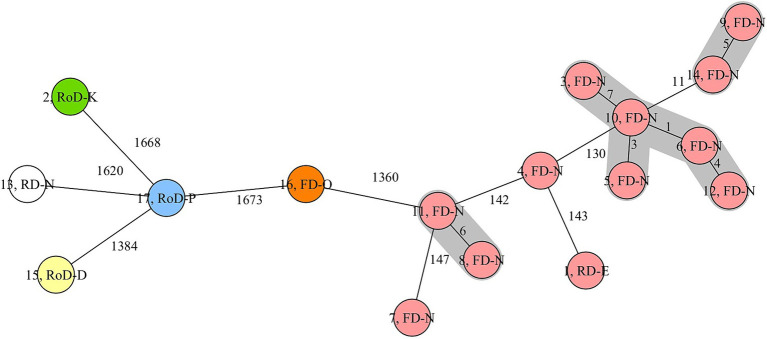 Figure 1
| Hunting district | Sampled animals | Total animals per district | Detection of | Detection rate | |||
|---|---|---|---|---|---|---|---|
| Fallow deer | Red deer | Roe deer | Wild boar | ||||
| A | - | 1 | 6 | 8 | 15 | - | 0% |
| B | - | - | 6 | 4 | 10 | - | 0% |
| C | 2 | - | 5 | 11 | 18 | - | 0% |
| D | 1 | - | 3 | 1 | 5 | 1 (RoD) | 20% |
| E | - | 6 | 7 | 7 | 20 | 1 (RD) | 5% |
| F | - | 4 | 2 | 7 | 13 | - | 0% |
| G | 9 | - | - | 1 | 10 | - | 0% |
| H | - | 1 | 8 | 5 | 14 | - | 0% |
| I | - | - | 3 | - | 3 | - | 0% |
| J | - | 2 | 2 | 5 | 9 | - | 0% |
| K | - | - | 2 | 2 | 4 | 1 (RoD) | 25% |
| L | - | - | 18 | 6 | 24 | - | 0% |
| M | - | - | 6 | 3 | 9 | - | 0% |
| N | 22 | 1 | 5 | 10 | 38 | 12 (11 FD 1 RD) | 32% |
| O | 4 | - | 3 | 1 | 8 | 1 FD | 13% |
| P | - | - | 8 | 7 | 15 | 1 (RoD) | 7% |
| Total | 38 | 15 | 84 | 78 | |||
| No. | Source | District | ST | AMR | AMR phenotype | Virulence associated genes | |
|---|---|---|---|---|---|---|---|
| 1 | Red deer | E | t127 | 1 | - | Susceptible |
|
| 2 | Roe deer | K | t1872 | 30 |
| PEN, FOX |
|
| 3 | Fallow deer | N | t127 | 1 | - | Susceptible |
|
| 4 | Fallow deer | N | t127 | 1 | - | Susceptible |
|
| 5 | Fallow deer | N | t127 | 1 | - | Susceptible |
|
| 6 | Fallow deer | N | t127 | 1 | - | Susceptible |
|
| 7 | Fallow deer | N | t127 | 1 | - | Susceptible |
|
| 8 | Fallow deer | N | t693 | 1 | - | Susceptible |
|
| 9 | Fallow deer | N | t127 | 1 | - | Susceptible |
|
| 10 | Fallow deer | N | t127 | 1 |
| Susceptible |
|
| 11 | Fallow deer | N | t693 | 1 | - | Susceptible |
|
| 12 | Fallow deer | N | t127 | 1 | - | Susceptible |
|
| 13 | Red deer | N | t3043 | 6238 | - | Susceptible |
|
| 14 | Fallow deer | N | t127 | 1 | - | Susceptible |
|
| 15 | Roe deer | D | t3583 | 133 |
| Susceptible | - |
| 16 | Fallow deer | O | t085 | 582 |
| Susceptible | - |
| 17 | Roe deer | P | t472 | 425 |
| Susceptible | - |
- —BfR10.13039/501100008751
Peer Reviews
No public reviews on file for this paper yet. If you reviewed it on a platform where reviews are public (OpenReview, ICLR, NeurIPS, ICML), you can paste yours below so the community can read it here.
Videos
No videos yet. Explain this paper in a talk, walkthrough, or lecture? Add one.
Taxonomy
TopicsEscherichia coli research studies · Plant Toxicity and Pharmacological Properties · Salmonella and Campylobacter epidemiology
Introduction
1
Staphylococcus (S.) aureus is a coccoid formed and Gram-positive bacterium that inhabits a wide variety of organs and tissues, such as the skin and mucosa of animals and humans. S. aureus may carry a large number of virulence associated genes; however, animals and humans may be colonized without showing disease symptoms. The ability to evade the human immune system as well as its capacity to express leucocidins and further toxins makes it to one of the most harmful bacteria for human and animal health. For instance, infections with S. aureus may lead to wound infections in all mammalian species, mastitis in dairy herds, skeletal disorders in poultry, or even a sepsis in humans (1–3). Moreover, due to the zoonotic potential of S. aureus, a transmission from animals to humans or vice versa may occur. In particular, the production of staphylococcal enterotoxin (SE) by S. aureus is a significant threat with regard to food poisoning. Thereby, the classical SE types A to E have the highest potential to cause food poisoning (4). Ingestion of SE contaminated food may lead to nausea, vomiting, diarrhea or abdominal pain. Besides SEs, the toxic shock syndrome toxin is of high importance for human health when being infected with S. aureus (5). Concerning antimicrobial resistance, methicillin-resistant S. aureus (MRSA) is of great concern for animal and human health, since treatment options may fail during an infection with MRSA. MRSA are resistant to virtual all beta-lactam antibiotics and often carry resistances to more antimicrobial classes. The beta-lactam antibiotic resistance in MRSA is most commonly transmitted by the mecA gene, however, in wildlife species such as wild hedgehogs, rabbits, and rodents, the mecC gene is also frequently found (6–9).
Data regarding S. aureus in wildlife is still rare in comparison to livestock or companion animals. S. aureus was found in a multiplicity of wild animal species such as rat, hedgehog, beaver, squirrel, fox, wild boar, deer or even bat, elephant and dolphin (10, 11). Also different MRSA clones were detected in a multitude of wildlife samples, expressing the potential of wild animals to act as reservoir and sentinel for MRSA carriage (12). Several studies have been conducted with regard to the genotypic characterization of S. aureus in wild animals. Thereby, a large variety of sequence types and clonal complexes was detected (10, 13). Moreover, S. aureus from wildlife and game meat was shown to exhibit the potential to produce virulence factors such as Panton-Valentine leucocidin (14, 15) or staphylococcal enterotoxins (16, 17). According to the European Union One Health 2022 Zoonoses Report, S. aureus enterotoxins were the second most frequently reported bacterial toxin-producing agents in foodborne outbreaks, and first for the number of hospitalizations and deaths in the year 2022 (18).
In Germany, game meat from wild boar, fallow, red and roe deer is frequently consumed and its handling may possess a possible risk for S. aureus transmission to humans. However, only few studies were conducted so far with respect to the S. aureus occurrence in wild animals that are hunted for human consumption. Therefore, the objective of this study was to investigate the occurrence of S. aureus in wild ungulates hunted in the German Federal State of Brandenburg. Furthermore, the presence of genes associated with virulence as well as antimicrobial resistance (AMR) was determined by whole-genome sequencing and bioinformatics.
Materials and methods
2
Sample collection and isolation
2.1
Sampling activities were conducted within a framework agreement involving the German Federal Institute for Risk Assessment (BfR) and the German Institute for Federal Real Estate (BImA). For details regarding the sampling strategy, please refer to Maaz et al. (19). In total, 23 driven hunts were visited in 16 different districts during the hunting season 2021/2022 from October 2021 to January 2022 in Brandenburg, Germany. Hunting was conducted several times per week. Two hundred and fifteen nasal swab samples of wild boars (n = 78), roe (n = 84), fallow (n = 38) and red deer (n = 15) were collected (Table 1). The samples were transported to the laboratory on day of collection and stored at 4°C until further analysis. Swab samples were analyzed for S. aureus by selective enrichment using the ISO 6888-3:2003 method (20), which is in particular applied when expecting low numbers of S. aureus. This protocol includes an initial enrichment step in modified Giolitti-Cantoni broth (Merck Millipore, USA) with addition of a 1% potassium tellurite solution (Merck Millipore, USA) under anaerobic conditions and subsequent streaking on Baird-Parker agar plates (Oxoid, UK) including egg yolk tellurite emulsion (Oxoid, UK). According to differences in colony morphologies, a loop of one to three presumptive S. aureus colonies was transferred to sheep blood agar plates (Oxoid, UK) and incubated for 20–24 h at 37°C. Species were determined using matrix assisted laser desorption ionization mass spectrometry (MALDI-TOF-MS; Bruker, USA). Colonies were spotted on the MALDI-TOF-MS target via direct transfer method and covered with 0.8 μl of α-Cyano-4-hydroxycinnamic acid (Bruker Scientific LLC). According to the manufacturer’s recommendations, the threshold score for acceptable S. aureus species identification was ≥2.000. The reference database was provided by Bruker (MBT-BDAL-8468).
Whole-genome sequencing and bioinformatic analysis
2.2
All isolates that were identified by MALDI-TOF-MS as being S. aureus were inoculated in 5 ml brain-heart-infusion broth and incubated at 37°C for 24 h. DNA of 1 ml culture was extracted using the Qiagen DNeasy Blood and Tissue Kit (Qiagen, Germany) according to the manufacturer’s protocol modified by adding 10 μl lysostaphin (Sigma Aldrich, USA) to the lysis buffer. The DNA library was prepared using an Illumina DNA Prep kit (Illumina Inc., USA) and the 150 bp paired-end sequencing run was performed on an Illumina NextSeq 500 instrument. Raw Illumina reads were trimmed and de novo assembled with the in-house developed AQUAMIS pipeline (21). Bacterial characterization such as determination of sequence types and analysis of AMR and virulence associated genes was done with the in-house developed Bakcharak pipeline.1 Phylogenetic analyses using core genome multi-locus-sequence-typing (cgMLST) as well spa type determination were conducted using Ridom SeqSphere+ version 7.0.4 according to the S. aureus cgMLST scheme comparing 1861 alleles (22). Spa types were additionally verified by PCR analysis and subsequent sanger sequencing (Eurofins, Luxembourg).
Antimicrobial susceptibility testing
2.3
Antimicrobial susceptibility testing was performed at the National Reference Laboratory for Antimicrobial Resistance at the BfR by broth microdilution according to international guidelines [ISO 20776-1:2006 (23)/CLSI M07 Ed 12 (24)]. It was carried out using a commercial standardized antibiotic panel (Sensititre EUST scheme from Thermo Fisher Scientific, UK) that is recommended by the European Food Safety Authority (EFSA) for resistance monitoring in MRSA from livestock and food (25). For interpretation of the minimum inhibitory concentration (MIC) of the individual strains, the following EUCAST ECOFFs for S. aureus (accessed 2024-06-11) were used: Penicillin >0.125 mg/L; Cefoxitin >4 mg/L; Chloramphenicol >16 mg/L; Ciprofloxacin >2 mg/L; Clindamycin >0.25 mg/L; Erythromycin >1 mg/L; Fusidic acid >0.5 mg/L; Gentamicin >2 mg/L; Kanamycin >8 mg/L; Linezolid >4 mg/L; Mupirocin >1 mg/L; Rifampin >0.016 mg/L; Streptomycin >16 mg/L; Quinupristin-Dalfopristin >1 mg/L; Tetracycline >1 mg/L; Tiamulin >2 mg/L; Trimethoprim >2 mg/L; Vancomycin >2 mg/L. For quality control of resistance testing, the S. aureus strain ATCC 29213 and Enterococcus faecalis strain ATCC 29212 were used.
Results
3
Occurrence and genotypic characteristics of S. aureus in wild ungulates
3.1
S. aureus was recovered from 17/215 nasal swabs in six of the 16 hunting districts (D, E, K, N, O, P) by selective enrichment. This corresponds to a total detection rate of approximately 8% among the sampled artiodactyl species. The positive rate per district was 32% (N), 25% (K), 20% (D), 13% (O), 7% (P) and 5% (E; Table 1). Most isolates were retrieved from fallow deer (n = 12; 32% positive rate), whereas fewer isolates were retrieved from red (n = 2; 13% positive rate) and roe deer (n = 3; 4% positive rate; Table 1). S. aureus was not found in nasal swabs from wild boars in the respective hunting season. S. aureus isolates were associated with spa types t127 (n = 10), t1872 (n = 1), t693 (n = 2), t3043 (n = 1), t3583 (n = 1), t085 (n = 1), and t472 (n = 1). Sequence types (ST) 1 (n = 12), ST30 (n = 1), ST133 (n = 1), ST425 (n = 1), ST582 (n = 1), and ST6238 (n = 1) were determined (Table 1).
Phylogenetic relationships
3.2
The cgMLST analysis showed that t127-ST1 isolates of fallow deer (No. 3, 4, 5, 6, 7, 9, 10, 12, 14) obtained from hunting district N generally had less than 150 allelic differences (AD). The isolates from other districts were, despite of one case, considerably different based on genomic analysis. As shown in Figure 1, a cluster was built of five closely related t127-ST1 S. aureus isolates (No. 3, 5, 6, 10, 12) from district N that only differed in a maximum of seven alleles. In addition, two other closely related clusters consisting of two t127-ST1 (No. 9, 14) and two t693-ST1 isolates (No. 8, 11), respectively, appeared. The additional two other t127-ST1 isolates from fallow deer (No. 4, 7) and district N were only distantly related to the t127-ST1 cluster isolates with AD >100. Interestingly, the only isolate of red deer (No. 13) obtained in hunting district N was associated to ST6238 as well as spa type t3043 and considerably differed from the other t127-ST1 isolates of fallow deer. In contrast and despite the geographical distance between hunting districts E and N (linear distance ca. 75 km), the t127-ST1 isolate (No. 1) of red deer from hunting district E had comparably lower AD to one isolate of fallow deer from hunting district N (No. 4; Figure 1).
Phylogenetic analysis (core genome multilocus sequence typing) of S. aureus isolates with various sequence types (colours) from different wild ungulates (1–17) and districts (letters). FD, fallow deer; RD, red deer; RoD, roe deer. Red, ST1; Orange, ST582; Blue, ST425; Green, ST30; Yellow, ST133; White, ST6238.
Antimicrobial resistance and virulence associated genes
3.3
The number of AMR genes was rather low (Table 2). Four isolates carried the fosfomycin resistance transmitting fosB gene. One of these isolates additionally harbored the blaZ gene and expressed phenotypic resistance to penicillin (MIC >2 mg/L) and cefoxitin (8 mg/L) in the antimicrobial susceptibility testing. The isolates were susceptible to all other antimicrobial substances according to the EUCAST ECOFFs mentioned in section 2.3. This t1872-ST30 isolate was obtained from a roe deer fawn (<1 year old) sampled in a hunting district located at the periphery of the metropolitan area of Berlin-Potsdam. A high number of virulence associated genes was detected in each isolate. Genes encoding SE or SE-like (SEl) were found in 14/17 isolates (Table 2). In particular, an seh gene was present in all t127-ST1 isolates disregarding the hunting district of origin. The t1872-ST30 isolate harbored genes encoding SEA, SEG, SEI, SEM, SEN, SEO and SElU and the t3043-ST6238 isolate of the hunting district C carried genes for SEI, SEM, SEN, SEO and SElU. Besides SE and SE-like genes, the toxic shock syndrome toxin (TSST) encoding tst gene was detected in the t1872-ST30 isolate (Table 2). Moreover, the t1872-ST30 isolate carried the immune evasion cluster genes scn, chp and sak.
Discussion
4
Wild ungulates may be carriers of potentially pathogenic microorganisms such as S. aureus. Since game meat is frequently consumed, food safety aspects are elementary in this area. In this study, the occurrence and genotypic characteristics of S. aureus were determined in hunting districts of the federal forest division of the BImA in the German Federal State of Brandenburg in the hunting season 2021/22.
Occurrence and sequence types
4.1
In total, approximately 8% of all sampled wild ungulates carried S. aureus in their nostrils; however, the positive rates in fallow deer (32%) and red deer (13%) were higher than in roe deer (4%). On the contrary to other studies, which showed a prevalence of up to 18% in Spain (26), 33% in Portugal (27) or 37% in Germany (28), in this study, S. aureus was not found in the nostrils of wild boars in the respective hunting season.
A recent Portuguese study elucidates the epidemiological links of S. aureus at the animal-human interface (29). Several sequence types were determined in the detected S. aureus isolates in this study. Although some S. aureus can be classified into livestock-associated, healthcare-associated or community-associated according to their ST, other STs have been reported from various sources e. g. humans, livestock, companion animals and wildlife (30). The latter seems to be the case in this study for those being associated to ST1, ST30, ST133, ST425, ST582, and ST6238. S. aureus with ST1, ST30, ST133, and ST425 were already reported in different species of wild animals before (10) and their presence was also shown in humans (31). S. aureus ST582 seems to be more prevalent in human clinical samples (32–34) than in animal samples; however, in a previous study, ST582 was detected in a purulent subcutaneous lesion of a farm rabbit (35). S. aureus ST6238 is a relatively new sequence type and was originally detected in a horse in the year 2022 (36).
Transmission of S. aureus in wild ungulates
4.2
Interestingly, several t127-ST1 S. aureus isolates obtained from fallow deer of the same district and during the same hunt clustered closely together in the phylogenetic analysis comparing their core genomes. The close genetic relationship of the respective isolates indicates a common source of colonization, possibly accompanied by intraspecific spread, within the local fallow deer population. There may be several reasons for the clonality of the isolates. One possible hypothesis is that these wild artiodactyls might have been colonized in the same area in this specific district, where S. aureus inhabits a particular niche and was transmitted to the carriers. S. aureus may for instance be present in surface water (37) or being secreted via animal feces (38, 39), so that a transmission may take place in close contact to the contaminated area; e.g. during sniffing or rolling on the ground. However, neither of the ten wild boars nor the five roe deer sampled within the same hunting district carried S. aureus, which would contradict this assumption. A further possibility is that positive individuals with clonal S. aureus isolates might be related to each other. Fallow deer are gregarious animals, often forming herds of does accompanied by fawns and few males during various seasons (40). ST1 isolates were obtained primarily from fawns and young fallow deer (<2 years) and therefore could have been transmitted from one animal to another due to close contact within the herd. The need of close contact may be further supported by the notable difference to the S. aureus isolate of the red deer sampled at the same hunting district. It is also noteworthy that European herds of fallow deer usually stay within a relatively small territory (in average 3 to 5 km^2^) compared to European red deer [in average 9 to 36 km^2^; (41)]. Some red deer populations additionally have long migration routes (42, 43). Thus, the infection of this red deer individual may have occurred under other habitat conditions. Moreover, the distant relation of S. aureus isolates from different districts illustrates that, at least in the sampled areas, there was no obvious transmission of S. aureus between the districts, probably due to the long distances between hunting districts or to local habitat fragmentation (44).
Antimicrobial resistance and virulence factors
4.3
S. aureus is one of the high priority pathogens with regard to annual deaths and antimicrobial resistance (45). Especially, the most prevalent ST1 in this study has also been frequently reported as MRSA in either a clinical, human context, in which the strains often harbor the staphylococcal chromosome cassette (SCC) mec type IV as well as virulence genes for human adaptation like the immune evasion cluster genes sak and scn, or in a livestock context harboring the SCCmec V in combination with resistance genes erm(A) and vga(A) (46, 47). In contrast, the ST1 isolates in this study lack all of these typical genes for human or livestock adaptation and seem to be unaffected from antimicrobial pressure. Only the t1872-ST30 S. aureus isolate in this study showed phenotypic resistance to the beta-lactam antibiotics penicillin and cefoxitin, whereas the other isolates were susceptible to all tested antimicrobials. Accordingly, the t1872-ST30 isolate harbored the beta-lactamase coding blaZ gene, which confers resistance to penicillin and, in the case of hyperproduction, may also confer resistance to oxacillin or cefoxitin (48, 49). Interestingly, this strain was obtained from an individual hunted in a district near Berlin and Potsdam, which is among the areas with the higher settlement coverage of all hunting districts regularly sampled by the BfR (41). Moreover, the isolate was obtained from a roe deer fawn. As reviewed before (41), this individual likely did not roam long distances before sampling, as European females of this deer species typically have a territory size <1 km^2^. Thus, it is highly probable that transmission occurred directly from the immediate environment or the mother doe. Except the t1872-ST30 isolate, all other S. aureus isolates of this study were susceptible to the tested antimicrobial substances and did not harbor any AMR genes despite the fosfomycin resistance transmitting fosB gene discovered in four isolates. A recent study shows an increasing prevalence of the fosB gene in S. aureus (50). The high susceptibility to most antimicrobials seems to be reasonable, since antimicrobial pressure in the hunting areas predominantly covered by forest may be low, there is no need for bacteria to develop or keep antimicrobial resistance to survive. However, wild ungulates living in regions more intensively used for livestock farming were observed to carry Staphylococcaceae isolates with reduced susceptibility to cefoxitin more often than wild ungulates in less anthropized areas (41, 51). Despite these observations and coincidences, we deliberately refrain from delving further into the possible transmission routes and sources of the sampled animals due to the general lack of epidemiological information in this field. Future studies should focus on providing more detailed insights into possible transmission routes in anthropized habitats.
S. aureus may carry a multiplicity of virulence associated genes. With respect to food safety, in particular staphylococcal enterotoxin or staphylococcal enterotoxin-like genes are of great importance (4). The uptake of SEs via food such as milk or meat may lead to nausea, vomiting, diarrhea or abdominal pain. Especially young and old people or persons with immunodeficiencies are prone to suffer severely from staphylococcal food poisoning. In this study, 14/17 isolates harbored SE or SEl genes. In particular, an seh gene was detected in all of the t127-ST1 S. aureus isolates and is highly conserved in strains of this ST. (47) Although SEH is regarded as less potent than other SEs, food poisoning by SEH due to consumption of contaminated food was occasionally reported (52, 53). Two isolates carried a multiplicity of SE or SEl genes in their genomes in this study. The t3043-ST6238 S. aureus isolate was characterized by genes for SEI, SEM, SEN, SEO and SElU. Those genes are located in the so-called enterotoxin gene cluster (egc) (54). Food poisoning caused by S. aureus that carried the sei gene was already described in previous studies (55, 56). However, SEI seems to have a rather low emetic activity (57) and sei carrying strains only produce a relative low amount of SEI (58). However, isolates carrying the egc were shown to be the causative agent of food poisoning and were already related to food-borne outbreaks (59). The highest toxicogenic potential was detected in the t1872-ST30 S. aureus isolate in this study. ST30 S. aureus are characterized as human-adapted strains (60) and was isolated from a comparably strong anthropized area. Besides its antimicrobial resistance, as mentioned above, this isolate carried genes encoding a high number of staphylococcal enterotoxins as well as genes for the toxic shock syndrome toxin and the immune evasion cluster. Elements of the immune evasion cluster function as evading mechanism with respect to the human immune system and the toxic shock syndrome toxin may act as superantigen in the human body (5). Regarding food safety, the t1872-ST30 S. aureus isolate in this study also carried the egc [SEG, SEI, SEM, SEN, SEO, SElU; (54)]. Moreover, the t1872-ST30 isolate harbored the sea gene. The appearance of sea and tst genes in t1872-ST30 S. aureus is common (61). The sea gene is often located within the immune evasion cluster complex (62). SEA is the most common toxin in relation to food poisoning (63) and several food-borne outbreaks caused by SEA were reported (64, 65).
The finding of potentially virulent S. aureus in wild ungulates elucidates that during handling of hunted animals as well as processing of game meat strict hygienic measures are of significant importance to prevent direct transmission of S. aureus from animals to humans or meat surfaces, and thus the possibility of serious infections and food poisoning. This study is limited to wild ungulates from the German Federal State of Brandenburg. However, this data expands the knowledge about zoonotic pathogens in specific regions in Germany.
Conclusion
5
Wild animals may carry potentially virulent S. aureus as indicated by the findings of this study. The close phylogenetic relationship of S. aureus isolates indicates a possible spread between animals from the same territory or a common source of colonization. Handling of animals or their carcasses might contribute to staphylococcal infections in humans. Moreover, meat contamination and subsequent food poisoning due to SE producing strains may occur, if recommended hygiene measures are not applied during processing game meat. Monitoring of pathogens in wild game animals is of great importance to evaluate pathogen ecology, zoonotic potential, significant risks and develop recommendations.
Data availability statement
The datasets presented in this study can be found in online repositories. The names of the repository/repositories and accession number(s) can be found at: https://www.ncbi.nlm.nih.gov/bioproject, PRJNA641762.
Ethics statement
Ethical approval was not required for the study involving animals in accordance with the local legislation and institutional requirements because the basis of the sampling approach was a framework agreement involving the German Federal Institute for Risk Assessment (BfR) and the German Institute for Federal Real Estate (BImA). The federal forest division of the BImA is responsible for forest and game management over 476,000 ha of hunting area in Germany.
Author contributions
TL: Conceptualization, Data curation, Funding acquisition, Investigation, Methodology, Writing – original draft, Writing – review & editing. RM: Conceptualization, Data curation, Writing – original draft, Writing – review & editing. JS-W: Conceptualization, Writing – original draft, Writing – review & editing. MR: Conceptualization, Writing – original draft, Writing – review & editing. SM: Conceptualization, Funding acquisition, Writing – original draft, Writing – review & editing.
The reference list from the paper itself. Each links out to its DOI / PubMed record.
- 1Holmes MA Zadoks RN. Methicillin resistant S. aureus in human and bovine mastitis. J Mammary Gland Biol Neoplasia. (2011) 16:373–82. doi: 10.1007/s 10911-011-9237-x 21984431 · doi ↗ · pubmed ↗
- 2Kwiecinski JM Horswill AR. Staphylococcus aureus bloodstream infections: pathogenesis and regulatory mechanisms. Curr Opin Microbiol. (2020) 53:51–60. doi: 10.1016/j.mib.2020.02.005, PMID: 32172183 PMC 7244392 · doi ↗ · pubmed ↗
- 3Szafraniec GM Szeleszczuk P Dolka B. Review on skeletal disorders caused by Staphylococcus spp. in poultry. Vet Q. (2022) 42:21–40. doi: 10.1080/01652176.2022.2033880, PMID: 35076352 PMC 8843168 · doi ↗ · pubmed ↗
- 4Hennekinne JA De Buyser ML Dragacci S. Staphylococcus aureus and its food poisoning toxins: characterization and outbreak investigation. FEMS Microbiol Rev. (2012) 36:815–36. doi: 10.1111/j.1574-6976.2011.00311.x, PMID: 22091892 · doi ↗ · pubmed ↗
- 5Dinges MM Orwin PM Schlievert PM. Exotoxins of Staphylococcus aureus. Clin Microbiol Rev. (2000) 13:16–34. doi: 10.1128/CMR.13.1.16, PMID: 10627489 PMC 88931 · doi ↗ · pubmed ↗
- 6Rasmussen SL Larsen J Van Wijk RE Jones OR Berg TB AngenØ. European hedgehogs (Erinaceus europaeus) as a natural reservoir of methicillin-resistant Staphylococcus aureus carrying mec C in Denmark. P Lo S One. (2019) 14:e 0222031. doi: 10.1371/journal.pone.0222031, PMID: 31490992 PMC 6730924 · doi ↗ · pubmed ↗
- 7Ruiz-Ripa L AlcaláL Simón CGómez P Mama OM Rezusta A. Diversity of Staphylococcus aureus clones in wild mammals in Aragon, Spain, with detection of MRSA ST 130-mec C in wild rabbits. J Appl Microbiol. (2019) 127:284–91. doi: 10.1111/jam.14301, PMID: 31063623 · doi ↗ · pubmed ↗
- 8Sahin-Tóth J Albert E Juhász A GhidánÁJuhász J Horváth A. Prevalence of Staphylococcus aureus in wild hedgehogs (Erinaceus europaeus) and first report of mec C-MRSA in Hungary. Sci Total Environ. (2022) 815:152858. doi: 10.1016/j.scitotenv.2021.152858, PMID: 34995585 · doi ↗ · pubmed ↗