Spread of shingles impeded by previous surgical scar?
Makoto Shiraishi, Masakazu Kurita

TL;DR
A case of shingles showed that the virus could not cross a previous surgical scar due to nerve damage and instead spread in a different direction.
Contribution
Demonstrates how surgical scarring can influence the spread of the varicella zoster virus.
Findings
The virus could not spread across the surgical scar due to damaged cutaneous nerves.
The virus detoured to the upper left from the scar instead of spreading normally.
This case highlights the role of nerve pathways in shingles progression.
Abstract
We herein report an atypical case of shingles caused by varicella zoster virus after surgery. The virus, which goes along with the cutaneous nerve from the ganglia, was unable to spread across the previous surgical scar due to damage of the cutaneous nerves, but made a detour to the upper left direction from the scar.
Genes, proteins, chemicals, diseases, species, mutations and cell lines named across the full text — each resolved to its canonical identifier and authoritative record.
Click any figure to enlarge with its caption.
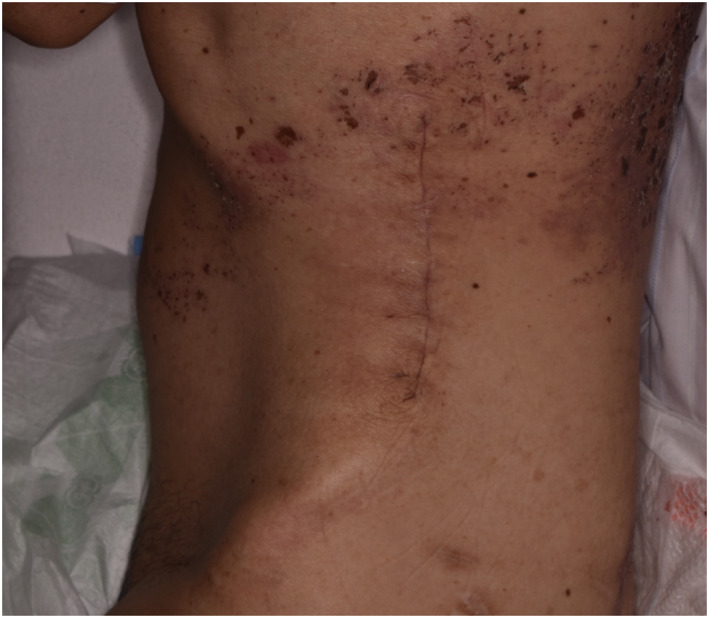 Figure 1
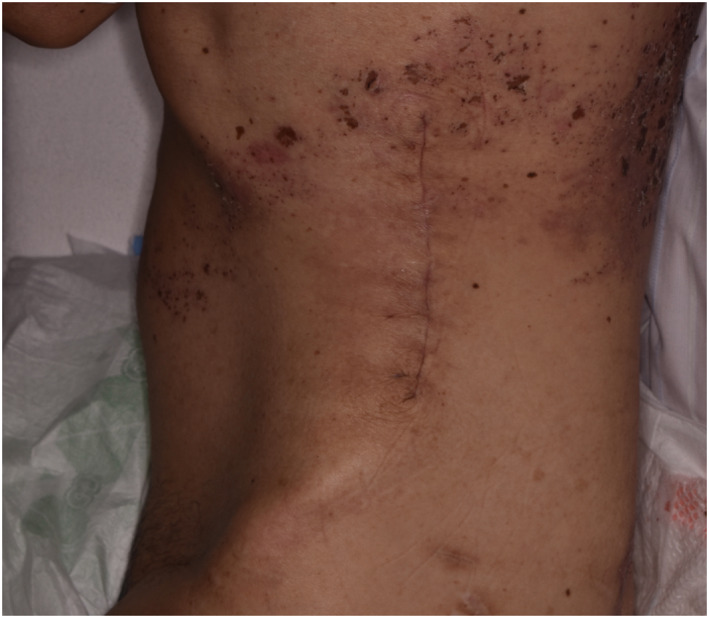 Figure 2
- —This article received no specific grant from any funding agency in the public, commercial, or not‐for‐profit sectors
Peer Reviews
No public reviews on file for this paper yet. If you reviewed it on a platform where reviews are public (OpenReview, ICLR, NeurIPS, ICML), you can paste yours below so the community can read it here.
Videos
No videos yet. Explain this paper in a talk, walkthrough, or lecture? Add one.
Taxonomy
TopicsDermatologic Treatments and Research · Genetic and rare skin diseases. · Dermatological and Skeletal Disorders
We present a case of a 76‐year‐old man diagnosed clinically with shingles which occurred after two surgical treatments for pressure ulcers. Upper‐body blisters appeared on the left lateral thoracic region 4 days after the second operation, which turned into scabs a week later. Around the surgical scar, these scabs were only seen on the dorsal side of the surgical scar at the first operation; however, the scabs above the scar level extended from the dorsal to the ventral side (Figure 1), indicating that varicella zoster virus was unable to spread across the scar due to damage to the cutaneous nerves.
CONFLICT OF INTEREST STATEMENT
None to declare.
AUTHOR CONTRIBUTIONS
Makoto Shiraishi: Conceptualization (lead); data curation (lead); formal analysis (lead); investigation (lead); methodology (lead); software (lead); validation (lead); visualization (lead); writing – original draft (lead); writing – review & editing (lead). Masakazu Kurita: Conceptualization (supporting); project administration (lead); supervision (lead); writing – review & editing (supporting).
ETHICS STATEMENT
Not applicable.
PATIENT CONSENT
Patient consent was obtained for publication.