Pseudoprogression of cutaneous squamous cell carcinoma invading the super vermillion border following programmed death‐1 inhibitor monotherapy
Sach Thakker, Naghmeh Yousefzadeh, Jafar Al‐Mondhiry

TL;DR
A woman with lip cancer initially showed signs of tumor growth after immunotherapy, but later achieved full remission, highlighting the potential of this treatment and the concept of pseudoprogression.
Contribution
This case report presents a rare instance of pseudoprogression in cutaneous squamous cell carcinoma treated with a PD-1 inhibitor.
Findings
The patient showed initial tumor growth and new lymphadenopathy after starting Cemiplimab.
Complete remission was achieved after five infusions with no adverse events.
The case illustrates the phenomenon of pseudoprogression in immunotherapy for cSCC.
Abstract
A 55‐year‐old woman with a moderately differentiated cutaneous squamous cell carcinoma (cSCC) of the upper lip experienced initial tumour growth and new lymphadenopathy after starting immunotherapy with Cemiplimab, but achieved complete remission with no adverse events after five infusions. This case underscores the potential of immunotherapy for cSCC in sensitive head and neck areas and illustrates the phenomenon of pseudoprogression, where apparent tumour growth can occur before clinical improvement.
Genes, proteins, chemicals, diseases, species, mutations and cell lines named across the full text — each resolved to its canonical identifier and authoritative record.
Click any figure to enlarge with its caption.
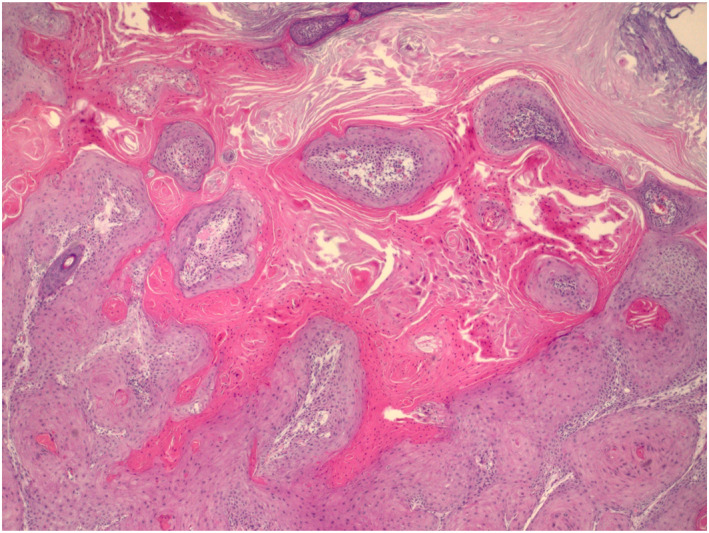 Figure 1
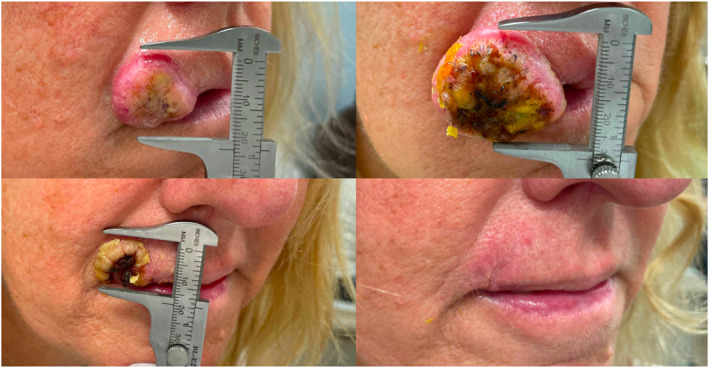 Figure 2
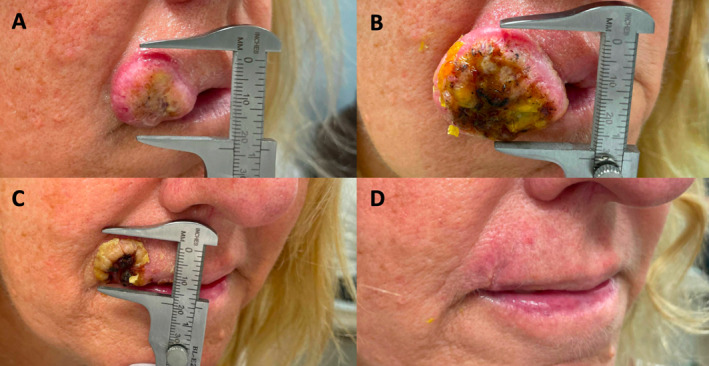 Figure 3
- —This article received no specific grant from any funding agency in the public, commercial, or not‐for‐profit sectors.
Peer Reviews
No public reviews on file for this paper yet. If you reviewed it on a platform where reviews are public (OpenReview, ICLR, NeurIPS, ICML), you can paste yours below so the community can read it here.
Videos
No videos yet. Explain this paper in a talk, walkthrough, or lecture? Add one.
Taxonomy
TopicsNonmelanoma Skin Cancer Studies · Cutaneous Melanoma Detection and Management · Cancer and Skin Lesions
A 55‐year‐old Caucasian female presented for evaluation of a tumour of the right upper lip (2.3 × 2.5 cm) (Figure 1a). Shave biopsy confirmed moderately differentiated cutaneous squamous cell carcinoma (cSCC), keratoacanthoma subtype, without perineural invasion (Figure 2). Cemiplimab 350 mg was administered intravenously every 3 weeks. One week after the first infusion, clinical exam demonstrated substantial growth in the tumour (3 × 3.5 cm) in addition to new cervical lymphadenopathy (Figure 1b). US‐guided lymph node biopsy showed reactive hyperplasia with no tumour involvement. Clinical regression of the tumour was noted following second infusion, 3 weeks after the first infusion (Figure 1c). With continued treatment, her lymphadenopathy resolved, and rapid clinical resolution of the tumour was observed without any immune‐related adverse events (Figure 1d). Due to complete clinical remission, treatment was discontinued after the fifth infusion (13 weeks after first infusion). She remains clinically and radiographically disease free at the 1 year follow up.
While definitive radiation or surgery is the standard of care for cSCC, immunotherapy should be considered for tumours affecting sensitive portions of the head and neck, based on growing literature showing high sensitivity of cSCC to programmed death‐1 inhibition with a limited toxicity profile.1, 2 Furthermore, this case highlights a striking clinical presentation of pseudoprogression, which can be seen with even large increases in tumour volume (in this case, 50%) and new potential disease sites. Psuedoprogression of head and neck cSCC is a rare occurrence, with one cohort study reporting an incidence of 1.3%.3
CONFLICT OF INTEREST STATEMENT
None to declare.
AUTHOR CONTRIBUTIONS
Sach Thakker: Conceptualization (lead); writing – original draft (lead); writing – review & editing (equal). Naghmeh Yousefzadeh: Investigation (supporting); writing – original draft (supporting). Jafar Al‐Mondhiry: Conceptualization (equal); supervision (equal); writing – original draft (equal); writing – review & editing (equal).
ETHICS STATEMENT
Not applicable.
PATIENT CONSENT
Consent for the publication of all patient photographs and medical information was provided by the authors at the time of article submission to the journal, stating that all patients gave consent for their photographs and medical information to be published in print and online and with the understanding that this information may be publicly available.
The reference list from the paper itself. Each links out to its DOI / PubMed record.
- 1Rabinowits G , Migden MR , Schlesinger TE , Ferris RL , Freeman M , Guild V , et al. Evidence‐based consensus recommendations for the evolving treatment of patients with high‐risk and advanced cutaneous squamous cell carcinoma. JID Innov. 2021;1(4):100045. PMID: 34909742; PMCID: PMC 8659794. 10.1016/j.xjidi.2021.100045 34909742 PMC 8659794 · doi ↗ · pubmed ↗
- 2Migden MR , Rischin D , Schmults CD , Guminski A , Hauschild A , Lewis KD , et al. PD‐1 blockade with cemiplimab in advanced cutaneous squamous‐cell carcinoma. N Engl J Med. 2018;379(4):341–351. Epub 2018 Jun 4. PMID: 29863979. 10.1056/NEJ Moa 1805131 29863979 · doi ↗ · pubmed ↗
- 3Haddad R , Concha‐Benavente F , Blumenschein G , Fayette J , Guigay J , Colevas AD , et al. Nivolumab treatment beyond RECIST‐defined progression in recurrent or metastatic squamous cell carcinoma of the head and neck in Check Mate 141: a subgroup analysis of a randomized phase 3 clinical trial. Cancer. 2019;125(18):3208–3218. 10.1002/cncr.32190 31246283 PMC 6771504 · doi ↗ · pubmed ↗