Genetic variations of Toll-like receptor 4 gene in exon 2 of South African Dorper sheep
Lebelo Selala, Teedzai Chitura, Vusi Mbazima, Louis Tyasi

TL;DR
This study identifies a genetic variation in the TLR4 gene of South African Dorper sheep, finding a common SNP in exon 2.
Contribution
The study reports a novel SNP (T2249C) in the TLR4 gene of Dorper sheep, contributing to understanding genetic diversity in this breed.
Findings
A synonymous SNP (T2249C) was identified in exon 2 of the TLR4 gene in Dorper sheep.
The TT genotype was more common than TC, with the T allele being dominant.
The population was found to be in Hardy-Weinberg Equilibrium with moderate polymorphism.
Abstract
The study was conducted to identify the sequence variation of Toll-like receptor 4 (TLR4) in exon 2 of South African Dorper sheep. Blood samples were collected from fifty (n = 50) South African Dorper sheep aged between 3 and 4 years. The Deoxyribonucleic acid (DNA) was extracted, amplified, and sequenced for the TLR4 gene. DNA sequencing was used to identify the sequence variations of the TLR4 gene in South African Dorper sheep. The results showed that one synonymous single nucleotide polymorphism (SNP) of the TLR4 gene in exon 2 position T2249C was identified. Two genotypes (TT and TC) were discovered from the identified SNP. The dominant genotype was TT (0.60) over TC (0.40), with the dominant allele T (0.80) over C (0.20). The results also indicated that the used population was in the Hady-Weinberg Equilibrium. Polymorphism genetic analysis findings suggest that the identified…
Genes, proteins, chemicals, diseases, species, mutations and cell lines named across the full text — each resolved to its canonical identifier and authoritative record.
Click any figure to enlarge with its caption.
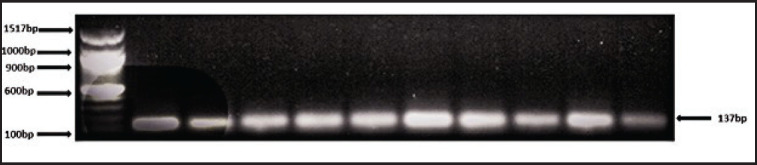 Figure 1
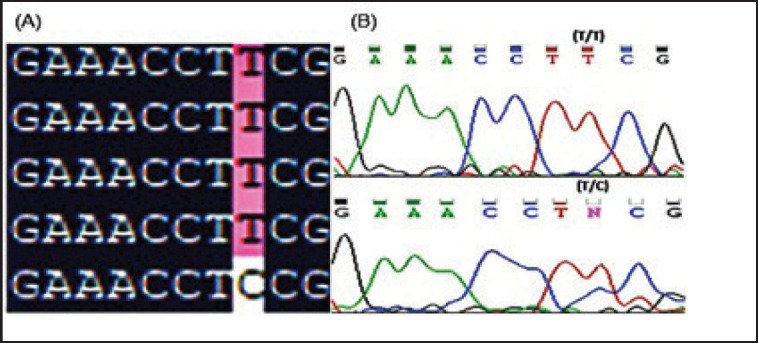 Figure 2
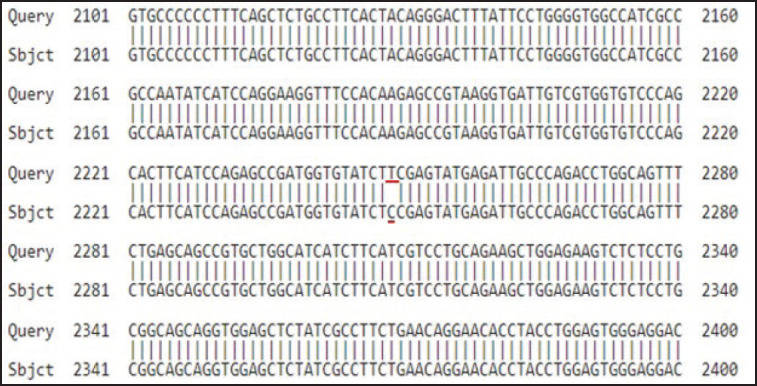 Figure 3
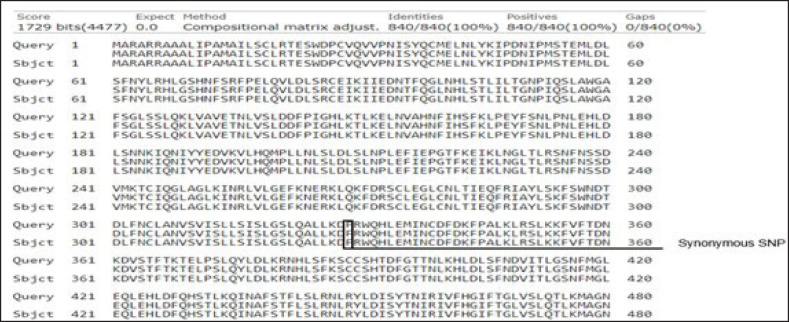 Figure 4
| Genotype |
| Genotype frequency | Allele | Allelic frequency |
|
|---|---|---|---|---|---|
| TT | 30 | 0.60 | T | 0.800 | 3.130ns |
| TC | 20 | 0.40 | C | 0.200 |
| SNP | Gene homozygosity ( | Gene heterozygosity | Effective allele number | Polymorphism information content ( |
|---|---|---|---|---|
| T>C | 0.680 | 0.320 | 1.471 | 0.269 |
Peer Reviews
No public reviews on file for this paper yet. If you reviewed it on a platform where reviews are public (OpenReview, ICLR, NeurIPS, ICML), you can paste yours below so the community can read it here.
Videos
No videos yet. Explain this paper in a talk, walkthrough, or lecture? Add one.
Taxonomy
TopicsImmune Response and Inflammation · Milk Quality and Mastitis in Dairy Cows · Reproductive Physiology in Livestock
Introduction
The Dorper sheep was attained by crossbreeding the Dorset Horn and Black-heated Persian and has the ability to produce fast-growing lambs and the ability to survive under harsh environmental conditions [1]. This breed plays a very significant role in the lives of rural community dwellers by providing by-products such as mutton, milk, and skin and income generation [2]. However, this breed is not resistant to gastrointestinal parasites [3], hence the study related to genetic resistance is important to identify the genetic resistant sheep that might be used for breeding. Toll-like receptors (TLRs) are vital mechanisms of the innate immune system [4]. The* Toll-like receptor 4 (TLR4) *gene is one of the TLR and is a potential genetic marker since it is associated with disease vulnerability and resistance traits, which were conducted through single nucleotide polymorphisms (SNP) [5]. Sallam [6] indicated that this gene is found on chromosome 21. The SNPs of this gene have been studied in different sheep breeds, including Turkish sheep breeds [7] and Barki sheep [6]. Based on the knowledge of the authors, there is no documented literature on the sequence variation of TLR4 gene in South African Dorper sheep. The work was conducted to identify the sequence variations of the TLR4 gene in exon 2 of South African Dorper sheep.
Materials and Methods
Ethical approval
The AREC/02/2020: PG was a project number for ethical approval of this study by the University of Limpopo (UL).
Study site
The work was done at the UL farm, which is found 9 km north-west of the university campus. The rainfall, latitude, and longitude of the area are as explained by Tyasi et al. [8].
Experimental animals, research design, and blood collection
The blood samples (5 ml) were collected from fifty (n = 50) Black-headed Dorper sheep. The blood samples were collected using vacutainer tubes containing an anticoagulant of ethylene diamine-tetraacetic acid (EDTA) (0.5%). The blood was kept at 4°C until the Deoxyribonucleic acid (DNA) was extracted [9].
DNA extraction and amplification
The genomic DNA was obtained from the blood samples of each animal by following Norgen’s Genomic DNA Isolation Kit protocol (Norgen Biotek Corp., Canada). A region of purified DNA was amplified by polymerase chain reaction (PCR) using forward (5’-ACCCTTGCGTACAGGTTGTTC-3’) and reverse (5’ ATGGCTGCCTAAATGTCTCAGG-3’) primers specific for a region of exon 2 of *TLR4 *[10].
DNA sequencing
PCR products of a region of exon 2 of the TLR4 gene were used for sequencing to detect SNPs in the targeted region.
Statistical analysis
The data were analyzed using POPGENE software (version 1.32, University of Alberta, Canada).
Results
Amplified nucleotide sequence analysis
Amplification was done during the PCR to detect the size of the gene. Clearly, amplified products of TLR4 with an amplicon size of 137 bp are shown in Figure 1.
Sequencing analysis of TLR4 gene in Dorper sheep
DNAMAN and chromatograms were used for sequence analysis. The SNP of TLR4 was recognized, whereby a T>C transition of exon 2 at location 2249 was indicated by Figure 2.
Gene sequence alignment
The blast was used to find the pairwise alignments of DNA. Figure 3 indicates DNA pairwise alignment results of TLR4 sequence which demonstrates the location of TLR4 SNP. The sequence alignment results showed that T2249C was in the SNP position.
TLR4 fragments amplicon. M, DL 1517 DNA marker (1,000bp, 900bp, 600bp, and 100bp, respectively).
Sequence analysis (A) DNAMAN analysis and (B) chromatograms analysis. Nucleotide sequence analysis showing T2249C transition in exon 2 of TLR4 in Dorper sheep.
Nucleotide pairwise alignment outcome.
Protein sequence alignment
The blast was used to determine the sequence alignment. Figure 4 indicates the protein sequence alignment of TLR4. The results indicated a synonymous SNP. T>C SNP results in no change in the amino acid phenylalanine, as shown in protein sequence position 329.
Allelic and genotypic frequencies
The genotypic frequency of TT was higher than the genotypic frequency of TC with the allelic frequency of T being higher than the allelic frequency of C in *TLR4 *as shown in Table 1. The chi-square test showed that the examined frequencies were not significantly different from the expectations of Hardy-Weinberg.
Population genetic analysis
The outcomes of the population genetic analysis (Table 2) showed that the heterozygosity was lower than homozygosity with an effective number (N**e) of 1.47 indicating that there were moderate polymorphisms within the South African Dorper sheep population.
Protein sequence alignment for TLR4 in Dorper sheep showing synonymous SNP. Query is the protein sequence from NCBI Accession number: NP_001129402 and Subject is the protein sequence with SNP.
Discussion
According to Astuti et al. [11], the Dorper sheep breed is one of the sheep that requires the investigation of candidate genes that might be used as genetic markers for genetic resistance. This was done to detect sequence variations in the TLR4 gene of South African Dorper sheep using DNA sequencing. The findings of the current study revealed a nucleotide substitution of thymine (T) into cytosine (C) synonymous SNP in exon 2 of TLR4 gene in Dorper sheep at nucleotide position 2249. DNA sequencing findings of Sallam [6] in the TLR4 gene of Barki sheep identified a nonsynonymous mutation (rs592076818; c.1710) substitution of cytosine (C) into adenine (A) in exon 3 which results in the substitution of asparagine (Asn) into lysine (Lys) amino acids in protein sequence position 570. DNA sequencing results of Yaman [7] in TLR4 gene of Turkish sheep breeds (4 native and 4 composite breeds) revealed fifteen SNPs and twelve of them were nonsynonymous, while three of them were synonymous on positions 873 guanine (G) change into adenine (A), 897 C change into T, and 1132 C change into T. The current study suggests that TLR4 gene has a synonymous SNP in exon 2 that might be used as a genetic marker. The limitations of the present study are: 1) the investigated population size was small, and 2) marker-trait association was not computed. As a result of the findings of this study, more research needs to be done with a larger sample size and to conduct marker-trait associations with disease-related traits.
Conclusion
The current study concludes that the Toll-like receptor 4 gene in South African Dorper sheep had the sequence variation of a thymine (T) change to a cytosine (C) nucleotide at position 2249 of exon 2. Further studies need to be done on the association of the identified SNP with disease-related traits.
The reference list from the paper itself. Each links out to its DOI / PubMed record.
- 1Cloete SWP Snyman MA Herselman MJ Productive performance of Dorper sheep Small Rum Res 200036211935 https://doi.org/10.1016/S 0921-4488(99)00156-X 10.1016/s 0921-4488(99)00156-x 10760448 · doi ↗ · pubmed ↗
- 2Molabe KM Mbazima V Gunya B Tyasi TL Growth traits as indicators of body weights in Dorper sheep Am J Anim Vet Sci 202217433238 https://doi.org/10.3844/ajavsp.2022.332.338
- 3Seyoum Z Getnet K Chanie M Derso S Fentahun S Morbidity parameters associated with gastrointestinal tract nematodes in sheep in Dabat district, Northwest Ethiopia Biomed Res Int 201820189247439 https://doi.org/10.1155/2018/92474392967091110.1155/2018/9247439 PMC 5835302 · doi ↗ · pubmed ↗
- 4Werling D Jungi TW Toll-like receptors linking innate and adaptive immmune response Vet Immunol Immunopathol 200391112 https://doi.org/10.1016/S 0165-2427(02)00228-31250784410.1016/s 0165-2427(02)00228-3 · doi ↗ · pubmed ↗
- 5Alim MA Fu Y Wu Z Zhao SH Cao J Single nucleotide polymorphisms of Toll-like receptors and association with Haemonchus contortus infection in goats Pak Vet J 20163628691
- 6Sallam AM A missense mutation in the coding region of the Toll-like receptor 4 gene affects milk traits in Barki sheep Anim Biosci 20213448998 https://doi.org/10.5713/ajas.19.09893281907110.5713/ajas.19.0989 PMC 7961266 · doi ↗ · pubmed ↗
- 7Yaman Y Association of Toll-like receptor 4 (TLR 4) gene exon 3 variants with serostatus of the ovine Johne’s disease (paratuberculosis) in Turkish sheep Turk J Vet Anim Sci 20204454247 https://doi.org/10.3906/vet-1909-98
- 8Tyasi TL Mathye ND Danguru LW Rashijane LT Mokoena K Makgowo KM Correlation and path analysis of body weight and biometric traits of Nguni cattle breed J Adv Vet Anim Res 20207114855 https://doi.org/10.5455/javar.2020.g 4043221912110.5455/javar.2020.g 404PMC 7096126 · doi ↗ · pubmed ↗